Time flies …

I don’t know where the time is. This year just seems to be flying past me … We’ve just been on holiday, got a new car, celebrated Easter and now it’s already May – my birthday month …

To be honest, I haven’t done that much crochet recently. At least not much I am able to show right now.
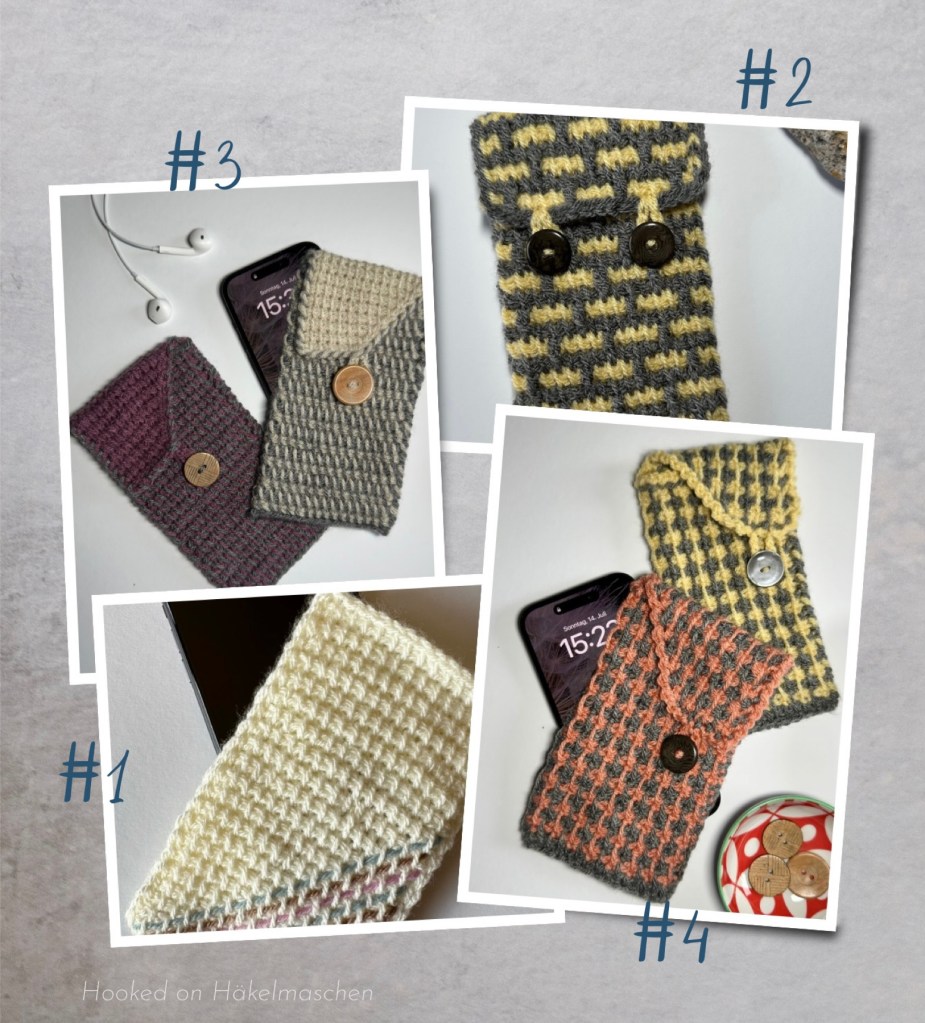
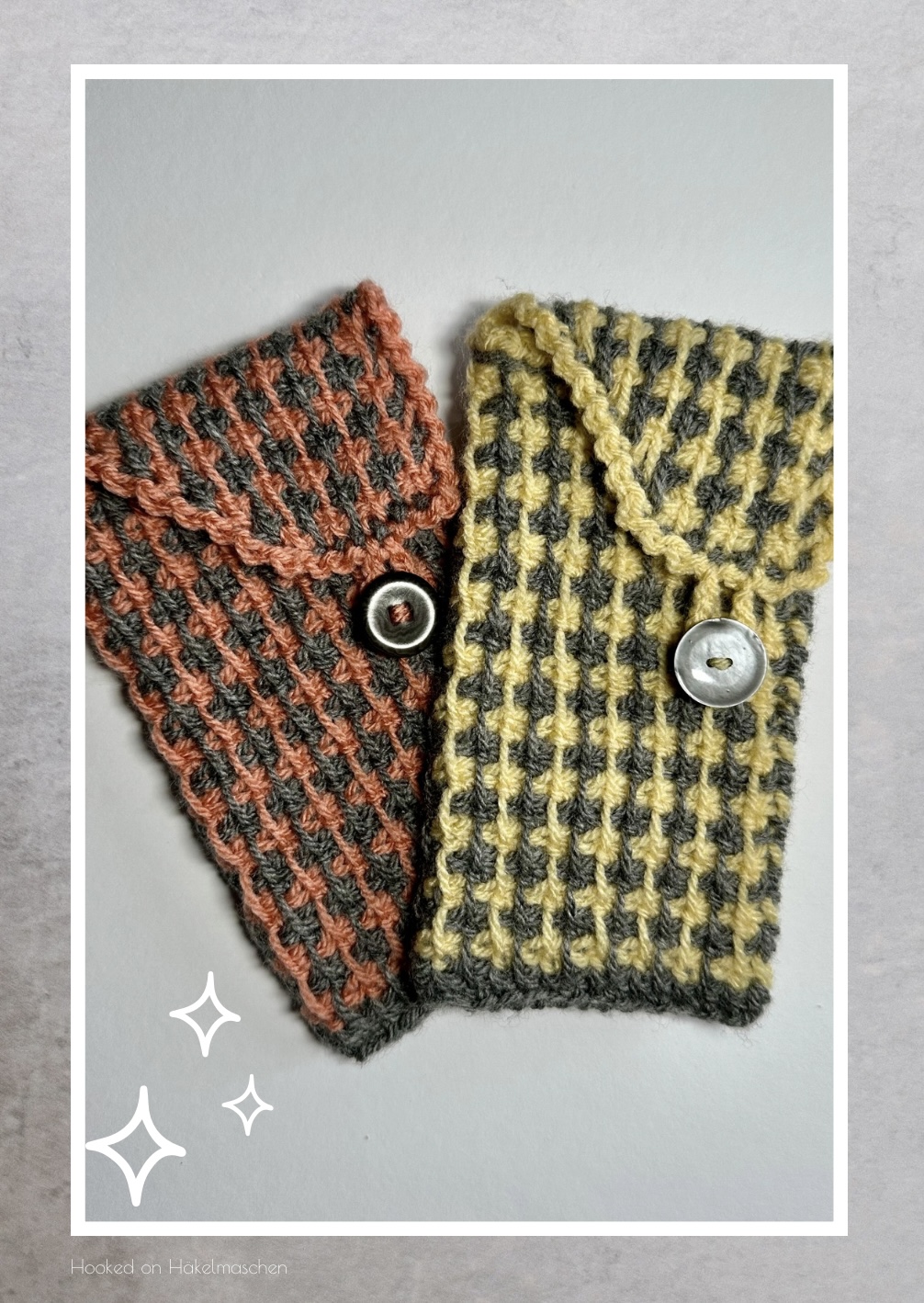
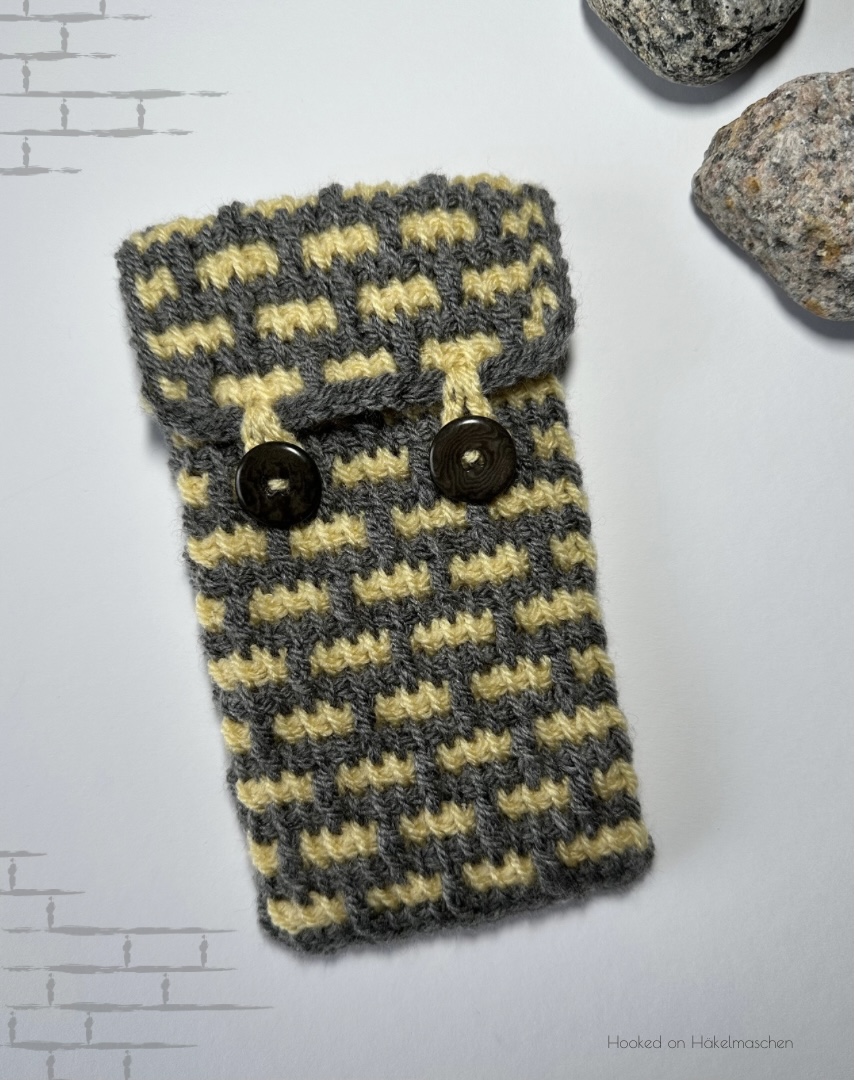
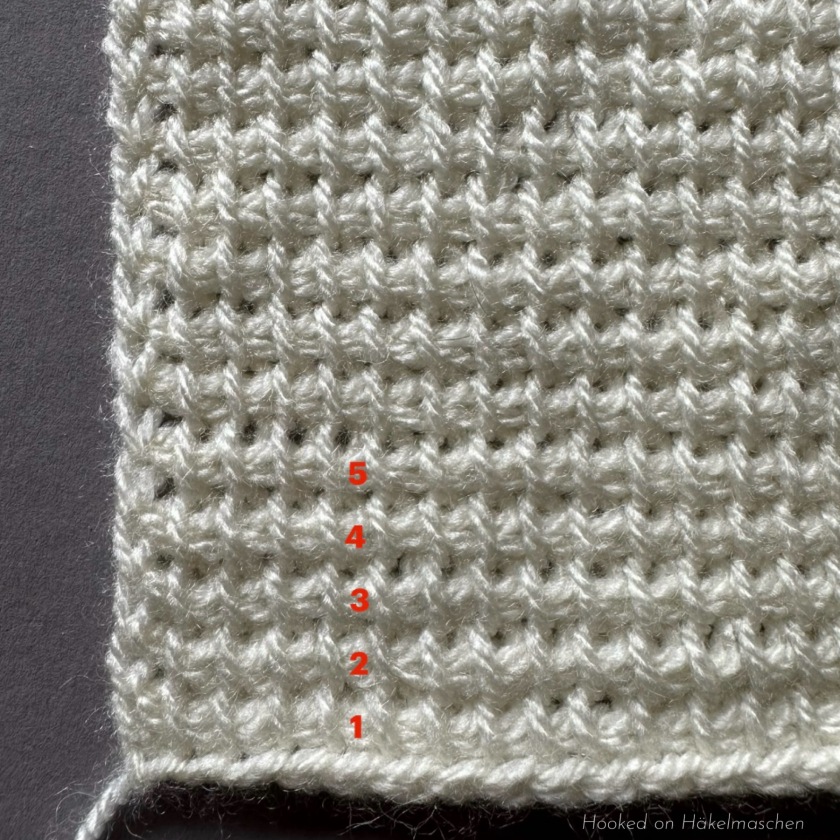
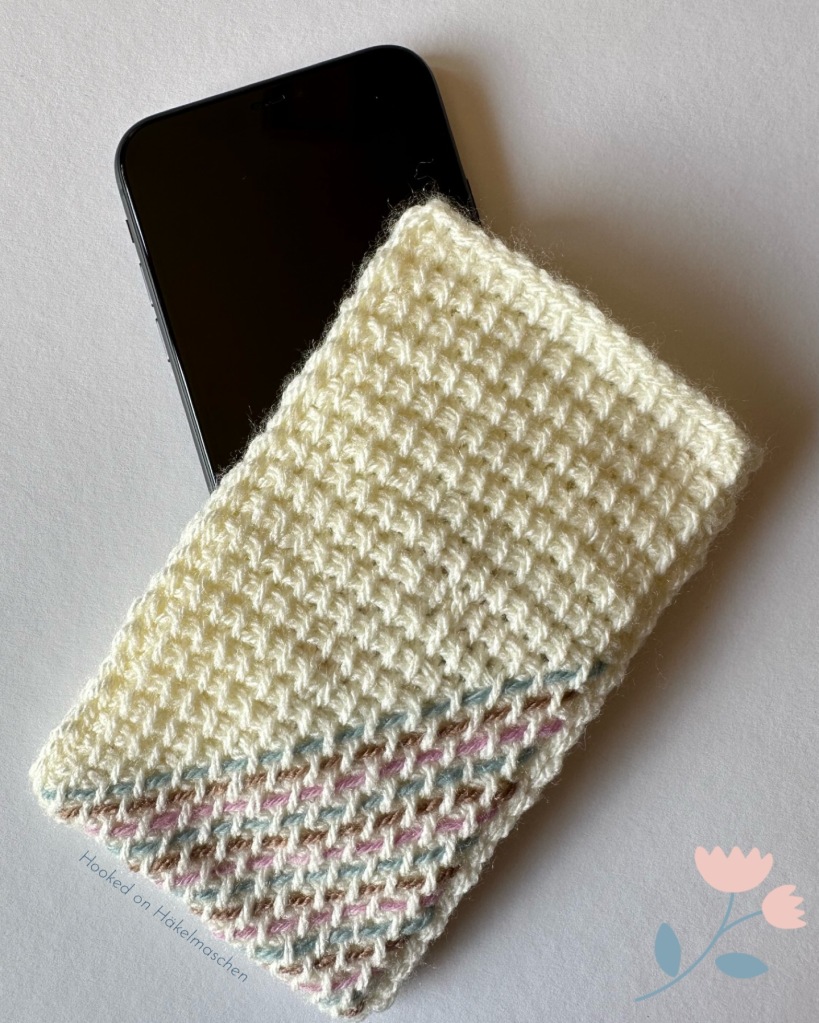
I am still playing around with Tunisian crochet. So far I have never worked with two colours in Tunisian crochet. So I am just practicing different techniques and I’m curious to see what effects you can achieve with it.

Besides, I am currently working on a shawl in Tunisian crochet, designed by Rachel Henri.

Comme un Air de Printemps

means Spring is in the Air in English and is available on Ravelry.

I love the construction of this shawl! It is more ore less worked in strips that are connected as you go. Therefore you even don‘t need a Tunisian crochet hook. A normal hook is absolutely sufficient as long as it is long enough to carry 12 stitches or so.

I am using a 4-ply sock yarn with 76% Cotton. The colours are a soft mixture of grey, pink and lilac. Unfortunately they do not show so well in my picture.

And I was also able to do two small tests.

Easy Come Easy Go

is the new pattern by Pam Knighton-Haener from A Yarn of Serendipity that was just released. Her the link to Ravelry, but it’s also available her other platforms.

I was happy to test this pattern a few days ago and am very pleased with the result.

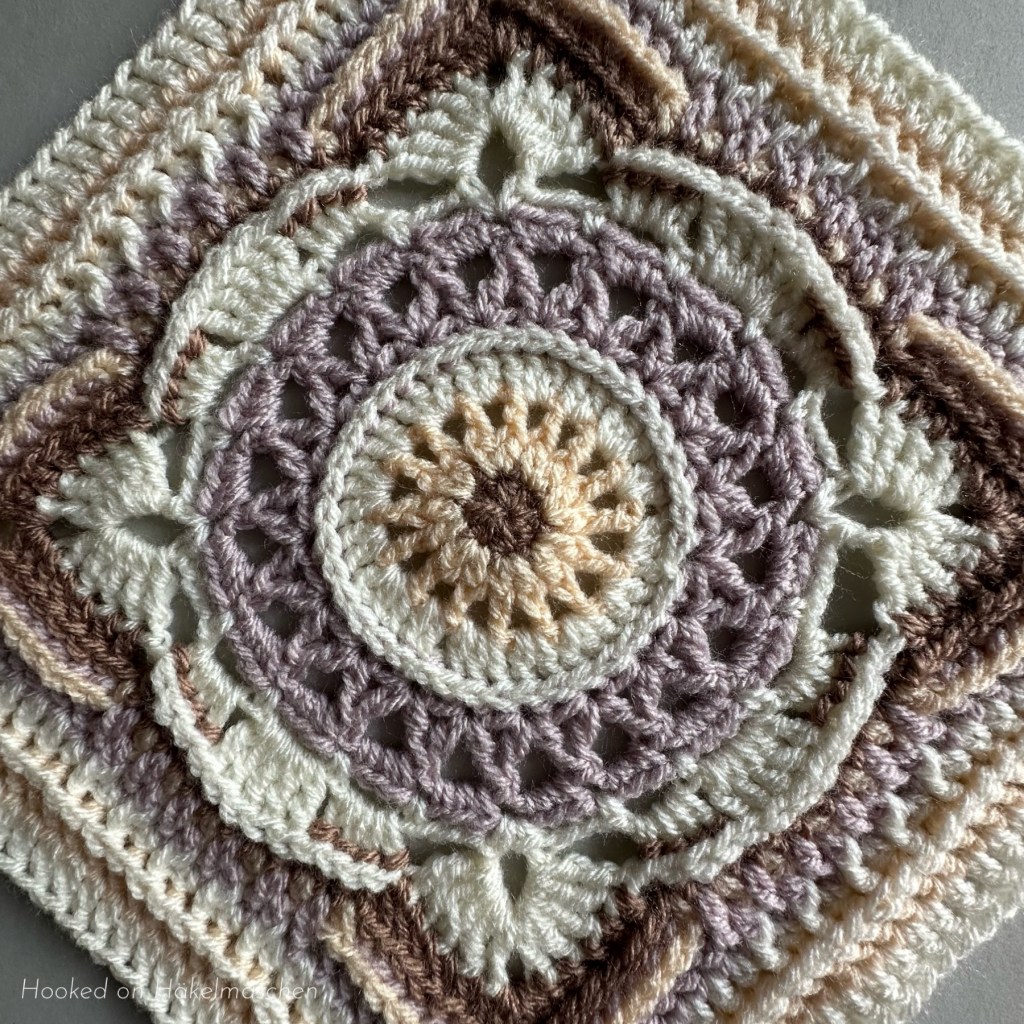
My version is made Stylecraft Special DK and a 4 mm hook. I followed colourway 1 – Pam offers two different ones in her pattern – and replaced the colours as follows

  • Colour A – 1067 Grape
  • Colour B – 1026 Apricot
  • Colour C – 1240 Soft Peach
  • Colour D – 1832 Mushroom

First I was a bit unsure about this colour combination but I think it worked quite well. However, I am sure this square will also look great in just one colour.

The finished square has 39 stitches per side. Of course the final size will depend on the yarn you use. Mine measures about 26 cm / 10 inch.

At the moment I’m thinking about making a wall hanging from different afghan squares. This one would be a good start. Let’s see….

Dream, Sparkle, Shine

I also helped testing a new pattern designed by Ana. Her lovely Dream, Sparkle, Shine.
Ana had chosen a great colour combination from Hobbii Mocktail yarn.

The pattern is available on Ravelry too.

I had no suitable colour changing yarn in my stash so I had to experiment a bit with my Stylecraft Special DK.

Photo credit: Ana Morais Soares / One Skein of Love

This turned out to be more tricky than I thought and I was not quite able to achieve the effect I had in mind. That‘s why I made only a smaller piece over a few repeats.

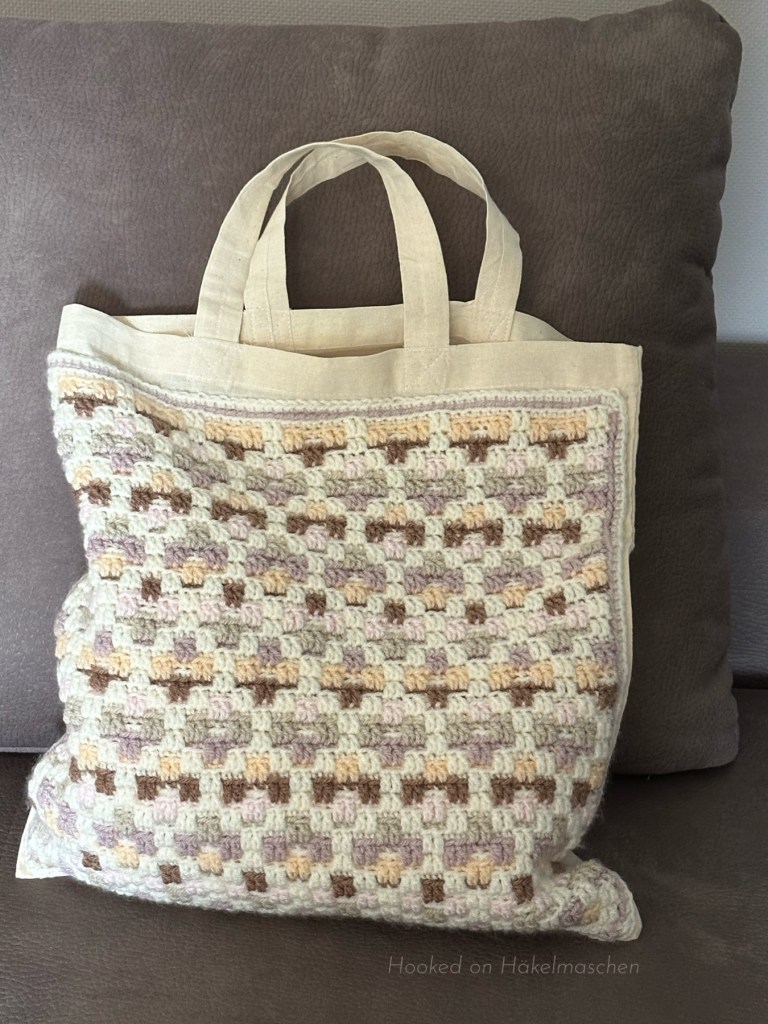
I used Cream as background colour and always used the 5 contrasting colours in the same order. I love the colour combination! (Although I didn’t get the desired effect and although a bit more contrast might be better for mosaic crochet.)

  • Background – 1005 Cream
  • Colour A – 1064 Mocha
  • Colour B – 1844 Toy
  • Colour C – 1832 Mushroom
  • Colour D – 1218 Parchment
  • Colour E – 1240 Soft Peach

Originally I wanted to make a cushion out of it, but then I had another idea. I had a simple cotton bag, a promotional gift from a pharmacy, with logo on one side. My patch had the perfect size to fit on the front side. So I made a small border – just one round of single crochet – and sewed it on. Voila – a new project bag.

And that’s all there is for today! Have a lovely time 💕

Pinwheel Square

Another test for Pam

I recently had the opportunity to test a new design from Pam Knighton-Haener / A Yarn of Serendipity: The Pinwheel Square.

The pattern was just released and is available on Ravelry.
The skill level of the pattern is categorised as mid-intermediate. As always, the written instructions are very clear and accompanied by detailed photos for each round.
Made with Aran / Worsted Weight yarn (#4) the final size of the square will be 11 or 12 inch / 28 or 30,5 cm – depending on the size of the crochet hook used. And of course, the final stitch count matches all the others from Pam’s squares.

My yarn and colours

As you may know, I often use a light weight (#2) cotton yarn for these tests. Something like Schachenmayr Catania or Hobbii Rainbow Cotton 8/4. The reason is just that I have accumulated a lot of these yarns by crocheting amigurumi and can go with my stash. Besides they have a great colour range and a good stitch definition.

Somehow this time I decided to go with my stash of Stylecraft Special DK.

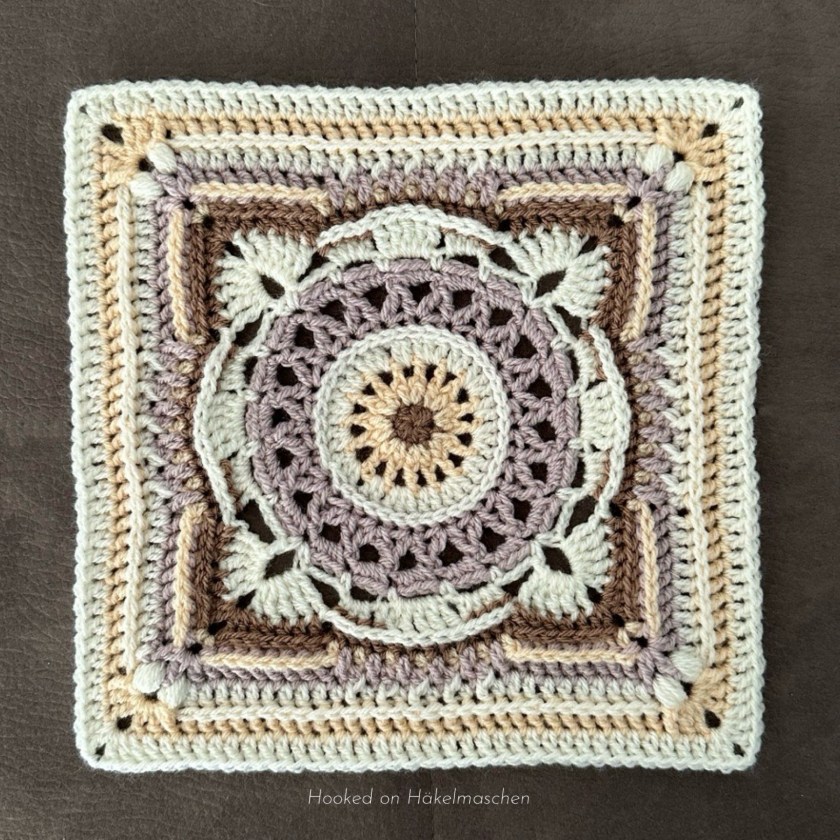
I have just used a similar colour combination for another test in overlay mosaic. Just all in neutrals. I loved the result and was curious how it would look in regular crochet.

Well, I am more than happy with the result!

I used a 4 mm hook and the final size of my square is 26 cm – about 10 1/4 inch.
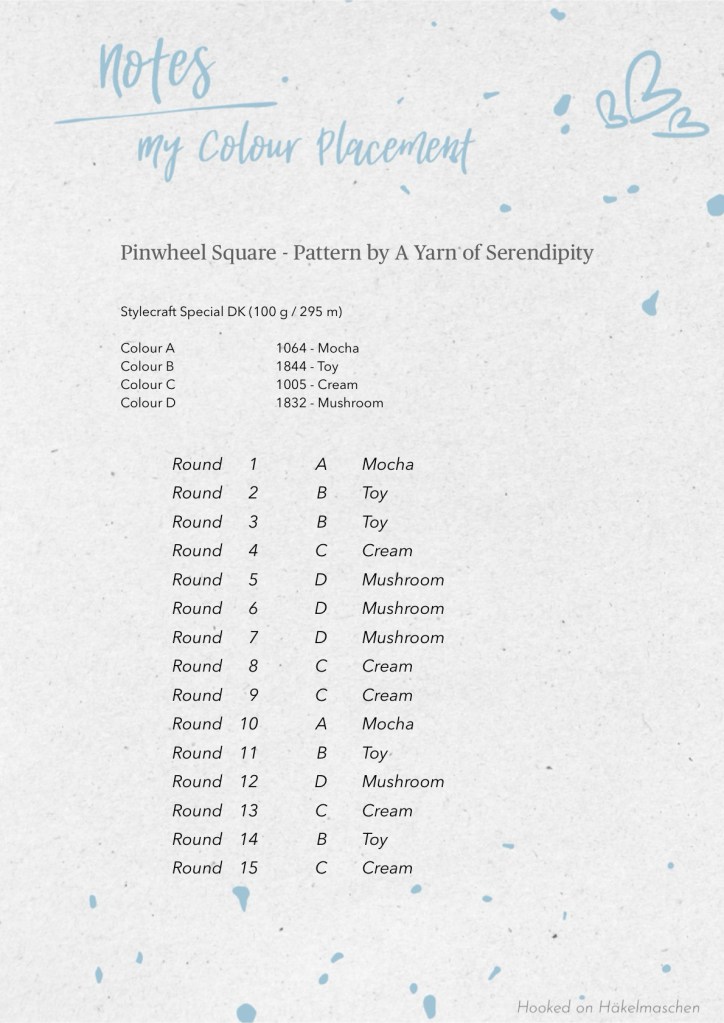
If you are interested in my colour way, here my notes.

Happy hooking 💕

Impressions from East Frisia

No social media and only little crochet for something over a week …
Therefore a lot of wind and long walks. We are just back from a lovely holiday in East Frisia.

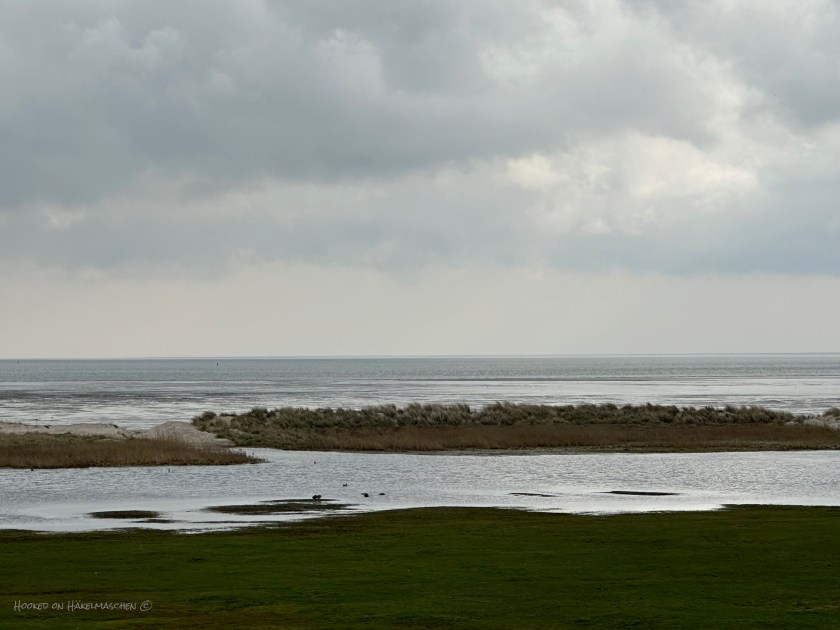
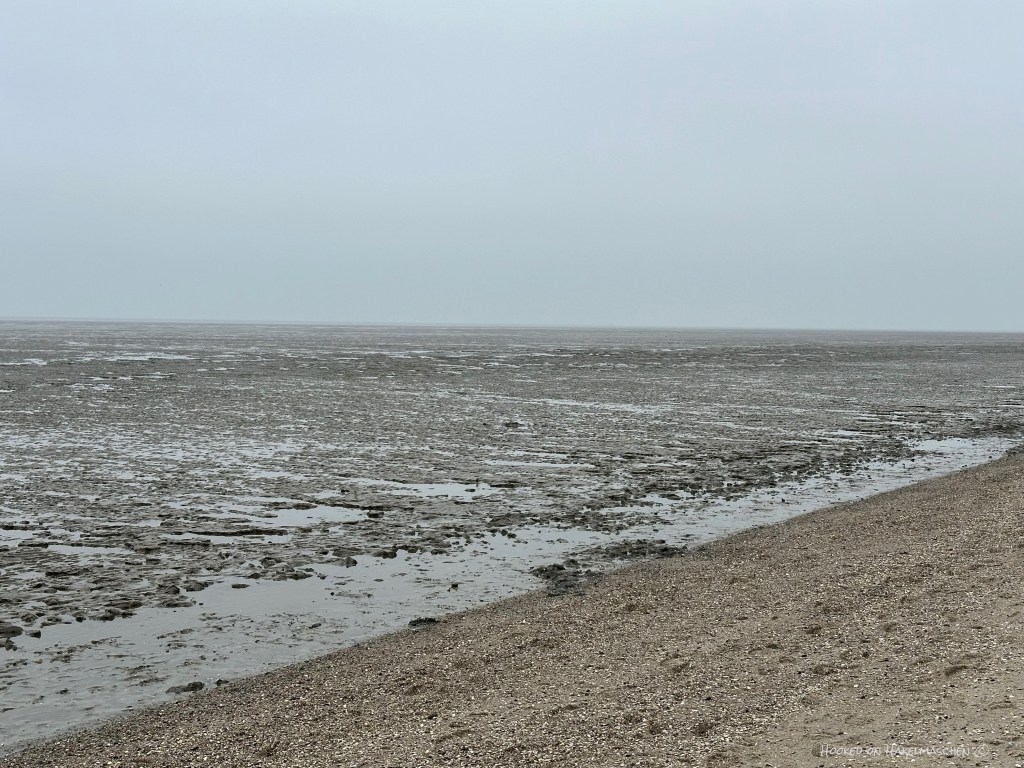
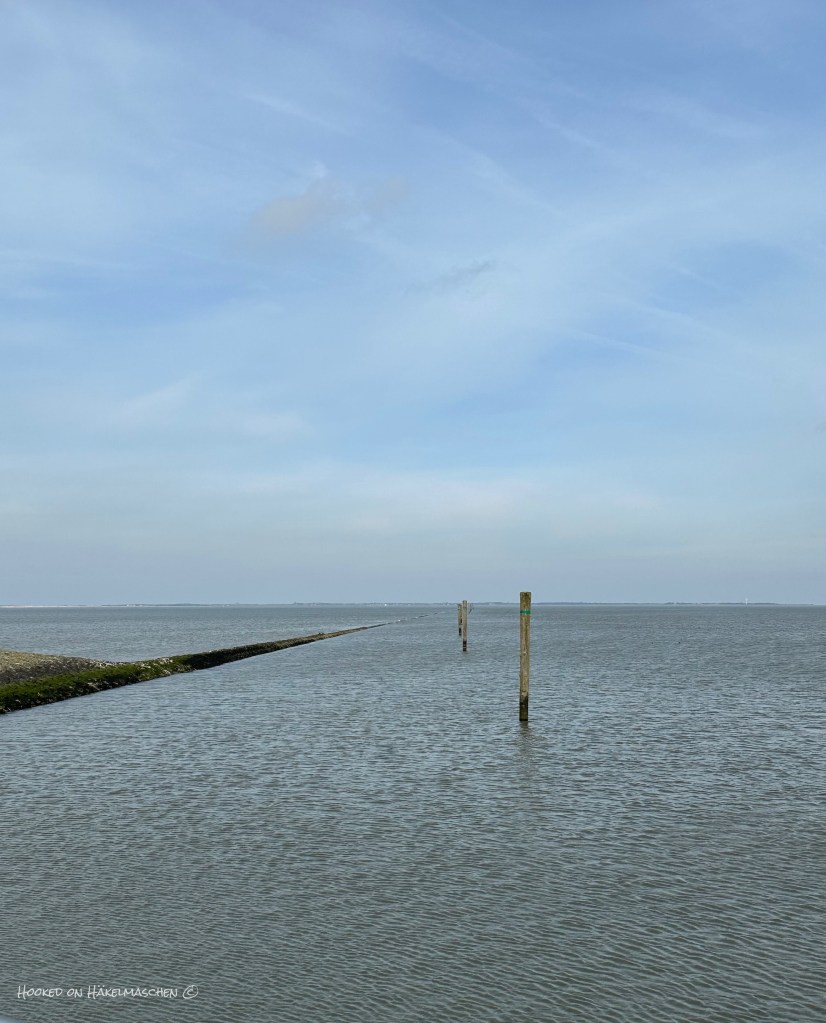
East Frisia is located in north-west Germany, directly on the North Sea coast. It belongs to the UNESCO World Heritage Wadden Sea and is one of my favorite spots here in Germany.
Although now our temperatures at home are very spring-like, it was still relatively cold and stormy on the coast. But I love this harsh climate. And I love the changing tides. I find it particularly fascinating at low tide. It is a very special silence, you mostly only hear the wind and the seagulls.

Although it was cold and windy, we had long walks on the beach. Afterwards we had home-baked cake and a large pot of East Frisian tea in our favourite tea room.
East Frisian tea is traditionally drunk with „kluntje“ and cream. „Kluntje“ is a rock candy sugar. You put it in the cup first, then the tea is poured over it and finally a dash of cream is added – and do NOT stir! Yummy! It’s a wonder I haven’t put on weight.

If you ever come to East Frisia you should visit Neuharlingersiel and the beach of Schillig. (Besides all the other lovely places there, of course. )
Schillig has a beautiful bathing beach (not to recommend in March) and also a long dog beach where you can walk right by the water (provided it is high tide and it is there). When the weather is good you can see some of the East Frisian islands off the coast.
From there it is about 30 km to Neuharlingersiel. A small fishing village with many colorful boats in the harbor. The ferry to Spiekeroog – one of the East Frisian islands – also leaves from there.

I would have liked to show you photos of the many sheep that normally romp around on the dykes. Unfortunately it was still too cold and they were all still in their warm stables.

Some impressions of our holiday

Sigh* – it was so relaxing! But, life has got me back and so has the crochet world!
I’m currently translating Ana.‘s new Spring Cal pattern. Pam also has a new design that is currently being tested. And I am working and practicing on some Tunisian crochet things. And, oh, yes, Easter is just around the corner. So stay tuned!

Have a lovely time 💕

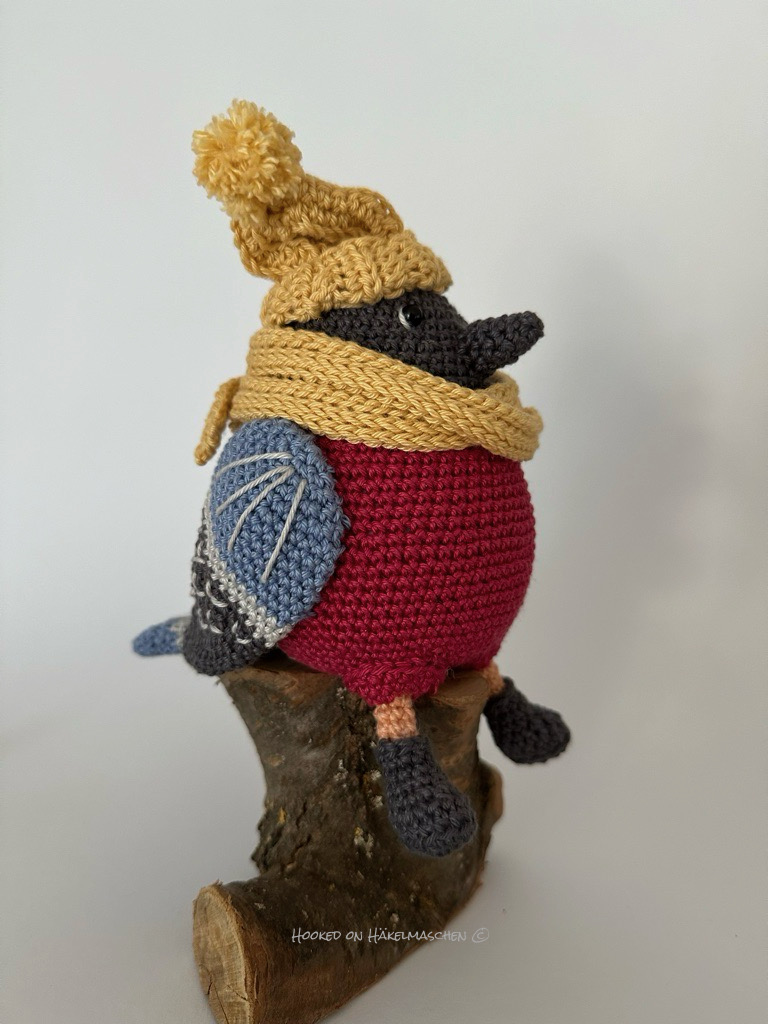
Oh look – A Snowbird …

Em … to be honest, I had no idea what kind of bird a snowbird is as we don’t have them in Europe. I had to ask Google and the answer was that nowadays many different birds in Canada are called snowbirds and indeed, Google showed me a lot of different pictures. But originally “Snowbird” was the name for a Junko. Do you know them?

However, I would like to introduce you to my new flatmate: little Snowbird.

This cute snowbird is part of the pattern Winter Birds 2 from @natura_crochet. I spotted it on Instagram last year. It was sometime before Christmas, so I got it myself as a present.
The pdf is more like a booklet than a single pattern. It is beautifully designed and contains patterns for three different birds: Kingfisher, Waxwing and a Chickadee – plus the Snowbird as a bonus pattern. All birds are very colourful and wintery styled with hat and scarf.

I used Schachenmayr Catania and Wenco DIY (a German brand) with a 2,25 mm hook. Both are 100% Cotton sport weight (#2) yarn with a yardage of 125 m / 50 g.

On my desk: ready to assemble

My colours are:

  • 429 – Anthrazit / Catania
  • 434 -Nebel / Catania
  • 258 – Erdbeere / Catania
  • 206 – Honig / Catania
  • 51, blau / DIY
  • Head – Anthrazit
  • Body – Nebel, Erdbeere
  • Wings – Blau, Nebel, Anthrazit
  • Tail – Blau, Nebel, Anthrazit
  • Legs – Anthrazit, Honig, Erdbeere
  • Beak – Anthrazit
  • Hat / Scarf – Honig

I made some small adjustments to the hat and the scarf. I made the scarf a little shorter and narrower and the hat a little wider – it just worked better with my yarn.

I have to confess, I was a little hesitant about sewing the parts together. I don’t have much experience in assembling such small parts. So they So they have been lying in my basket for days (weeks?). But the placement etc. is well explained in the pattern and all went well!

I am absolutely happy with the result. Just started the Waxwing …

Have a lovely time 💕

Tunisian Crochet Heart

A while ago I came across this pattern on Ravelry: Tunisian Crochet Heart by Joy Clements from Crochet Road. Cute little hearts made in a combination of Tunisian and regular crochet.
I lately rediscovered my love of Tunisian crochet and dug out my Tunisian hooks, so of course this pattern caught my eye… But to be honest, what really convinced me to try it was a picture I saw on Ravelry: these little hearts are not only a perfect Valentine’s gift, they are also perfect as a small pincushion. Plus, big bonus, you also can clip on a few stitch markers. Very handy for me! This way I can have one or two stitch markers with me – just in case I need them unexpectedly – without having to carry the whole box.

The pattern

In my opinion the pattern is absolutely beginner friendly. Everything is explained very well along with a lot of pictures and videos. You won‘t even need a Tunisian crochet hook, a normal hook is absolutely sufficient.

The pattern has instructions for the heart itself which you can use as gift hanger, bunting or whatever comes to your mind. There are also instructions for joining two hearts to give it -stuffed with some fiberfill – a three-dimensional look. Last but not least you can create a tiny heart-shaped bag.

My hearts

These hearts are quick and fun to make. So I made some in different yarn weights and qualities. I decided to stuff mine with fiberfill. I only could not decide whether I prefer them more or less stuffed. So they all look a bit different.

My small hearts are made with Cotton sport weight yarn and my 3,00 mm Clover Amour hook. They measure about 5 cm / 2 inch.

Yarn and colours are:

  • Schachenmayr Catania (100% Cotton – 125m / 50 g)
    • 263 – Soft Apricot
    • 408 – Altrosa (dusky pink)
    • 258 – Erdbeere (strawberry / red)
    • 205 – Apfel (apple / green)
  • Scheepjes Catona (100% Cotton – 125m / 50 g)
    • 520 – Lavender
  • Wenco DIY (a German brand that I bought in a supermarket)
    • 51 – blau (blue)

I probably will gift the red and pink ones for Valentine‘s Day. The green and blue one will definitely be used as pincushion.

With my left over yarn (DK yarn) from my Legacy blanket the hearts turned out about 7 cm / 2 3/4 inch. I made them with a 4,5 mm hook, but this time with a Tunisian hook. I guess it will also work with a normal crochet hook – personally I just found it more comfortable with a Tunisian hook..

Yarn and colours are:

  • Drops Lima (65 % Wool, 35% Alpaca – 100 m / 50 g)
    • 100 – Off White
  • Drops Merino Extra Fine (100 % Wool – 105 m / 50 g)
    • 15 – Light Sea Green

I am just thinking about making some bookmarks using just a single heart. Maybe decorated with some embroidery? I probably will have to try it …

In case I have inspired you, the pattern for this little cuties is available on Ravelry.

If you love to crochet hearts just like I do, you might want to have a look at the ones I did last year.

Happy Valentine‘s Day ♥️

Stellar

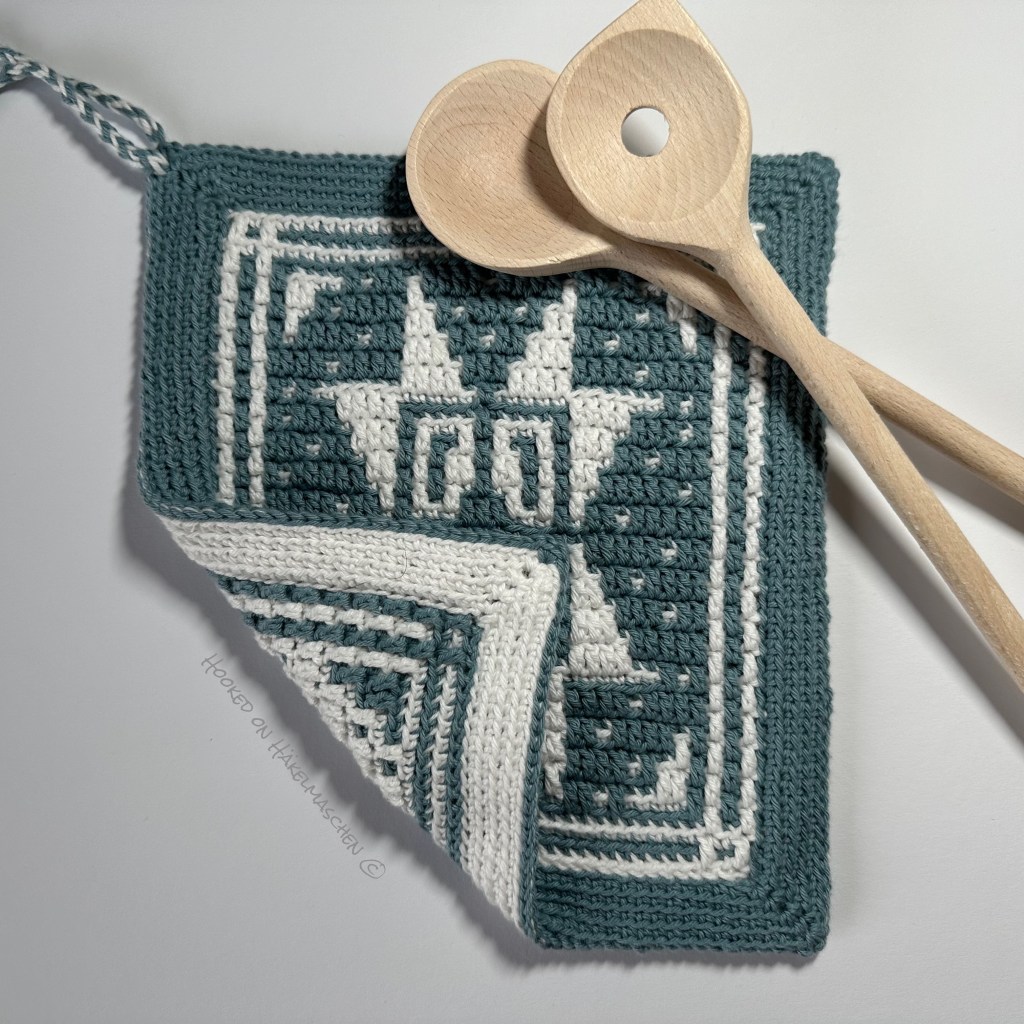
My new potholder

… or new coaster? I am not sure yet …

You may have already seen that Ana from One Skein of Love has published a new blanket pattern: Stellar.

Again, it is a pattern in Overlay Mosaic – this time she used Hobbii Portobello in two different colours.  Of course you can use any other yarn as well and as many colours you like. A colour changing yarn would also look great!

Photocredit: Ana Morais Soares / One Skein of Love

The pattern is available on Ana’s Ravelry page and in all her other shops.

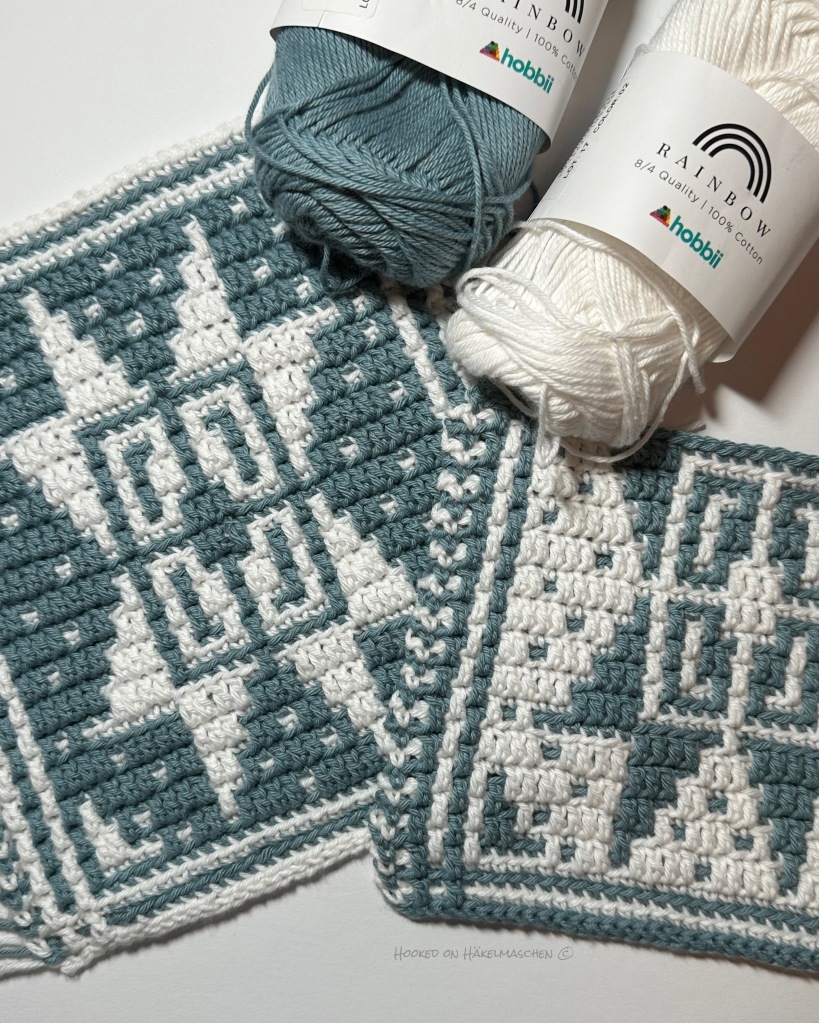
I had the pleasure of testing this pattern and translating it into German. However, I only had little time over Christmas and the turn of the year, so I only made a small square for testing. Originally I wanted to use it as a coaster, but when I finished it I thought it would be a good size for a potholder as well.

I used Hobbii Rainbow Cotton 8/4 and a 2,75 mm hook. Colours are 002 Natural White and 079 Dusty Blue Green.

With 170 m / 50 g Hobbii Rainbow Cotton 8/4 is rated as a Fingering weight yarn. So it’s actually too thin to make a potholder out of it. Therefore I made a second square in reversed colours and connected them both together – just to achieve a nice thickness.

The Joining

At first I thought about joining the two squares in one step with the slip stich round. Like I did for my Wooly Friends Bag .
What I didn’t like about this method was the patience I needed. It cost me a lot of concentration to catch the corresponding stitches of both parts. All yarn tails were constantly in my way and it took me ages to get it done. I have therefore discarded this idea and tried something else:

I prepared each of the squares with a slip stich round. This gave me the opportunity to work a separate border (front layer) on each square and to use the back of the slip stitches to join the squares.

The layers are joined with simple stitches through the back of every second slip stitch.

When you do a normal double border, it can sometimes be hard to work in the back of the slip stitches in case your stitches are too tight or you started with the front layer first. That’s why I wondered if it would make a difference whether you connect the squares first or work the borders first.
I just gave it a try and initially made the border on one square, then joined it to the other one without a border. As the join is worked with a needle and not with a crochet hook, it is not difficult to work in the back of the slip stitches either way. So, in my opinion, it will not make a difference.

I worked the border on each side of the potholder like I would have done with the front layer of a double border: 4 rounds of single crochet worked in back loops only. Then both layers were joined with a slip stitch round. For the hanger, I made a thin (2 chains) I-cord from both colours and pulled it through one of the corners. That’s it!

The finished size of my potholder is 21 x 24 cm (about. 8 X 9,5 inch).

I am absolutely happy with the result!

Finished! – My Legacy Blanket

I hope you all had a great start in 2024 and are doing well!

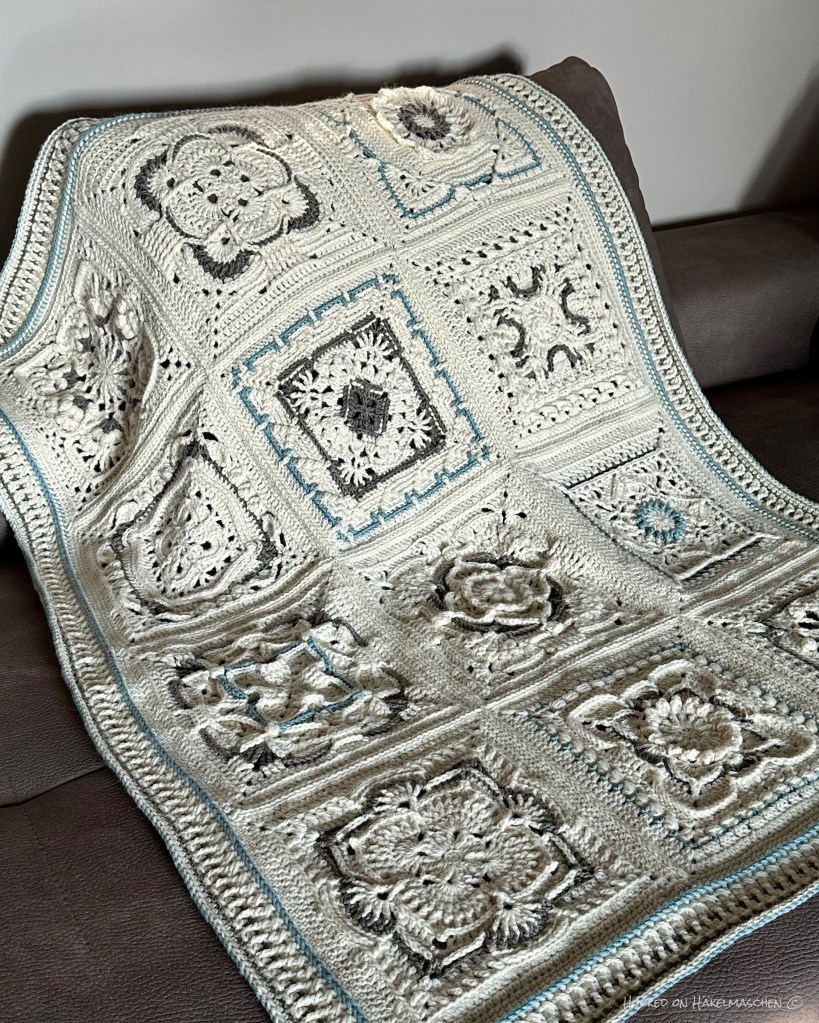
I’d like to start the new year by showing an ‘old’ project: My Legacy Blanket.

If you’ve read my posts about this last year, you’ll know that it is a design by Pam Knighton-Haener from A Yarn of Serendipity. She designed this blanket as a legacy for her grandchildren. You can read her story here.

The blanket is made up of 12 different squares and a wide border. When Pam completed the pattern for the border last year, she also revised the instructions for the 12 squares, and I had the opportunity to test some of them.

So I started this project somewhere in July or August last year. You might remember that I had a hard time choosing yarn and colours. And also some tries and errors with my colour placement. In the end I did more than one square twice as I was not happy with my colour arrangement. To be honest, I still had doubts when I joined the squares …
BUT – surprisingly- once it was finished, everything fitted perfectly. I think it turned out pretty well and I LOVE the result!


My blanket was finished by the middle of December, but unfortunately I had no chance to take some nice pictures. We had a VERY long period with lots of rain, dark clouds, a bit of snow, fog, lots of rain again, well, you get the picture …

But now, here’s a short summary and some pictures:

My Yarn and Colours

My final choice were

  • Drops Lima – 65% Wool, 35% Alpaca (100 m / 50 g)
    • colour 100 – Off White
  • Drops Merino Extra Fine – 100% Wool (105 m / 50g)
    • colour 07 – Light Taupe
    • colour 15 – Light Sea Green

Both are DK yarns (#3, Light Worsted).
The fact that I mixed both qualities was simply a question of the colour shades. The colour 100 – Off White looks a little softer with Lima than with Merino, probably due to the structure of the yarn. And I liked that better!

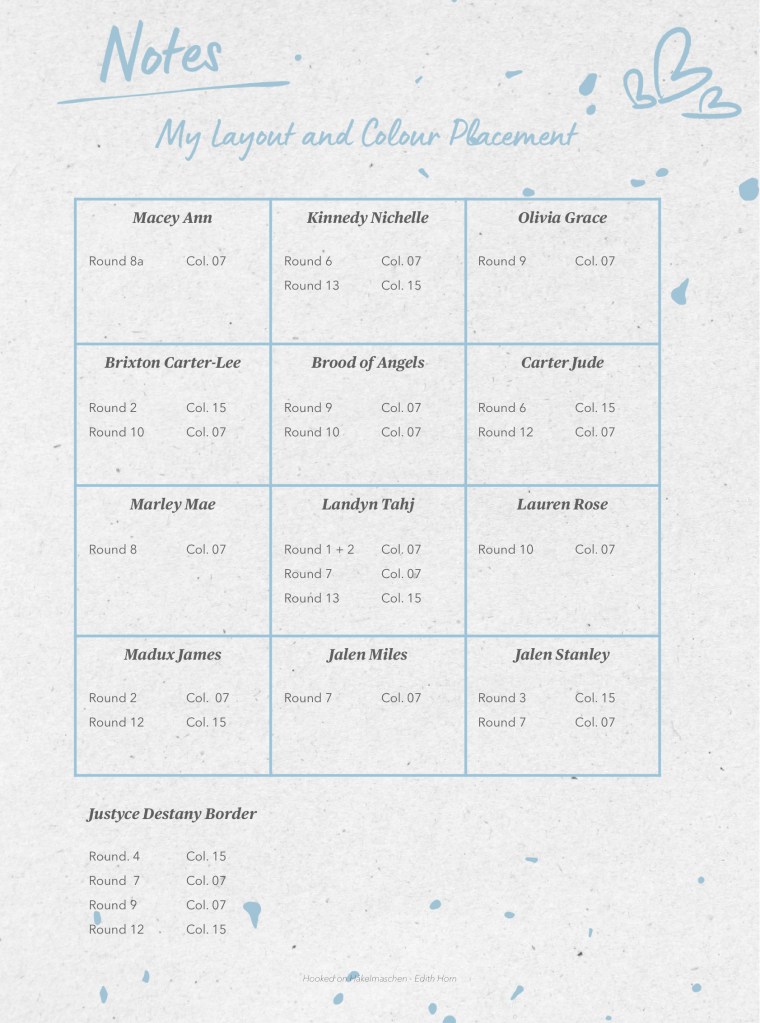
My Layout and Colour Placement

I used Drops Lima in Off White as main colour and only added a few accents with Light Taupe and Light Sea Green. So, in my notes below, I just listed the rounds with the accent colours – all other rounds are worked in Off White.

If you are interested in my colour scheme you can also download it here

Some technical aspects and measurements


My squares and the border are worked with a 4 mm hook throughout. Only for the Zipper Join and the last round of the border I went up to a 5 mm hook.

Each of my squares measures about 25 cm (about 10”). The final size of the blanket is about 90 x 115 cm ( 35,5 x 45 inch).

I am sorry, but with all my changes and redoings I did not pay attention on how much yarn I used. In total I needed a bit over 900 g of yarn. As a very rough estimation I‘d say you will need almost 50 g of Off White for each of the squares and another 100 g or 150 g for the border. Additional 2 or 3 balls of each, Light Taupe and Light Sea Green. But that’s without any guarantee.

The patterns for all these lovely squares and the border are available in Pam’s Ravelry store.

In case you missed my previous posts about this project, you will find them here

Looking at these pictures I have to say: with all its ups and downs, it was a great journey and I am absolutely happy with my make!

Have a lovely week 💕

Something nice and small – Still feasible before Christmas

Are you celebrating Christmas and still looking for a little something to give as a gift or decorate? These two crochet patterns, Glittery Christmas Baubles and Sparkly Stars, are really quick to make and look fantastic.
I’ve had a lot of fun crocheting them over the last few days and have found them quite addictive. The yarn you use will make them look very different, so they don’t necessarily have to look Christmassy. It all depends on your preference.

Both patterns require very little yarn, so they are great for using up any leftovers.

Glittery Christmas Baubles

The pattern is from Ana Morais Soares from One Skein of Love.
As the name of the pattern applies, Ana has used glittery yarn in some parts. I did not have anything with glitter on hand – so mine are made with some leftover yarn from my Legacy Blanket.

A little side note: Yes, my Legacy Blanket is finally finished! To be precise, it’s been finished for about a fortnight now, but I haven’t managed to take some nice pictures yet. The weather here is mostly pretty grey at the moment – clouds, rain, or fog. I hope it gets better in the next few days!

Back to my baubles, I think they clearly show what I meant at the beginning – they look more rustic than glittery and Christmassy.

I’m totally in love with this look!

I used

  • Drops Lima (100 m / 50 g) – colour 100, Off White
  • Drops Merino Extra Fine (105 m / 50 g) – colour 07, Light Brown
  • Drops Merino Extra Fine (105 m / 50 g) – colour 15, Light Greyish Green

with a 3,5 mm hook.

The bauble itself consists of two halves that are sewn together. First, you crochet the two halves, then you join them together while inserting the bauble.
Ana used a Christmas bauble for this. Unfortunately, I didn’t have one that was the right size. So I put a polystyrene ball inside mine. It’s a 7 cm (2 3/4 inch) ball. The circumference is about 22 cm, just over 8.5 inches. It fits perfectly!

Of course, you can use various decorative stitches to join the two halves. Alternatively, if you prefer not to stitch them together, a crochet join, such as a simple zipper join, works very well.

I tried different joins, and the one shown on the left is my favourite.

It is made with slip stitches worked through the back loops. On each half, I inserted the hook top down, from outside to inside. I started with a slip stitch through the back loop of a stitch on the lower half, then slip stitched through the corresponding stitch on the upper half. And so on … It creates a nice kind of braided effect.

Sparkly Stars

Sparkly Stars is a pattern by Joy Clements from Crochet Road, which I spotted on Ravelry. These five-pointed stars are as quick to make and as addictive as Ana’s baubles. They can also be used simply as winter decorations.

Here, too, the final look can be influenced by the yarn and colours used.

The pattern offers two different sizes, contains detailed pictures and also a link to a video tutorial.

I used the same yarn and colours as for the baubles, but this time with a 4 mm hook. So again, no sparkle or glitter.

My small stars are about 9 cm and the tall ones about 14 cm.

Both patterns, the Glittery Christmas Baubles and the Sparkly Stars are available on Ravelry.

Glittery Christmas Baubles on Ravelry
Sparkly Stars on Ravelry

I will definitely make some more baubles and stars using different yarns.

Have a lovely time 💕

Little Christmas Wreath

A free pattern for a simple & cozy crochet decoration

Post revised in December 2025

Back in 2023, I was looking for some easy-to-make Christmas decorations.

Although our home is furnished in a clean and simple style, I prefer my Christmas decorations to feel a bit more traditional and nostalgic. I had been looking for something like a candy cane or a classic Christmas wreath, and somehow that search sparked the idea to make my own. So I grabbed some yarn, picked up my hook, and got started…

I really like the result! And I thought I might as well write down the pattern and share it with you. Maybe you like it too…

I used Schachenmayr Catania and a 2.75mm hook to make my wreaths. They measure about 6 cm in diameter, which is between 2 1/4 and 2 1/2 inches.

I used

  • 212 Khaki – for the wreath
  • 192 Weinrot (Wine Red) – for decoration
  • 105 Natur (Off White) – also for decoration

You will need only small amounts.

Catania is 100 % mercerised cotton and has 125 m per 50 g. You can easily substitute it with any other sport weight yarn.

And, the pattern will also work with any other yarn weight. Only the size of the finished wreath might vary.

And of course you can use any other colour you like and decorate your wreath with whatever comes to your mind.

Some ideas for decoration

To decorate the little Christmas wreaths, you can simply sew on a few beads or stars, for example. Or cut out small shapes from felt and stick them on …

Unfortunately, I didn’t have any of these items on hand, so I focussed on what you can do with yarn.

I immediately thought of some ribbons and bows. But you can also just embroider some French Knots, as shown in the picture below (bottom right).

Variant A – A Simple “Red Ribbon”

To symbolise a little ribbon, I simply worked a round of slip stitches around the stitches of round 1. The ends of the ribbon (made of chains) are tied to a bow.

To make the chains as small as possible, I used a crochet hook that was one size smaller (2.75 mm) than for the wreath (2.75 mm). The slip stitches were made with a 3.5 mm hook to avoid them from being too tight.

Here is how to make Variant A

  • The yarn has to be on the back side of the work for the slip stitches, but on the front to work the chain stitches.
    • Therefore, insert the hook between any two hdc of round 1 and bring the yarn from back to front
  • Start with the smaller hook size. Make a slip knot and chain 22. My chain was about 7 cm / 2 3/4 inch long.
  • Change to the bigger hook size. Start at the stitch to the left of the chain (where the thread comes in front) and slip stitch around all the stitches of round 1.
  • Change to the smaller hook again. Make another 22 chains.
  • Fasten off and secure the ends – either with some knots or just sew them away on the back side
  • It might look a bit bulky if the bow is tied, so just lay it in shape and fix it with a thread as described below (Variant B).

Variant B – A Two-coloured “Bow”

This bow is made from a chain, approximately 15 or 16 cm (about 6 inch) long.

Here is how to make Variant B

As before, it’s best to use a smaller hook size to ensure the chains are nicely small. I used my 1.75mm hook again.

The bow is made with two different colours (A and B). To get the striped effect, the colours are changed with every stitch.

Please note: You probably have to work a little more slowly and tighten the previous stitch slightly with each colour change.

  • Start with a slip knot on the hook using colour A.
  • Grab the colour B thread and make a chain.
  • Grab the colour A thread again to make the next chain
  • Continue like this until you reach the desired length

And a word about the yarn ends:

Like shown in the photo above, I simply cut off the yarn at the ends of the chain and untangled it a little. Unfortunately, I didn’t like it at all!

So here’s my tip: Think twice before cutting the thread. You can just as easily sew it on the back (shown in the photo on top of the page). Looks better, doesn’t it?

Variant C – A Two-coloured “Ribbon”

A two-coloured alternative to variant A

Here is how to make Variant C

  • For this two-coloured ribbon, again, the yarn is needed in the back to work the slip stitches. Start and end of the threads are needed on the front to tie the bow.
    • So, bring the yarn to the front between any two stitches of round 1. Like in Variant A, only this time, the two threads, (colour A and B) at once.
    • Leave the tails long enough to tie the bow later. Mine we’re about 20 cm long
  • On the front side: start with a slip knot in one of the threads (colour A)
    • Using colour A, slip stitch around the stitch directly to the left of the thread.
    • Work the second slip stitch around the next stitch, using colour B
    • Work the next slip stitch using colour A again – and so on

As with the two-colored chain (Variant B), you will probably have to tighten the previous stitch a bit after the color change.

At the end of the round, cut the yarn, again leaving a long tail. Bring the ends to the front and tie a bow. Then, shorten them to your desired length.

In case you want to hang your wreaths, simply attach a thread, ribbon, or cord to the backside. Ensure it’s roughly aligned with the centre of the bow (where appropriate).

If you like my little Christmas Wreath and would like to make one too, you can download the free pattern here

The pattern is not tested. So, if you spot any errors or have any questions, don’t hesitate to contact me.
And please, feel free to add your projects to my Ravelry page.

Have fun 💕

Magic Winter – My finished blanket

You probably have seen my previous post about my test of Ana’s Magic Winter Cal when I was still working on the border. Well…

… after 840 slipstitches, 2.616 double crochets, 5.208 single crochets and another 888 slipstitches and 12 single crochets (chains not counted) the border is finished. YAY!

I opted for a two-coloured double border – all in Vintage Peach for the back layer and a combination of Silver and Vintage Peach for the front side.

In total I needed 12 balls of Stylecraft Special DK – you’ll find the detailed yarn amounts below. Made with a 4 mm hook my blanket measures about 121 x 146 cm (48 x 57 inch).

In the end, my color placement turned out to be slightly different from what I originally had in mind. But I think I got the Sunrise-on-a-frozen-winter-morning look I wanted. And – I know, I already said that last week – I am totally happy with the result!

As promised, here some detailed information about my yarn amounts.

And, if you are interested, you can download a row-by-row guide of my colour placement here.

The Magic Winter CAL started last Friday and will continue until 15th December. So, there is still time to join in.
I found that most parts of the pattern worked up quite quickly. Only the tapestry parts took me a little longer. Tapestry in Overlay Mosaic needs a bit of practice. You will have to get the hang of how to carry the yarn, especially with the double crochets. However, you only need it in a few rows. In addition, you can of course also decide to omit the tapestry technique and only work the normal overlay mosaic. All up to you!

The pattern is available on Ravelry.

Personally, I’m going to snuggle up under my new Magic Winter Blanket for now.

Have a lovely time 💕