I love yarn and I love working with yarn. I especially love crochet and Tunisian crochet.
Sometimes I test crochet patterns, sometimes I design something myself and sometimes I just make something nice for myself.
Em … to be honest, I had no idea what kind of bird a snowbird is as we don’t have them in Europe. I had to ask Google and the answer was that nowadays many different birds in Canada are called snowbirds and indeed, Google showed me a lot of different pictures. But originally “Snowbird” was the name for a Junko. Do you know them?
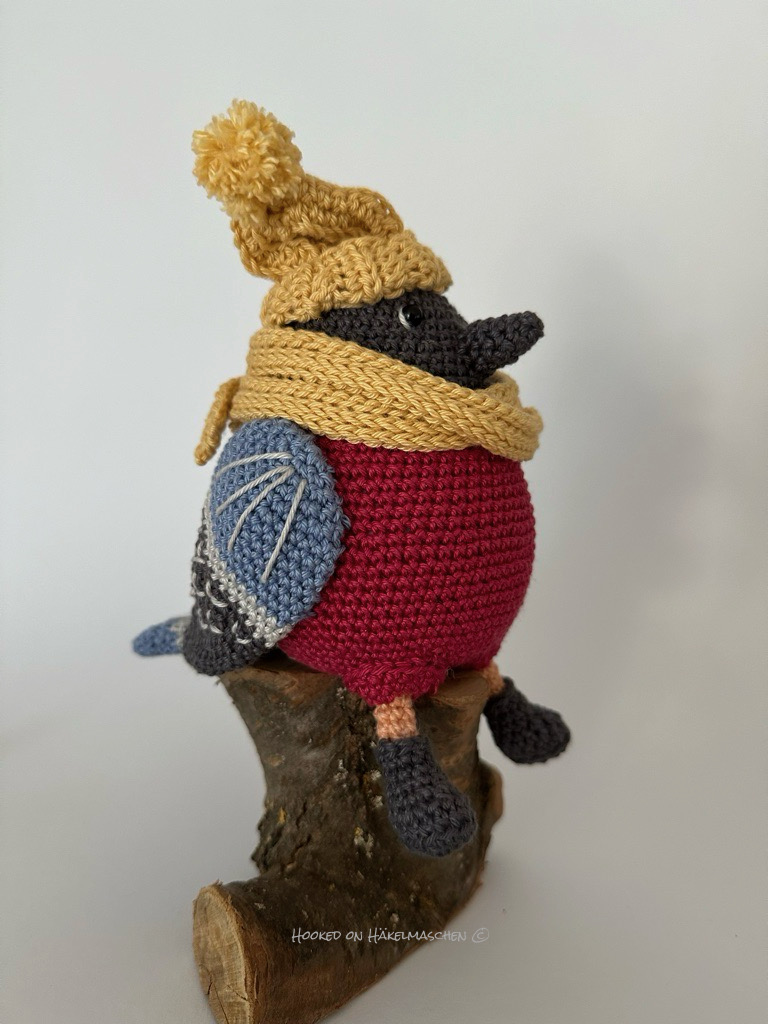
However, I would like to introduce you to my new flatmate: little Snowbird.
This cute snowbird is part of the pattern Winter Birds 2 from @natura_crochet. I spotted it on Instagram last year. It was sometime before Christmas, so I got it myself as a present. The pdf is more like a booklet than a single pattern. It is beautifully designed and contains patterns for three different birds: Kingfisher, Waxwing and a Chickadee – plus the Snowbird as a bonus pattern. All birds are very colourful and wintery styled with hat and scarf.
I used Schachenmayr Catania and Wenco DIY (a German brand) with a 2,25 mm hook. Both are 100% Cotton sport weight (#2) yarn with a yardage of 125 m / 50 g.
On my desk: ready to assemble
My colours are:
429 – Anthrazit / Catania
434 -Nebel / Catania
258 – Erdbeere / Catania
206 – Honig / Catania
51, blau / DIY
Head – Anthrazit
Body – Nebel, Erdbeere
Wings – Blau, Nebel, Anthrazit
Tail – Blau, Nebel, Anthrazit
Legs – Anthrazit, Honig, Erdbeere
Beak – Anthrazit
Hat / Scarf – Honig
I made some small adjustments to the hat and the scarf. I made the scarf a little shorter and narrower and the hat a little wider – it just worked better with my yarn.
I have to confess, I was a little hesitant about sewing the parts together. I don’t have much experience in assembling such small parts. So they So they have been lying in my basket for days (weeks?). But the placement etc. is well explained in the pattern and all went well!
I am absolutely happy with the result. Just started the Waxwing …
A while ago I came across this pattern on Ravelry: Tunisian Crochet Heart by Joy Clements from Crochet Road. Cute little hearts made in a combination of Tunisian and regular crochet.
I lately rediscovered my love of Tunisian crochet and dug out my Tunisian hooks, so of course this pattern caught my eye… But to be honest, what really convinced me to try it was a picture I saw on Ravelry: these little hearts are not only a perfect Valentine’s gift, they are also perfect as a small pincushion. Plus, big bonus, you also can clip on a few stitch markers. Very handy for me! This way I can have one or two stitch markers with me – just in case I need them unexpectedly – without having to carry the whole box.
The pattern
In my opinion the pattern is absolutely beginner friendly. Everything is explained very well along with a lot of pictures and videos. You won‘t even need a Tunisian crochet hook, a normal hook is absolutely sufficient.
The pattern has instructions for the heart itself which you can use as gift hanger, bunting or whatever comes to your mind. There are also instructions for joining two hearts to give it -stuffed with some fiberfill – a three-dimensional look. Last but not least you can create a tiny heart-shaped bag.
My hearts
These hearts are quick and fun to make. So I made some in different yarn weights and qualities. I decided to stuff mine with fiberfill. I only could not decide whether I prefer them more or less stuffed. So they all look a bit different.
My small hearts are made with Cotton sport weight yarn and my 3,00 mm Clover Amour hook. They measure about 5 cm / 2 inch.
Yarn and colours are:
Schachenmayr Catania (100% Cotton – 125m / 50 g)
263 – Soft Apricot
408 – Altrosa (dusky pink)
258 – Erdbeere (strawberry / red)
205 – Apfel (apple / green)
Scheepjes Catona (100% Cotton – 125m / 50 g)
520 – Lavender
Wenco DIY (a German brand that I bought in a supermarket)
51 – blau (blue)
I probably will gift the red and pink ones for Valentine‘s Day. The green and blue one will definitely be used as pincushion.
With my left over yarn (DK yarn) from my Legacy blanket the hearts turned out about 7 cm / 2 3/4 inch. I made them with a 4,5 mm hook, but this time with a Tunisian hook. I guess it will also work with a normal crochet hook – personally I just found it more comfortable with a Tunisian hook..
Yarn and colours are:
Drops Lima (65 % Wool, 35% Alpaca – 100 m / 50 g)
100 – Off White
Drops Merino Extra Fine (100 % Wool – 105 m / 50 g)
15 – Light Sea Green
I am just thinking about making some bookmarks using just a single heart. Maybe decorated with some embroidery? I probably will have to try it …
In case I have inspired you, the pattern for this little cuties is available on Ravelry.
If you love to crochet hearts just like I do, you might want to have a look at the ones I did last year.
You may have already seen that Ana from One Skein of Love has published a new blanket pattern: Stellar.
Again, it is a pattern in Overlay Mosaic – this time she used Hobbii Portobello in two different colours. Of course you can use any other yarn as well and as many colours you like. A colour changing yarn would also look great!
Photocredit: Ana Morais Soares / One Skein of Love
The pattern is available on Ana’s Ravelry page and in all her other shops.
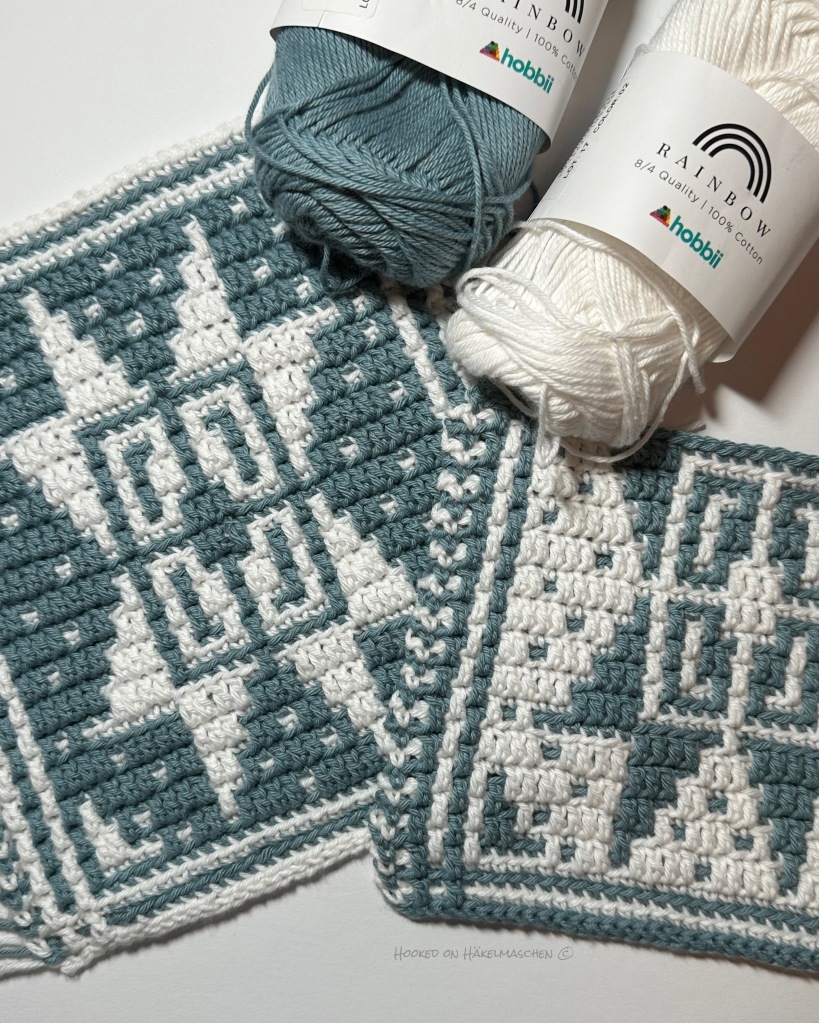
I had the pleasure of testing this pattern and translating it into German. However, I only had little time over Christmas and the turn of the year, so I only made a small square for testing. Originally I wanted to use it as a coaster, but when I finished it I thought it would be a good size for a potholder as well.
I used Hobbii Rainbow Cotton 8/4 and a 2,75 mm hook. Colours are 002 Natural White and 079 Dusty Blue Green.
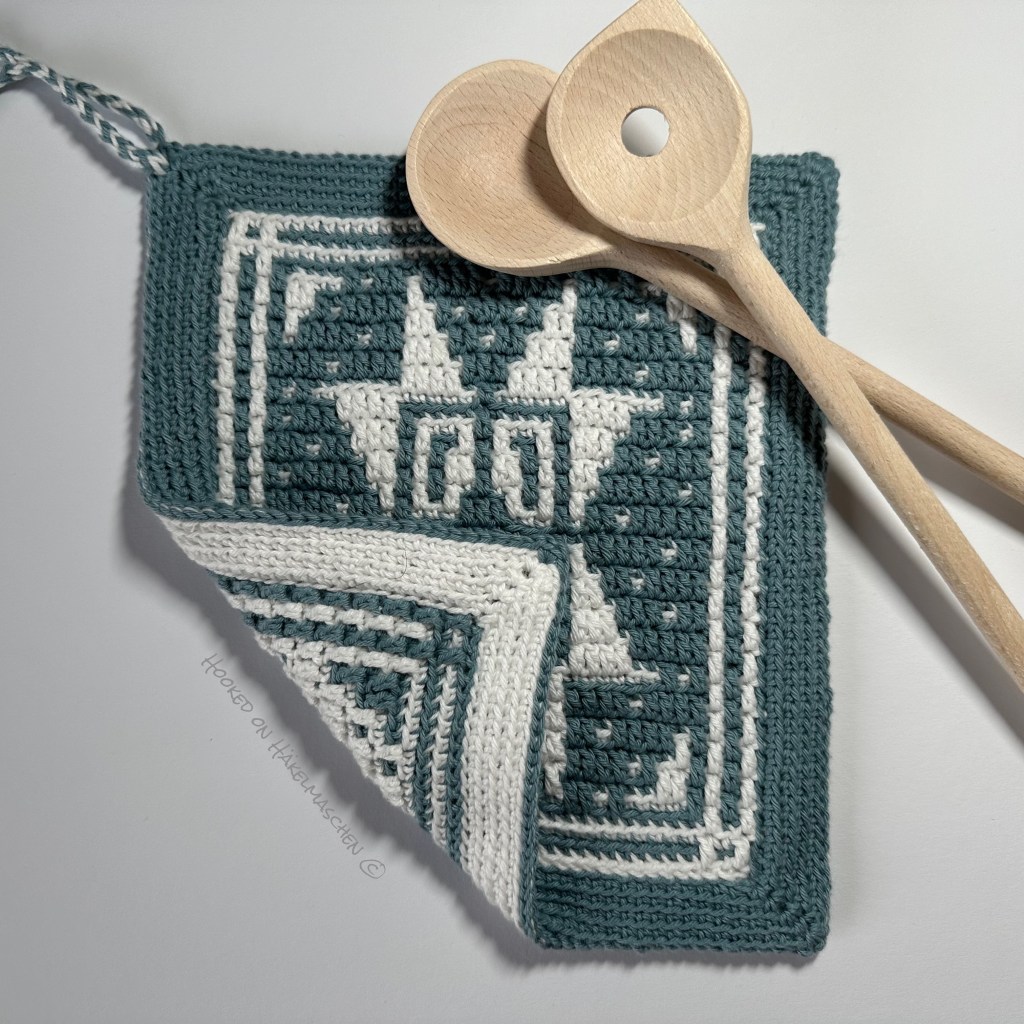
With 170 m / 50 g Hobbii Rainbow Cotton 8/4 is rated as a Fingering weight yarn. So it’s actually too thin to make a potholder out of it. Therefore I made a second square in reversed colours and connected them both together – just to achieve a nice thickness.
The Joining
At first I thought about joining the two squares in one step with the slip stich round. Like I did for my Wooly Friends Bag . What I didn’t like about this method was the patience I needed. It cost me a lot of concentration to catch the corresponding stitches of both parts. All yarn tails were constantly in my way and it took me ages to get it done. I have therefore discarded this idea and tried something else:
I prepared each of the squares with a slip stich round. This gave me the opportunity to work a separate border (front layer) on each square and to use the back of the slip stitches to join the squares.
The layers are joined with simple stitches through the back of every second slip stitch.
When you do a normal double border, it can sometimes be hard to work in the back of the slip stitches in case your stitches are too tight or you started with the front layer first. That’s why I wondered if it would make a difference whether you connect the squares first or work the borders first. I just gave it a try and initially made the border on one square, then joined it to the other one without a border. As the join is worked with a needle and not with a crochet hook, it is not difficult to work in the back of the slip stitches either way. So, in my opinion, it will not make a difference.
I worked the border on each side of the potholder like I would have done with the front layer of a double border: 4 rounds of single crochet worked in back loops only. Then both layers were joined with a slip stitch round. For the hanger, I made a thin (2 chains) I-cord from both colours and pulled it through one of the corners. That’s it!
The finished size of my potholder is 21 x 24 cm (about. 8 X 9,5 inch).
I hope you all had a great start in 2024 and are doing well!
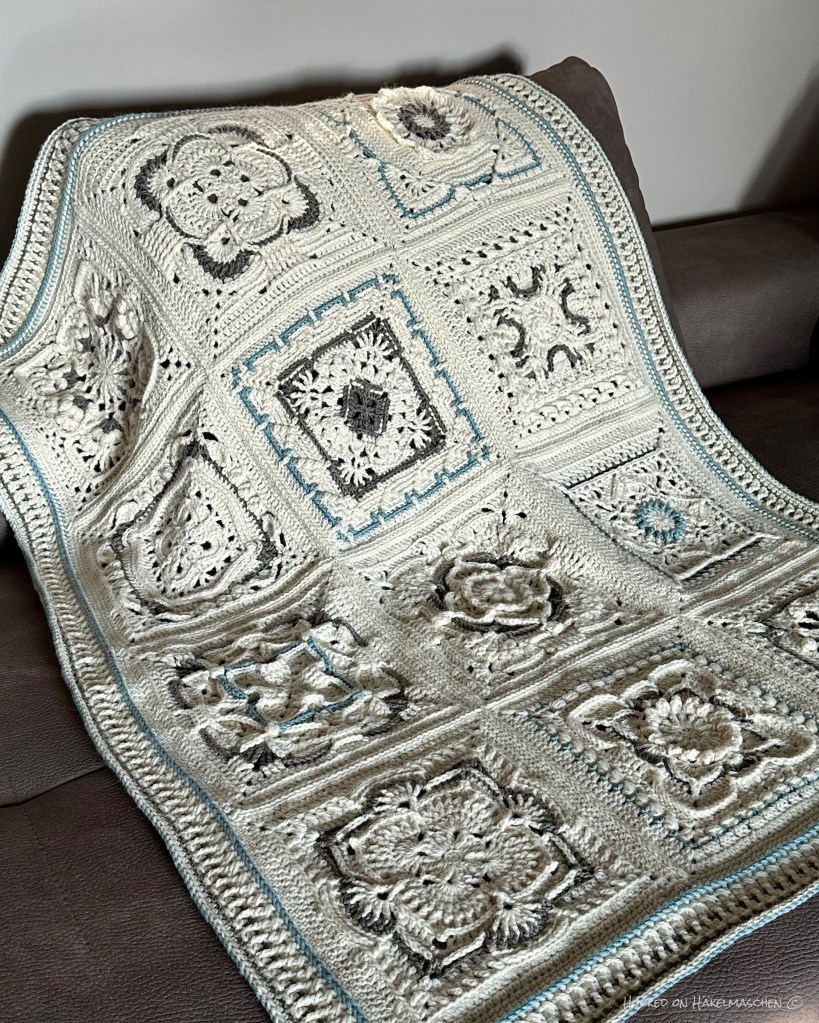
I’d like to start the new year by showing an ‘old’ project: My Legacy Blanket.
If you’ve read my posts on this topic from last year, you’ll no doubt know that the Legacy Blanket a design by Pam Knighton-Haener from ‘A Yarn of Serendipity’. She designed this blanket as a legacy for her grandchildren. You can read the story about it here.
The quilt consists of 12 different squares and has a wide border. When Pam finished the instructions for the border last year, she also revised the instructions for the 12 squares. So I had the opportunity to test a few of them.
I started this project sometime in July or August last year. You might remember that I found it difficult to choose the yarn and colours. And I went through quite a few trials and errors when it came to arranging the colours too. In the end, I ended up crocheting more than one square twice because I wasn’t happy with my colour arrangement. To be honest, I still had my doubts when I was joining the squares … BUT – surprisingly – once it was finished, everything fitted perfectly. I think it’s turned out really well and I LOVE the result!
My blanket was finished by the middle of December, but unfortunately I had no chance to take some nice pictures. We had a VERY long period with lots of rain, dark clouds, a bit of snow, fog, lots of rain again, well, winter …, you get the picture …
But here, at last, is a brief summary and a few photos:
My Yarn and Colours
My final choice of yarn and colours was
Drops Lima – 65% Wool, 35% Alpaca (100 m / 50 g)
colour 100 – Off White
Drops Merino Extra Fine – 100% Wool (105 m / 50g)
colour 07 – Light Taupe
colour 15 – Light Sea Green
Lima and Merino Extra Fine are both DK-weight yarns (#3, Light Worsted). The fact that I mixed the two yarns was simply a matter of colour tones. Colour 100 – Off White looks slightly softer on Lima than on Merino, probably because of the yarn’s texture. And I preferred that
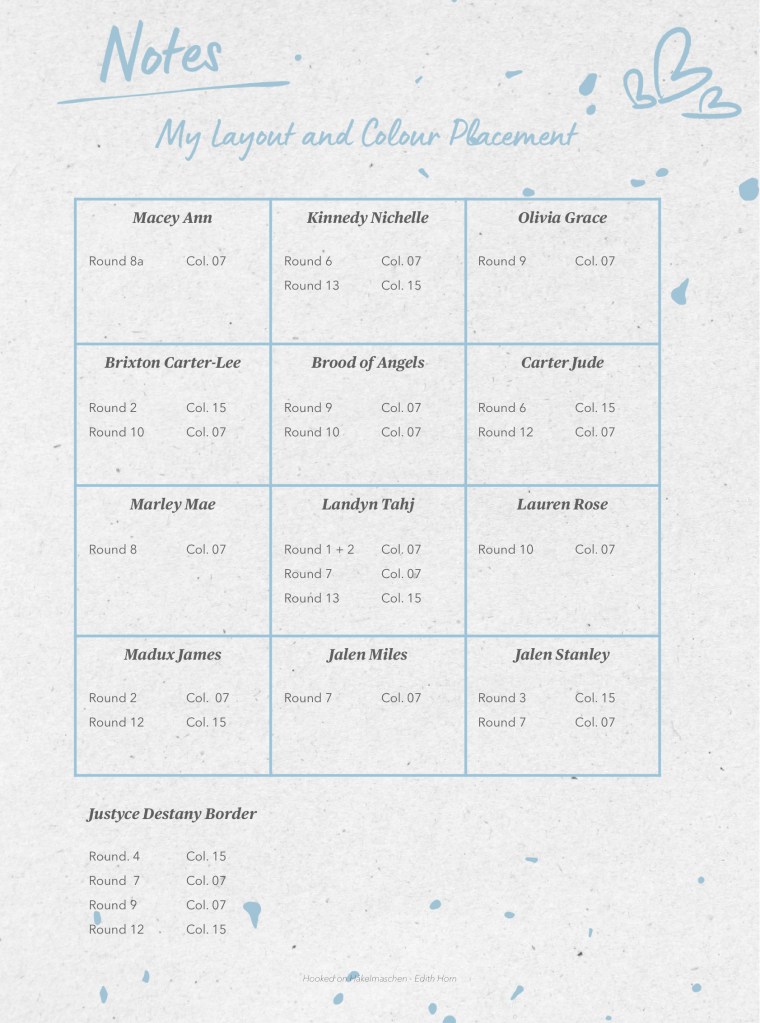
My Layout and Colour Placement
I used Drops Lima in Off White as main colour and only added a few accents with Light Taupe and Light Sea Green. So, in my notes below, I just listed the rounds with the accent colours – all other rounds are worked in Off White.
If you are interested in my colour scheme you can also download it here
My squares and the border are worked with a 4 mm hook throughout. Only for the Zipper Join and the last round of the border I went up to a 5 mm hook.
Each of my squares measures about 25 cm (about 10”). The final size of the blanket is about 90 x 115 cm ( 35,5 x 45 inches).
I’m sorry, but with all the changes and re-starts I’ve made, I didn’t keep track of how much yarn I used. In total, I used just over 900 g of yarn. As a very rough estimate, I’d say you’ll need almost 50 g of Off White for each of the squares, plus another 100 g or 150 g for the border. On top of that, you’ll need 2 or 3 balls each of Light Taupe and Light Sea Green. But that’s just a rough guide.
The patterns for all these lovely squares and the border are available in Pam’s Ravelry store.
In case you missed my previous posts about this project, you will find them here
Are you celebrating Christmas and still looking for a little something to give as a gift or decorate? These two crochet patterns, Glittery Christmas Baubles and Sparkly Stars, are really quick to make and look fantastic. I’ve had a lot of fun crocheting them over the last few days and have found them quite addictive. The yarn you use will make them look very different, so they don’t necessarily have to look Christmassy. It all depends on your preference.
Both patterns require very little yarn, so they are great for using up any leftovers.
Glittery Christmas Baubles
The pattern is from Ana Morais Soares from One Skein of Love. As the name of the pattern applies, Ana has used glittery yarn in some parts. I did not have anything with glitter on hand – so mine are made with some leftover yarn from my Legacy Blanket.
A little side note: Yes, my Legacy Blanket is finally finished! To be precise, it’s been finished for about a fortnight now, but I haven’t managed to take some nice pictures yet. The weather here is mostly pretty grey at the moment – clouds, rain, or fog. I hope it gets better in the next few days!
Back to my baubles, I think they clearly show what I meant at the beginning – they look more rustic than glittery and Christmassy.
I’m totally in love with this look!
I used
Drops Lima (100 m / 50 g) – colour 100, Off White
Drops Merino Extra Fine (105 m / 50 g) – colour 07, Light Brown
Drops Merino Extra Fine (105 m / 50 g) – colour 15, Light Greyish Green
with a 3,5 mm hook.
The bauble itself consists of two halves that are sewn together. First, you crochet the two halves, then you join them together while inserting the bauble. Ana used a Christmas bauble for this. Unfortunately, I didn’t have one that was the right size. So I put a polystyrene ball inside mine. It’s a 7 cm (2 3/4 inch) ball. The circumference is about 22 cm, just over 8.5 inches. It fits perfectly!
Of course, you can use various decorative stitches to join the two halves. Alternatively, if you prefer not to stitch them together, a crochet join, such as a simple zipper join, works very well.
I tried different joins, and the one shown on the left is my favourite.
It is made with slip stitches worked through the back loops. On each half, I inserted the hook top down, from outside to inside. I started with a slip stitch through the back loop of a stitch on the lower half, then slip stitched through the corresponding stitch on the upper half. And so on … It creates a nice kind of braided effect.
Sparkly Stars
Sparkly Stars is a pattern by Joy Clements from Crochet Road, which I spotted on Ravelry. These five-pointed stars are as quick to make and as addictive as Ana’s baubles. They can also be used simply as winter decorations.
Here, too, the final look can be influenced by the yarn and colours used.
The pattern offers two different sizes, contains detailed pictures and also a link to a video tutorial.
I used the same yarn and colours as for the baubles, but this time with a 4 mm hook. So again, no sparkle or glitter.
My small stars are about 9 cm and the tall ones about 14 cm.
Both patterns, the Glittery Christmas Baubles and the Sparkly Stars are available on Ravelry.
Glittery Christmas Baubles on Ravelry Sparkly Stars on Ravelry
I will definitely make some more baubles and stars using different yarns.
A free pattern for a simple & cozy crochet decoration
Last updated on June 5, 2026
Back in 2023, I was looking for some easy-to-make Christmas decorations.
Although our home is furnished in a clean and simple style, I prefer my Christmas decorations to feel a bit more traditional and nostalgic. I had been looking for something like a candy cane or a classic Christmas wreath, and somehow that search sparked the idea to make my own. So I grabbed some yarn, picked up my hook, and got started…
I really love the result! And I thought I might as well write down the pattern and share it with you. Maybe you like it too…
For my wreaths, I used Schachenmayr Catania yarn and a 2.75 mm crochet hook. Each wreath has a diameter of about 6 cm, which is between 2 1/4 and 2 1/2 inches.
Catania is 100 % mercerised cotton yarn and has 125 m per 50 g. Of course you can easily substitute it with any other sport weight cotton yarn.
My colours are
212 Khaki – for the wreath
192 Weinrot (Wine Red) – for decoration
105 Natur (Off White) – also for decoration
The pattern requires only need only small amounts of each color. So it’s also perfect for using up some leftovers.
These pattern also works with any other yarn weight. The only difference is that the size of the finished wreath may vary.
And of course you can use any other colour you like and decorate your wreath with whatever comes to your mind.
Some ideas for decoration
To decorate the little Christmas wreaths, you could, for example, simply sew on a few beads or little stars. Or cut out small shapes from felt and stick them on …
Unfortunately, I didn’t have any of these items on hand, so I focussed on what you can do with yarn.
I immediately thought of some ribbons and bows. But you can also just embroider some French Knots, as shown in the picture below (bottom right).
Idea #1 – A simple red ribbon
The making of decoration idea #1
To create a small ribbon, I simply crocheted a round of slip stitches around the stitches of round 1. The ends of the ribbon were made of chains stitches and have been tied into a bow.
I used two different hook sizes: – a 1.75 mm hook for the chain stithies, just to make them as small as possible – a 3.5 mm hook for the slip-stitches to avoid them from being too tight
This is how idea #1 is made
For the slip-stitches, the yarn should be at the back of the work; for the chain stitches, however, it should be at the front.
Therefore, insert the hook between any two hdc of round 1 and bring the yarn from back to front
Start with the smaller hook size. Make a slip knot and chain 22. My chain was about 7 cm / 2 3/4 inches long.
Switch to the larger hook size. Now work slip stitches around all the stitches of round 1, starting at the stitch to the left of where the yarn was brought to the front.
Switch to the smaller hook size again. Work another 22 chains.
Fasten off and secure the ends – either by tying a knot at each end, or by carefully sewing them away at the back
When the bow is tied, it may look a little bulky; simply shape it as desired and secure it with a thread as shown below (idea #2).
Idea #2 – A two-coloured bow
The making of decoration idea #2
This bow is made from a chain, approximately 15 or 16 cm (about 6 inches) long.
This is how idea #2 is made
As before, it’s best to use a smaller hook size to ensure the chains are nicely small. I used my 1.75 mm hook again.
The bow is made with two different colours (A and B). To get the striped effect, the colours are changed with every stitch.
Please note: You probably have to work a little more slowly and tighten the previous stitch slightly with each colour change.
Start with a slip knot on the hook using colour A.
Grab the colour B thread and make a chain.
Grab the colour A thread again to make the next chain
Continue like this until you reach the desired length
And a word about the yarn ends:
Like shown in the photo above, I simply cut off the yarn at the ends of the chain and untangled it a little. However, I didn’t really like the result! So I made a second version and sewed the threads away at the back. You can see this one in the first photo at the top of the page. I think it looks better.
Idea #3 – A two-coloured ribbon
The making of decoration idea #3
A two-coloured alternative to idea #1
This is how idea #3 is made
For this two-coloured ribbon, again, the yarn is needed in the back to work the slip stitches. Start and end of the threads are needed on the front to make and tie the bow.
So, bring the yarn to the front between any two stitches of round 1. Like in idea #1, but this time, two threads at once (colour A and B).
Leave the tails long enough to tie the bow later. Mine we’re about 20 cm long
On the front side: start with a slip knot in one of the threads (colour A)
Using colour A, slip stitch around the stitch directly to the left of the thread.
Work the second slip stitch around the next stitch, using colour B
Work the next slip stitch using colour A again – and so on
As with the two-coloured chain (idea #2), you will probably have to tighten the previous stitch a bit after the colour change.
At the end of the round, cut the yarn, again leaving a long tail. Bring the ends to the front and tie a bow. Then shorten the threads to the desired length.
In case you want to hang your wreaths, simply attach a thread, ribbon, or cord to the backside. Ensure it’s roughly aligned with the centre of the bow (where appropriate).
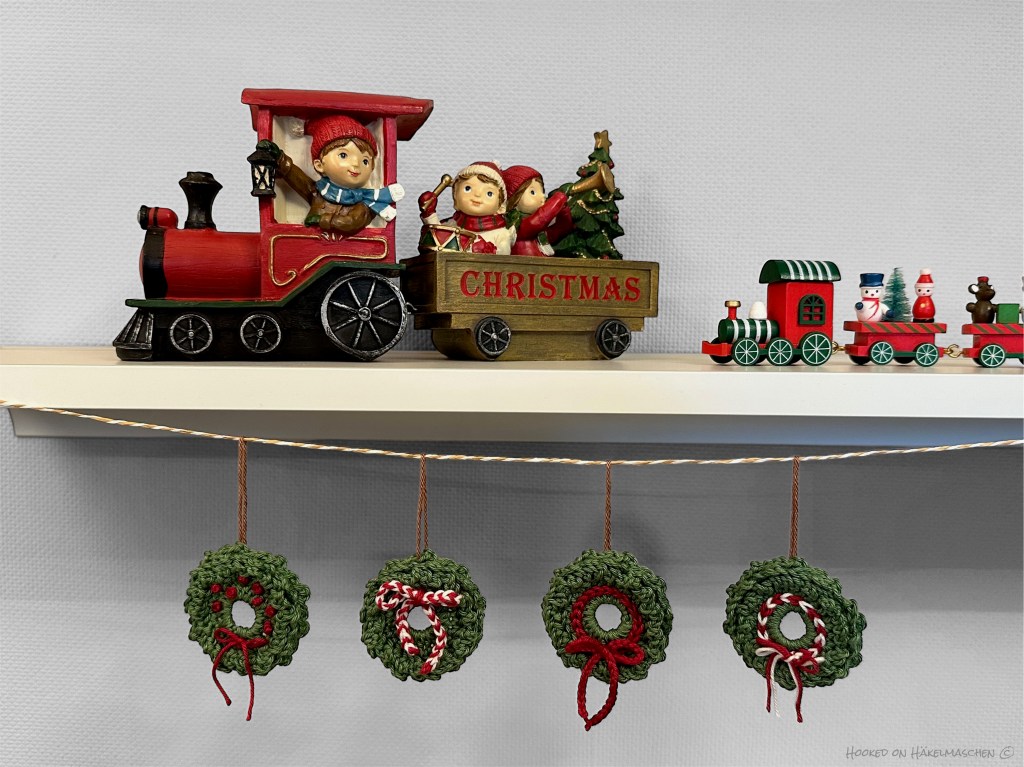
My Christmas decoration
Pattern Link
If you like my little Christmas Wreath and would like to make one too,
The pattern is not tested. So, if you spot any errors or have any questions, don’t hesitate to contact me. And please, feel free to add your projects to my Ravelry page.
You probably have seen my previous post about my test of Ana’s Magic Winter Cal when I was still working on the border. Well…
… after 840 slipstitches, 2.616 double crochets, 5.208 single crochets and another 888 slipstitches and 12 single crochets (chains not counted) the border is finished. YAY!
I opted for a two-coloured double border – all in Vintage Peach for the back layer and a combination of Silver and Vintage Peach for the front side.
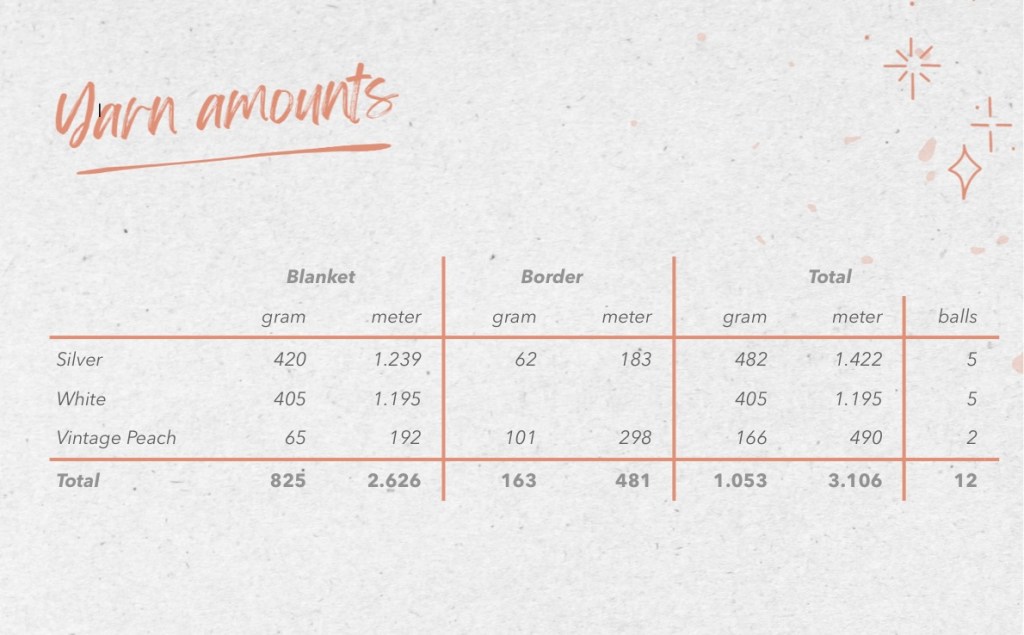
In total I needed 12 balls of Stylecraft Special DK – you’ll find the detailed yarn amounts below. Made with a 4 mm hook my blanket measures about 121 x 146 cm (48 x 57 inch).
In the end, my color placement turned out to be slightly different from what I originally had in mind. But I think I got the Sunrise-on-a-frozen-winter-morning look I wanted. And – I know, I already said that last week – I am totally happy with the result!
As promised, here some detailed information about my yarn amounts.
And, if you are interested, you can download a row-by-row guide of my colour placement here.
The Magic Winter CAL started last Friday and will continue until 15th December. So, there is still time to join in.
I found that most parts of the pattern worked up quite quickly. Only the tapestry parts took me a little longer. Tapestry in Overlay Mosaic needs a bit of practice. You will have to get the hang of how to carry the yarn, especially with the double crochets. However, you only need it in a few rows. In addition, you can of course also decide to omit the tapestry technique and only work the normal overlay mosaic. All up to you!
Have you seen Ana‘s new Cal? Magic Winter will start on Friday, 17. November 2023. The Introduction File with all relevant information is already available on Ravelry.
I had the pleasure of testing this wonderful pattern and also do the translations into German.
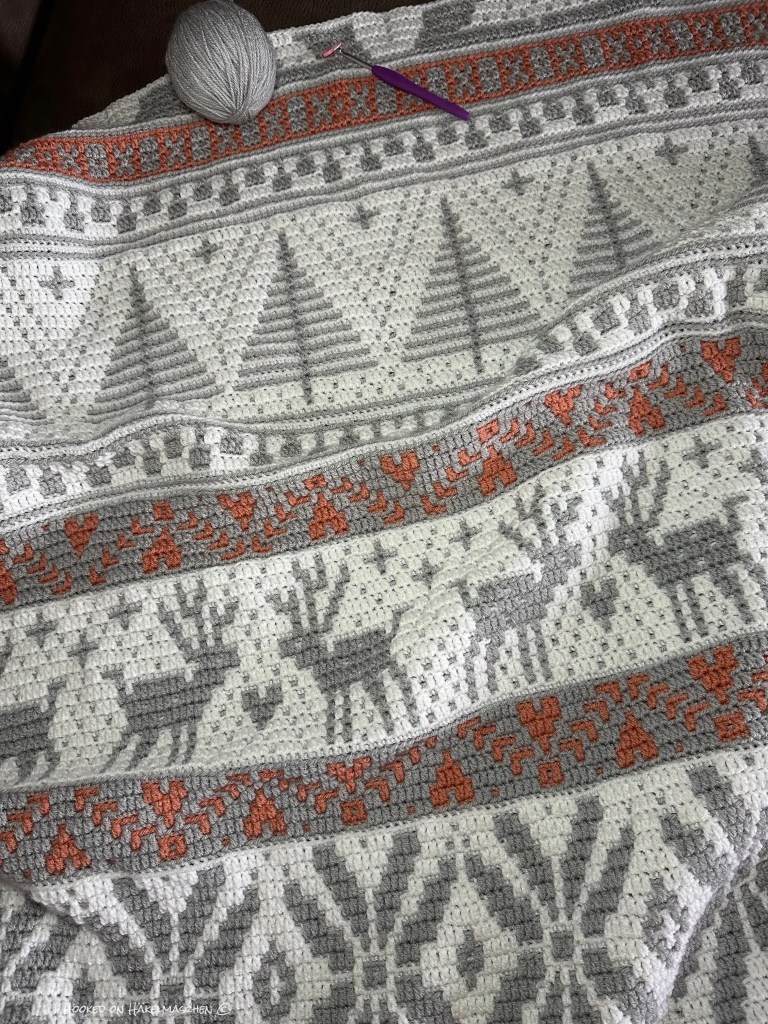
The Magic Winter blanket is made in Overlay Mosaic technique and also has a small section of Tapestry Mosaic. Of course, the pattern explains how to do both.
When Ana showed me her new design for the first time, I immediately thought about a clear, cold and frozen winter morning when the sun rises with a rosy shine. On these days, my grandma used to say: ›look, the angels are baking biscuits in heaven‹. So I immediately knew how I wanted my blanket to look like: a cold and clear winter morning with a beautiful sunrise …
I used Stylecraft Special DK in White, Silver and Vintage Peach and I am very happy with the result. At the moment I‘m still working on the border and can‘t show you a finished blanket. But I can give you some impressions.
If you are interested in my colour placements, I have already listed them here for part 1 of the Cal. The rest, including my yarn amounts, will follow next week when I am hopefully finished with the blanket.
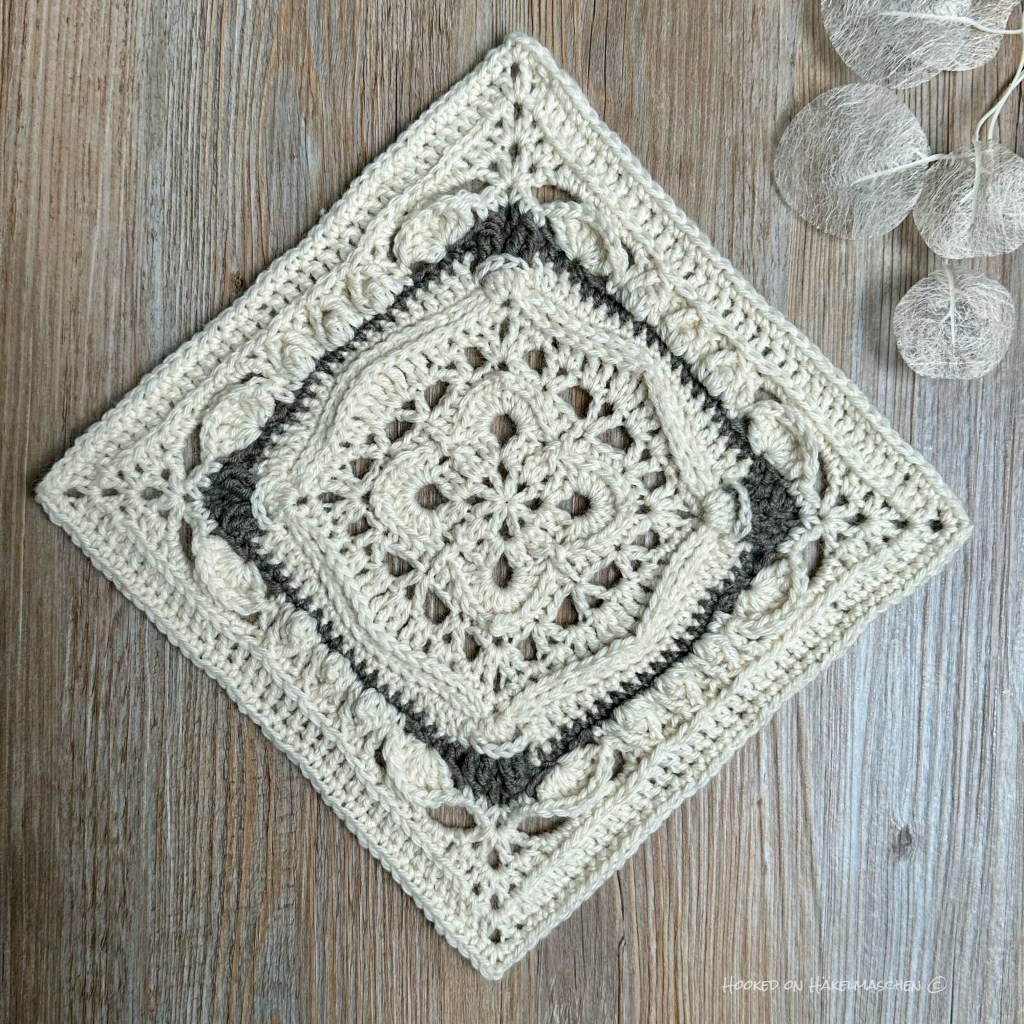
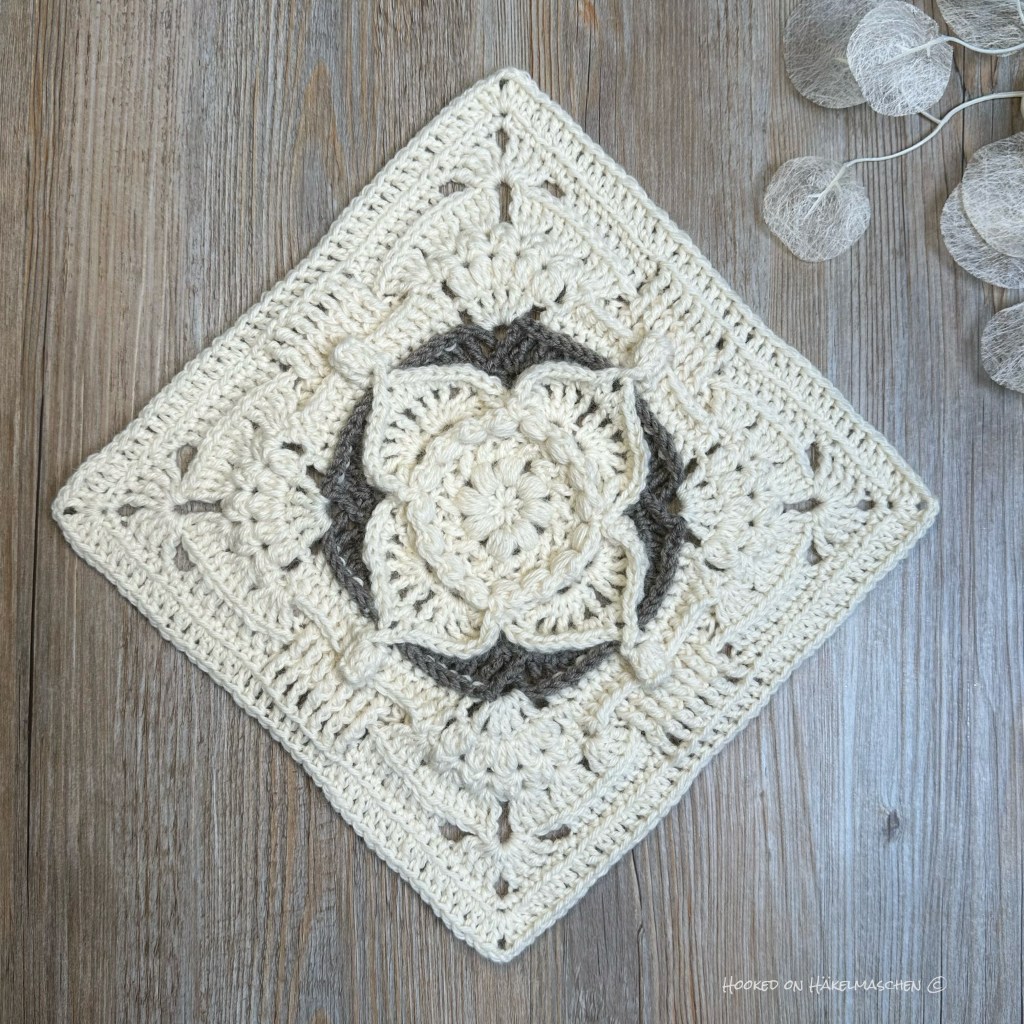
YAY! It took a while because I spent so much time thinking about the colours and how to arrange them … But finally … all 12 squares are finished! All tails are worked away and all squares are blocked.
These are the last three squares that were missing from my collection.
Lauren Rose
Brood of Angels
Macey Ann
I’ve just prepared the first squares to be joined together and spent a while working on the layout.
After arranging and rearranging the squares a few times, I settled on the layout shown on the left. I hope it will look nice!
The Zipper Join
In the Justyce Destany Border pattern for the Legacy Blanket Pam recommends to use the Zipper Join for joining the squares.
I have to admit, I’m no expert when it comes to joining squares. I once used the ‘join-as-you-go’ method to join a few granny squares – but I think that’s about it. So, for the Justyce-Destany border, I’m trying my hand at the zipper-join for the first time. The pattern includes a useful link to a video tutorial showing how to do this join. But if, like me, you prefer written instructions, I’ve also found a very clear and helpful guide from Raffaella from Raffamusa Designs. Nevertheless, the beginning is a bit fiddly – at least I think so … But I am slowly getting the hang of it. I experimented a bit with the crochet hook size at first and eventually settled on a 5.0 mm hook. I crocheted the squares using a 4 mm hook. However, with the larger hook, I find it easier to crochet even stitches when joining, which don’t end up too tight. So far, I’m happy with the result. It’s a very neat and flat join. Now on to the next squares!
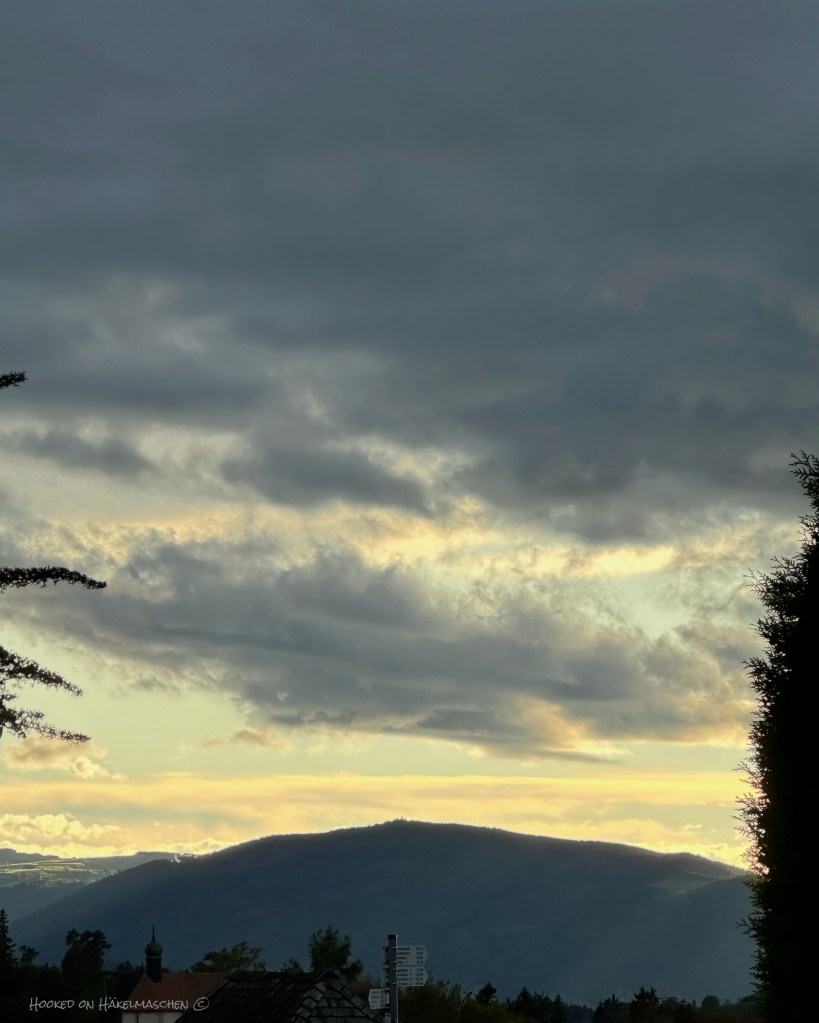
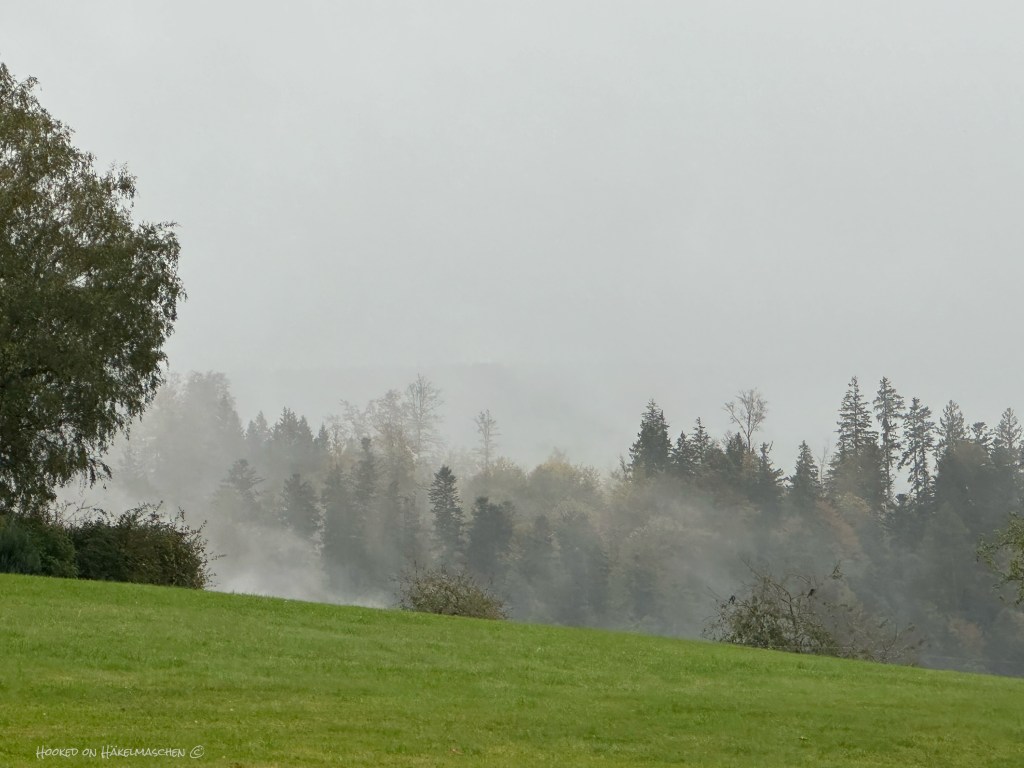
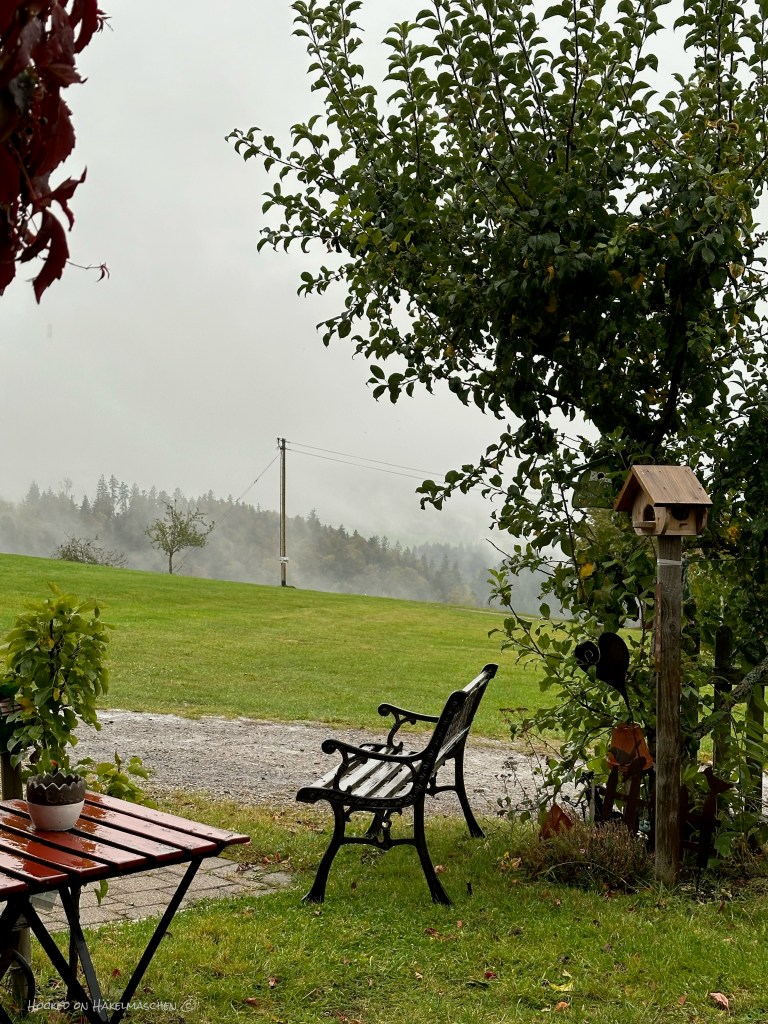
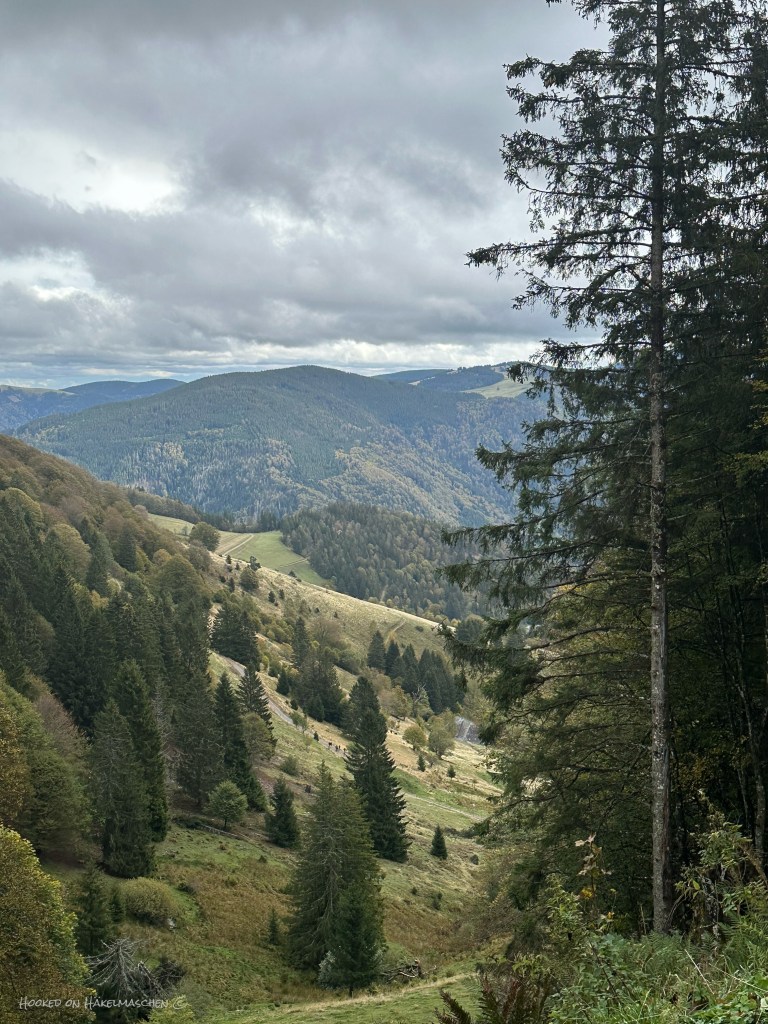
Last week we arrived back home from a lovely 10 days holiday. We were once again at one of my favorite places here in Germany, the Black Forest. The Black Forest is a mountainous region in southwest Germany and borders France. Among other things, it is very well known for the cuckoo clocks. We enjoyed the time very much, even though the weather was unfortunately very unstable. We had rain, wind, sunshine, dark clouds, fog …
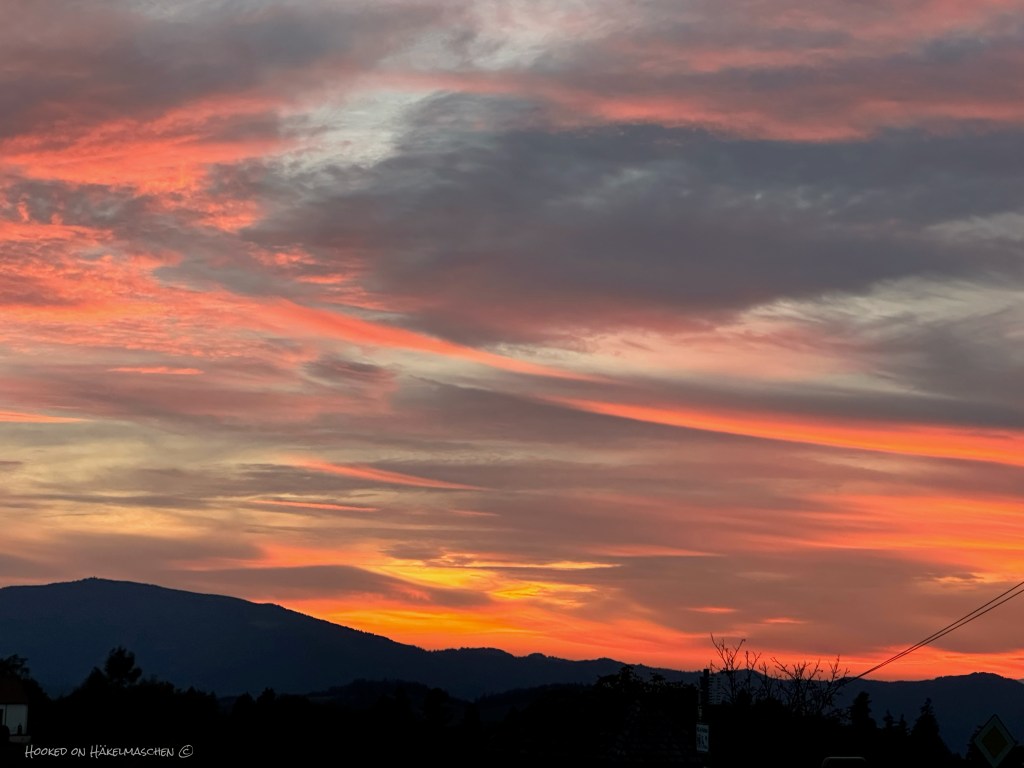
… and beautiful sunsets.
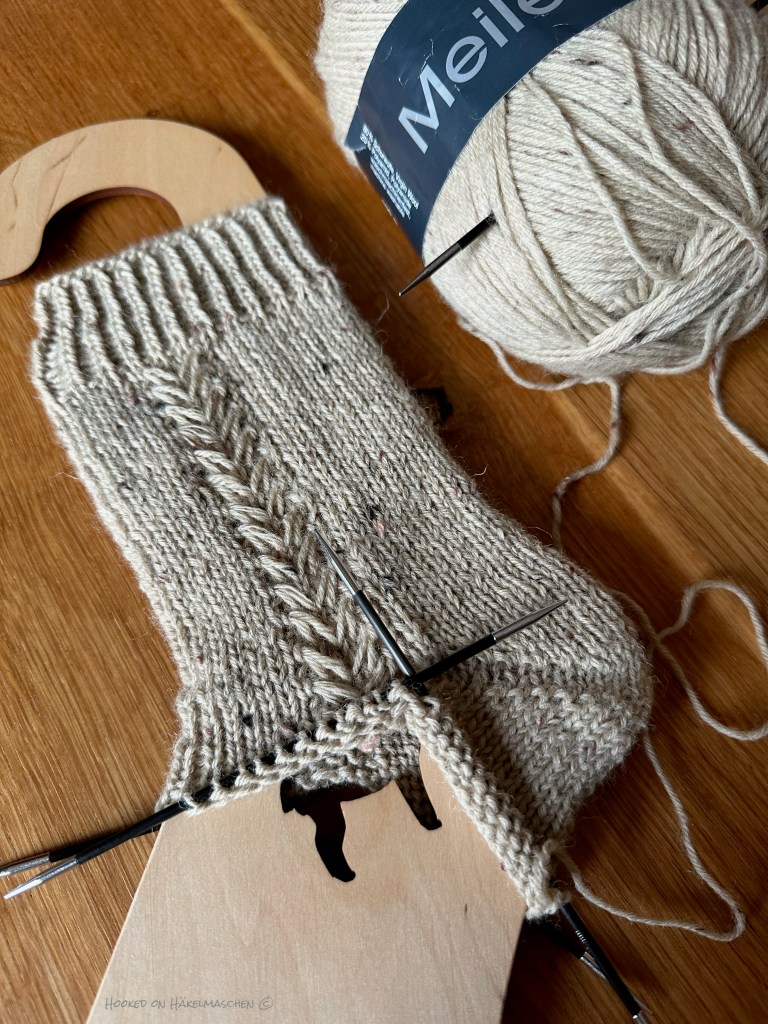
As usual, I didn’t crochet much on holiday, so there’s not much to show either. Only some new socks that I started to knit.
The pattern is called Laid Edges by Kellie Macpherson and is available for free on Ravelry. And wow – it‘s the first time that I work along an English sock pattern. So far it looks like I’ve mastered it (even though I decided to knit a different heel).
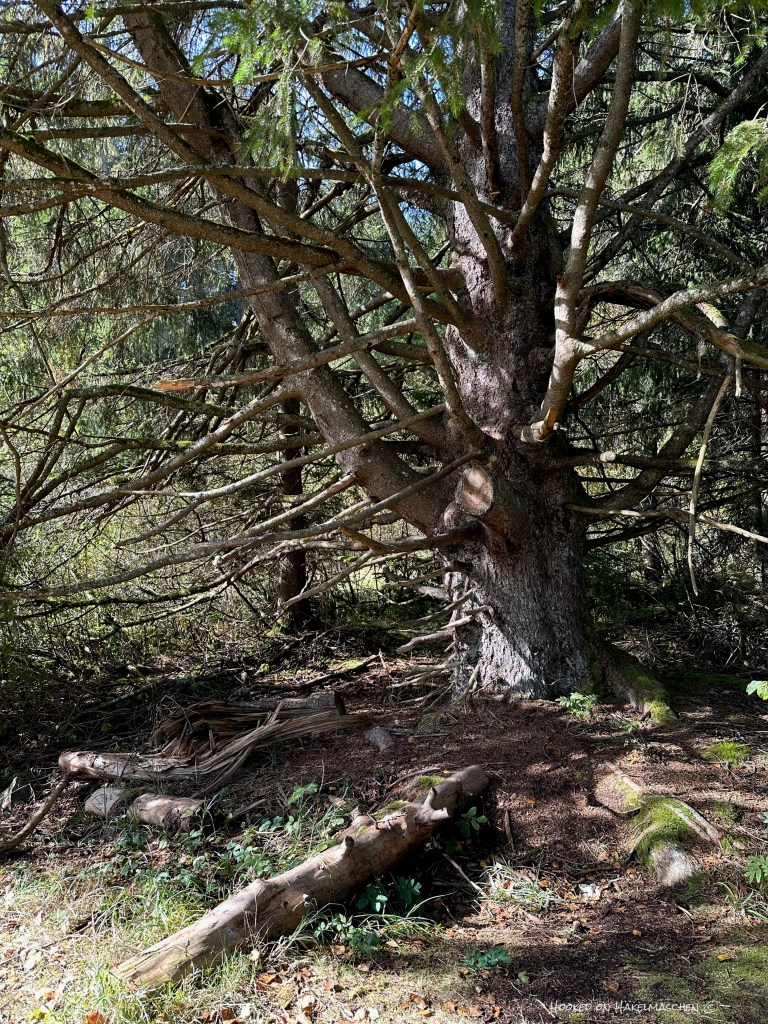
And some impressions from one of our long walks.
I love this region of Germany! I love the clear and fresh air, the people and especially my holiday place (the one on the picture above with the bench in the rain). Sigh* …
Well, now it’s on with normal life and it’s on with my Legacy blanket, a new test for Ana, the winter preparations in the garden and many more!




















 Hooked on Häkelmaschen