Pattern Testing Explained

Curious about crochet pattern testing? Learn what pattern testers do, what skills you need, how the process works, and how to get started yourself.

Cover image created with AI assistance

A few weeks ago, I wrote about my very first pattern test – that was back in 2019, seven years ago by now. In this post, I talked a little about my motivation and the fears I had when I started testing, as well as my experiences. If you missed the article, you can read it here.

While that previous article focused on my personal journey, this time I’d like to take a more practical look at pattern testing itself.

Would you like to try testing a pattern yourself, but aren’t quite sure how to get started? What skills you need and what you need to bear in mind?

I’ve been asked these questions many times in the past, and I’m happy to share my experiences here. However, these are my personal experiences, which are by no means necessarily universally applicable.

What you should know before applying as a pattern tester

Firstly, you need to know that testing crochet patterns does not usually involve any financial compensation. (As far as I know, the same applies to knitting patterns.)

Most designers will thank you with a copy of the finalised pattern.

So, before starting, keep in mind that you are effectively investing your own resources, such as time, yarn and other supplies. Speaking of time: you should be aware that testing a crochet pattern will require more time than if you were simply following a pattern to crochet a blanket, an Afghan square, an amigurumi, or whatever. I’ll explain why that is later.

The fun of being a pattern tester is getting access to a pattern before other people do, being part of the creative process and meeting like-minded people from all over the world.

Do you need special skills?

I’d say no, there aren’t any specific ones! At any rate, not as long as the test call doesn’t require specific skills.

Of course, you should already know how to crochet and have mastered the basic stitches. And you should be able to read, understand and follow a written pattern.

But mostly there is no need to have an intermediate or advanced skill level.

In my experience, it’s actually helpful for designers to have testers with varying levels of crochet skills. This makes it easier for them to assess whether the instructions are clearly worded and whether all the stitches are described properly.

What does a pattern tester actually do?

Post-it showing the basic tasks while testing a crochet pattern
Essential Tasks while Pattern Testing

Essentially, testing a pattern involves checking

  • wether the instructions in the pattern work in practice
  • wether they can be followed without struggling
  • wether the described result occurs
  • or wether there are any points where one gets stuck or might misunderstand something

However, designers often specify additional criteria that are important to them and which should be checked as part of the test. That may just be specific points that need to be read particularly carefully for clarity. But often it’s also about looking out for typos and spelling mistakes and / or checking the stitch counts.

Here, the requirements of a tester overlap with those of a technical editor. Checking stitch counts and correcting spelling mistakes are, strictly speaking, tasks of a technical editor.
On the other hand: in order to assess how clear a pattern is, a tester has to read the entire pattern anyway. In this context, you can also flag up spelling mistakes if you spot them (whereas a technical editor would look for this specifically). The same applies to the stitch counts. You should check them after every row or round in any case and in your own interest. Although, I must admit, I myself often don’t (and mostly regret it 3 or 4 rows or rounds later).
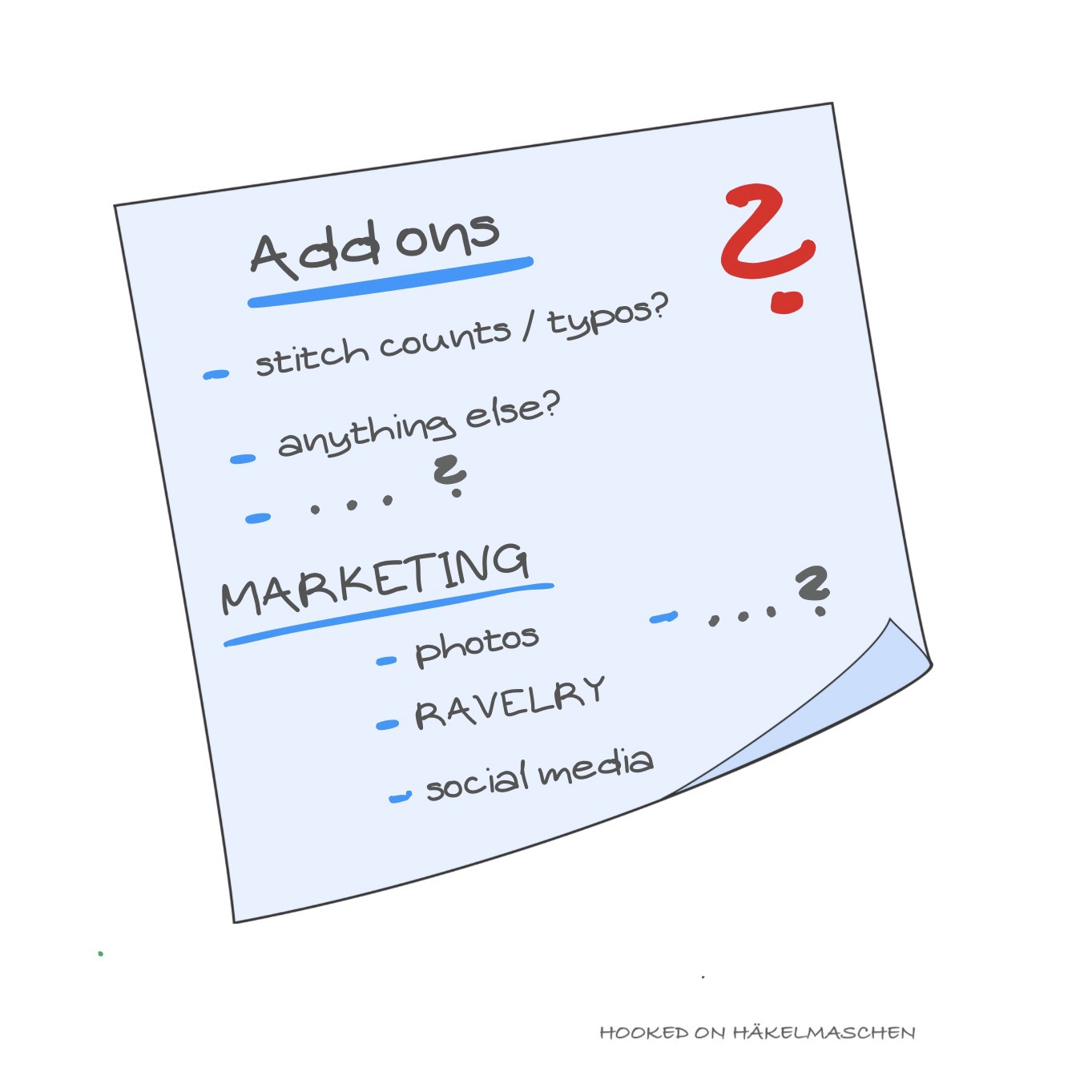
Post-it showing the add on tasks while testing a crochet pattern
Add On Tasks while Pattern Testing

Additionally, the demands are increasingly moving into the fields of marketing and social media.

So you may also be asked to

  • create a project page on Ravelry and link it to the pattern, once it has been published
  • provide at least one attractive, high-quality photo of the finished project
  • give the designer permission to use your photos for marketing purposes
  • post your finished project yourself on social media (Instagram, crochet groups on Facebook etc.) and to help spread the word about the pattern

A designer usually sets out their requirements and expectations in what is known as a ‘test call’.

It all starts with a test call

A designer uses a test call to recruit testers for a specific project. This is when they present their new design for the first time and state how many testers and what skills they are looking for.

It should contain all the information you need to decide whether you would like to take part in the test or not.

Besides at least one picture of the design, there should also be some basic information about the pattern. Such as the final size(s) of the project, yarn and yarn amounts required, skill level and so on.

Based on this information you can roughly estimate how long the project will take you and decide wether you can use yarn from your stash or wether you’ll need to buy some first.

All this is important to determine whether or not you can meet the deadline of the test. The deadlines is the date by which the test must be completed and should, of course, also be defined in the test call.

In addition to all this information, the test call should also provide an insight into the communication channels and how, and to what extent, the designer would like to receive feedback.

If there are any points you’d like to know about in advance but which aren’t covered in the test call, just ask. I think, communication is one of the most important things when it comes to testing.

Dos and Don’ts – How the testing process works

Once you’ve applied for a test call and been selected as a tester, the designer will send you the pattern. Then you’re all set to get started!

As you’ve seen, the requirements in a test can vary greatly. In my opinion, however, there are a few very general rules:

Two post-its listing the dos and Don’ts while testing a crochet pattern
Dos and Don’ts while Pattern Testing

Stay focused

From my own experience, I can say this: however excited you may be to start to work on a brand new design, and however keen you are to present your results, stay focused!

It’s surprising how easily a mistake can be overlooked in a pattern. Especially if you already have some experience with crochet, you might automatically work the correct stitch or sequence of stitches, even though there’s a little mistake hidden in the pattern.

Take notes

Make notes on everything. Whether it’s mistakes, wording you find hard to understand, or special stitches you might have struggled with. But also make a note of things you really like, e.g. clear, easy-to-understand explanations, particularly attractive design elements, etc. It’s best to also note down details about the yarn, the colours, the amount of yarn used and the crochet hook you used. Especially if you’re planning to post on social media later, you may well be asked about these things.

Meet deadlines

The most important deadline in a pattern test is the date by which the test must be completed. Depending on the project, there may also be other deadlines during the testing phase – dates by which a specific part should be completed or on which interim feedback is requested. You should meet these deadlines wherever possible. If, at any point, you realise that this will not be possible for whatever reason, you should inform the designer immediately.

Give constructive feedback

In my view, it is best to address errors and inconsistencies straight away. That way, any discrepancies can be resolved immediately.

If the designer has asked for final feedback, please provide them with honest and constructive feedback. Look at your notes and list what you liked about the pattern, where you might have struggled, and do mention any areas where you see room for improvement.

I know it’s not always easy to talk about the things that perhaps weren’t so positive. You just might not feel confident enough. Phrase it politely and constructively! And just keep in mind: the designer probably wouldn’t have asked if they weren’t genuinely interested. Your feedback can be incredibly important. It gives the designer the opportunity to improve their pattern writing. But don’t be angry or disappointed if they don’t take your suggestions on board. That’s entirely their decision.

Take nice photos

Once you’ve finished crocheting the project, you should at least take a nice photo of it and send it to the designer. That way, they can see that you’ve actually finished the test.

If you plan to post pictures on social media later, it is usually also a good tip to take pictures of the ‘Work in Progress’ (WIP) for larger projects. These photos are often ideal for ‘sneak peeks’ (if the designer wants this in the run-up to the pattern’s release). And these WIP photos often go down better on social media than posting the finished project with the caption “Look, I’ve tested pattern xy”.

What a tester shouldn’t do

I’ve been talking at length now about what a tester should do. But there are also a few absolute no-gos. Actually, though, these are things that should go without saying.

Of course, do not share the pattern. You should never do that anyway, even if it’s a pattern that’s freely available. Every pattern is protected by copyright! Of course it is ok to post a screenshot in your test group, just to mark a mistake or points where you are struggling. But don’t post it outside this group.

The same applies to photos of your test piece. You shouldn’t publish those until the pattern is released. The exception, of course, is if the designer asks you to post a few sneak peeks to promote the pattern ahead of its release.

Personally, I only upload my photos to Ravelry once the pattern has been published. Even though a pattern search on Ravelry won’t return any results until then, anyone who visits your profile will be able to see the photos.

However, the absolute no-go is simply to stop the test without letting the designer know. Of course, there may be times when something comes up in your life and you can’t finish the test. In that case, just let them know. I’ve never come across anyone who didn’t understand that.

Why a tester is more than only a crocheter

By now you’ve probably realised that a tester does much more than simply crochet a project.

You need to study the pattern in detail, clarify any issues, keep track of deadlines, document your work and formulate feedback.

The tasks continue if the designer would like you to help promote the pattern. To do this, you’ll naturally need some lovely photos, and you’ll need to come up with a description that includes all the key information about the pattern, post it, monitor the post, and reply to comments and questions.

So you’re not just a crocheter, but also a tester, a photographer, a content creator, an advertiser and a community manager.
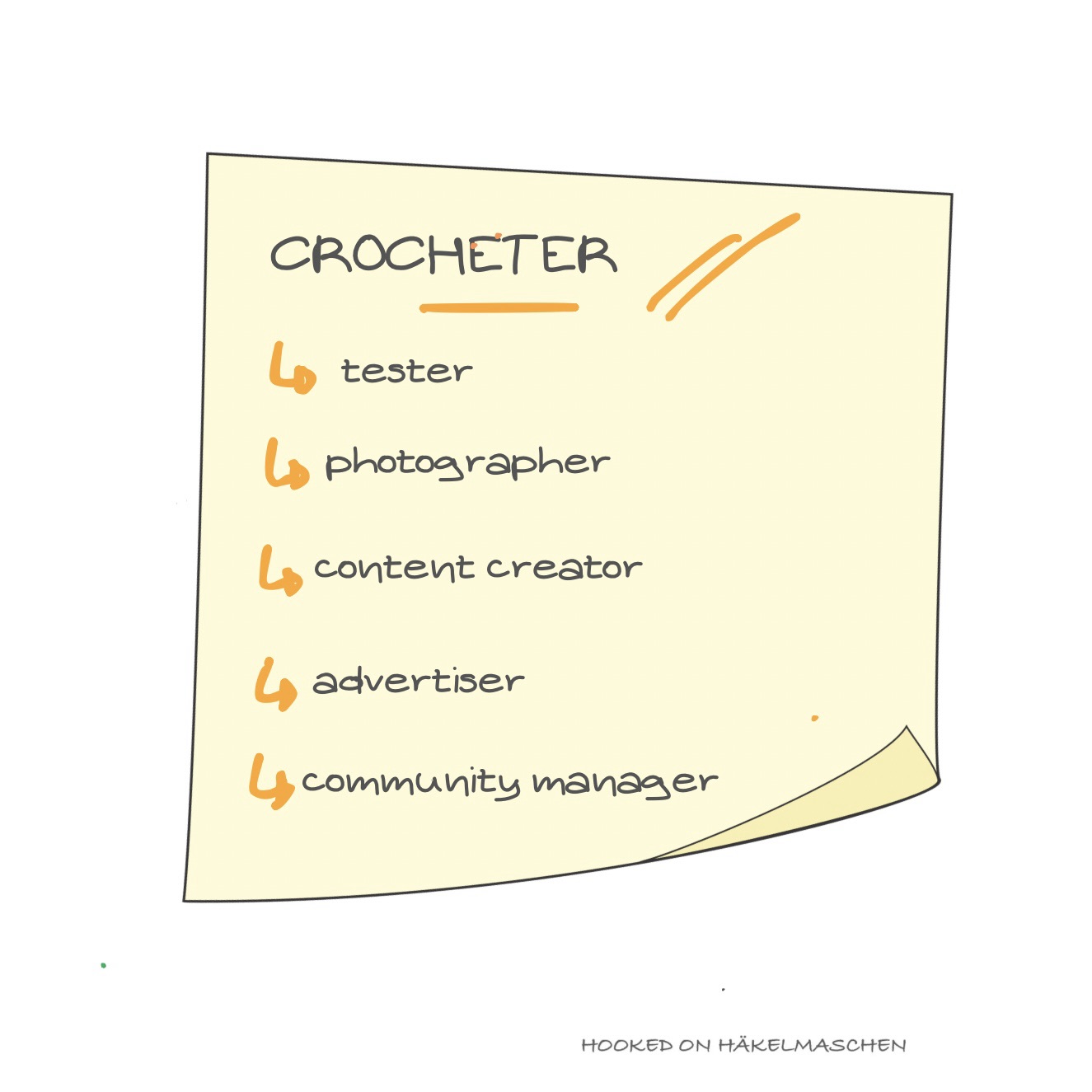
Post-it listing the roles of a crocheter while testing a pattern
Roles of a Crocheter while Pattern Testing

All of this takes extra time. That’s why I said at the start that testing a pattern will need more time than simply crocheting the pattern.

Are you still interested in becoming a tester?

How to become a pattern tester

There are various ways to become a pattern tester.

For instance, on Ravelry there’s a forum where designers share their patterns for testing. Unfortunately the focus there is mainly on knitting patterns, but there are also some lovely crochet patterns included.

Many designers also post their test calls on social media. Just keep an eye out.

Other designers have their own regular testing groups. This means they mainly work with the same people. However, they are often looking for new members too. So watch out designer specific crochet groups on Facebook.

Do you have a favourite designer you’d like to do a test for? If so, why not get in touch with them and let them know that you’re interested to work with them?

With all these various options, it’s helpful if you have photos of your previous work. These pictures are a bit like your shop window and will help the designer get a first impression of you.

So, if you spot a test call somewhere, you like the design and you meet the requirements: just apply!

My conclusion

I hope you’ve now got a rough idea of what’s involved in testing a crochet pattern. It’s a lot of work! It takes commitment. But it’s also great fun!

Over the years, I myself have become more selective about the tests I take part in. The reasons for this are primarily down to time constraints and health issues. Even so, I wouldn’t have missed the last seven years for the world.

I’ve learnt a lot during this time. I’ve learnt new crochet techniques. I’ve gained an insight into the process of creating a pattern. I’ve improved my communication skills and gained self-confidence. And I’ve met some really lovely people from all over the world!

Oh yes, the free patterns!
Well, I’m actually delighted with every single one. But to be perfectly honest, in my opinion, that shouldn’t be the main reason why you test crochet patterns.

So, just give it a go – and decide for yourselves!

Colour Stories and Crochet Memories

Crochet memories, Afghan squares and colour stories — a look back at years of testing beautiful designs for Pam Knighton-Haener.

I was quite surprised when I realised that I started testing patterns for Pam Knighton-Haener of A Yarn of Serendipity almost six years ago. Our collaboration began sometime around August or September 2020 — it certainly doesn’t feel that long ago!

If I remember correctly, I responded to a tester call she posted on Ravelry back then, and shortly afterwards she invited me to join her testing group.

Since then, I’ve had the chance to test around 30 of her wonderful Afghan square designs. I think I’ve written about most of them here on the blog… although I really should gather them all together in one place someday. To be honest, though, I’m still trying to figure out the best way to present all of my projects in a clear and organised way.

A few days ago, Pam contacted me and asked whether she could use some of my photos for her newly updated Etsy shop — especially because she loved my colour combinations.

Of course, I said yes straight away! As someone who loves playing with colour, that compliment probably meant even more to me than I can properly put into words.

Looking through and sorting the photos for Pam, I decided to standardise the backgrounds a little. I’d been meaning to create some colour boards featuring these squares for quite some time.

As a nice side effect, this also makes it much easier to combine them into collages. That also gives me the chance to show you at least a small selection of the squares I’ve tested for Pam over the years.

Here’s a little overview — arranged from left to right, top to bottom.

Row 1
Sweet Delusions Square + Mystified Square + Pinwheel Square + Wheel of What Square

Row 2
Tied Up With Bow Square + Dahlia of Yore Square + Margaret Square + Efflorescent Square

Row 3
Jewel Square + Head over Heels Square + Around the World Square + Sage Advice Square

Row 4
Joanne Square + Tickle Me Pink Square + Fancy Nancy Square + Em Cabal Square

If you’d like a bit more information about the individual patterns: the links will take you to the corresponding blog posts. I’ve updated them so that you can now find the pattern link at the end of each post.

And speaking of my collaboration with Pam, I should of course also mention the Legacy Blanket and the Mere Curiosity Square.

Pam designed the Legacy Blanket as a tribute to her grandchildren and my version came about when I helped test some of the revised patterns.

The Mere Curiosity Square, though, is an 11-inch Afghan square that Pam and I designed together back in 2023.

Working with Pam has always been such a joy. I love her creativity and the way she combines different stitches and textures. And honestly, there would be so much more to show — but this is at least a little glimpse into the past few years.

And what makes me happiest about all of this is not just being part of the testing process for so many beautiful designs, but knowing that my own colour choices became part of the story as well.

Testing the Wheel of What Square by A Yarn of Serendipity

I had the pleasure of testing the Wheel of What Square by A Yarn of Serendipity – a beautifully textured Afghan block that’s easy to customize with colours and perfect for mix-and-match patchwork blankets.

Last reviewed on May 12, 2026

A new design by Pam Knighton-Haener

A few months ago, back in August, I had the pleasure of testing another pattern for Pam Knighton-Haener of A Yarn of Serendipity. Pam has just released her beautiful new design: the Wheel of What Square.

The Wheel of What Square is another lovely Afghan block that perfectly complements all of Pam’s other designs. Like most of her squares, this one is designed in Aran / worsted weight yarn (#4). It measures about 11 or 12 inches, depending on whether a 4.5 mm or 5 mm crochet hook is used. All of Pam’s 11–12 inch squares share the same stitch count per side, so you can easily mix and match them to create a gorgeous patchwork blanket.

About the pattern

The pattern is rated as intermediate, but as always, Pam provides detailed, round-by-round photos that make it easy to follow along – even if you’re not an advanced crocheter.

Pam also includes two different colour versions in her pattern:

  • Version 1 uses four colours
  • Version 2 is worked in a single colour for a clean, classic look

My Test Version of the Wheel of What Square

For my test version I used Stylecraft Special DK from my stash and a 4 mm hook.

I opted for some light, summery colours.

As I used five colours in my version, it was difficult to stick to Pam’s original colour scheme.
As so often, I created my own combination – the one you can see on the left in the photo.

My finished square measures about 25 cm (10 in). It’s a little smaller than Pam’s sample simply because I used DK / light worsted yarn (#3), while she used Aran / worsted weight yarn (#4).

I‘m totally happy with how it turned out!

A Spark of Inspiration

I have to confess, after my square was finished and blocked, it was still lying on my desk for quite a while — I just didn’t get around to taking pictures. But seeing it every day sparked a new idea in my mind:

Every time I looked at it, I thought “This design would look amazing in Christmas colours!”

So of course, I had to try it!

My Wheel of What Christmas Version

For my Christmas version, I again used yarn from my stash – a mix of Stylecraft Special DK and Yarnsmiths Create DK, with the same 4 mm hook.

This time, I followed Pam’s Colourway 1, but replaced her shades with my own festive choices:

  • Colour A: 3090 Claret Red – Yarnsmiths Create DK
  • Colour B: 1824 Cypress – Stylecraft Special DK
  • Colour C: 3045 Off White – Yarnsmiths Create DK
  • Colour D: 1834 Lincoln – Stylecraft Special DK

And the result?

I absolutely love it!

The colours give the design such a warm and festive touch – perfect for the holiday season.

Final Thoughts

The Wheel of What Square is another beautifully written and well-thought-out design from Pam. It’s fun to crochet, looks amazing in any colour combination, and fits perfectly with her other squares.

If you’d like to try the Wheel of What Square yourself, you can find Pam’s pattern on Ravelry.

Pattern Link

Wheel of What Square on Ravelry

Discover the “Around the World Square” Afghan Pattern

Last updated on January 11, 2026

Some weeks ago I had the pleasure of testing another design by Pam Knighton-Haener from A Yarn of Serendipity:

The Around the World Square – The Pattern

With the Around the World Square Pam designed another lovely Afghan square.
The pattern offers two colour schemes, one with 5 colours and one with 7.
It is designed with worsted weight / Aran (#4) yarn and will have a finished size of about 28 cm (11 in) or 30 cm (12 in) depending on wether you work with a 4.5 or 5 mm crochet hook. The size and the number of stitches per side, of course, fit perfectly with all her other 11 / 12 inch squares.

The pattern is rated with an intermediate skill level. As almost always in Pam’s patterns, there are also a few special stitches here. But – also as always – everything is well explained. Besides, there are plenty of detailed pictures to help. Therefore, I think that even an ambitious beginner can crochet this square.
The pattern is available on Ravelry (link at the end of this post). If you hurry, you can still get a 30% discount until the end of July 2025. The discount also applies to all other patterns by Pam. It’s worth a look!

Around the World Square – My Version

Yarn and colours I used

For my test-version I used Hobbii Rainbow Cotton 8/6 from my stash.
Rainbow Cotton 8/6 is a 100% cotton yarns and has 105 m / 50 g (115 yards / 1.76 ounces).
Hobbii classifies it as a fine/sport weight yarn. Personally, I find that it is one of the thicker types, almost a DK weight. I therefore mostly use a 3.75 or 4.0 mm hook to work with it. For the Around the World Square I decided on my 4.0 mm Clover Amour hook. And, looking at the result, this was the correct choice.

Here my colour choice…

Unfortunately, by now, some of them are discontinued in the 8/6 quality.

My colour placement

I decided on a version with 5 colours. At first, however, I wasn’t sure whether my colours would really go together. That’s why I didn’t simply replace the colours of the five-colour version with my own. Instead, I once again created my individual colour placement. Even though I had doubts at first, I think the colours match quite well.

I have listed my colour placement here.

My square came out with about 26 cm (10.5 in) and I’m absolutely happy with the result!

Pattern Link

Around the World Square on Ravelry

Tested Pattern Review: Dahlia of Yore Square

Last updated on January 9, 2026

Last week I showed you the new design by Pam Knighton-Haener from A Yarn of Serendipity: the Dahlia of Yore Square.
I had the pleasure of helping to test the pattern. So, today I‘d like to show you my version of this lovely design.

But I have to admit, I wasn’t familiar with the word yore at all. Though, I had to look up the name of the design first. In case you feel the same way since English is not your native language either, here is the explanation I got from Google:

Yore means “long ago” and is used in the same way as “yesteryear”, “days gone by” and “old times”. Yore has a sentimental or nostalgic undertone and implies that the old times described are in some way superior to the present.

My yarn choice

With my yarn selection I tried to do justice to the name of the design. I decided on Drops Muskat as the slightly muted colours and silky sheen of the yarn emphasise a vintage look for me.

Drops Muskat is a mercerised cotton yarn and has about 100 m / 50 g. It is rated as a Double Knit (DK) / light worsted yarn weight (#3), great to work with a 4 mm hook.

I had used this yarn before for another of Pam’s designs, the Sage Advice square. Therefore, I knew that it is not easy to crochet. The yarn is spun from many thin threads, so you have to be very careful not to pull any of them. But the stitch definition and the final look are fantastic, aren’t they?

My colour choice

Drops Muskat
– 87 Pomegranate
– 09 Nutmeg
– 82 Silver Orchid

The colours were a bit hard to capture with my iPhone. So, in  my photos, the Silver Orchid looks a little more silver than it does in reality.

My colour placement corresponds to colourway 1 from the pattern. I replaced
– colour A with Silver Orchid
– colour B with Nutmeg and
– colours C and D with Pomegranate

Only in rounds 15 and 16 I used colour C instead of colour B.

My finished and blocked square measures about 26 cm, that’s about 10.25 inches.

About the pattern

The Dahlia of Yore pattern is available on Ravelry (link at the end of this post). The difficulty is rated as mid-intermediate. There are a few special stitches, but all are well explained. Additionally, detailed photos for each round help in case something should be unclear.

And, as always, the size and the final stitch count of the Dahlia of Yore Square match to Pam’s other squares perfectly. So it’s easy to integrate the square into a larger project – perhaps in a blanket or a cushion cover.

It‘s definitely worth trying! I absolutely happy with mine!

Pattern Link

Dahlia of Yore Square on Ravelry

My Winter’s Love blanket – it’s finished

Last weekend I made the last stitches on my Winter’s Love blanket. YAY – it is finished!

I really enjoyed working on it!

Here is a Short Summary

Winter‘s Love is the current Cal (Crochet-a-long) by Ana Morais Soares from One Skein of Love. The Cal already started on 22. November 2024. It is divided into 4 parts and part 4 – the last one – will already be published on Friday (13. December 2024). Time flies …
But it is never too late to get the pattern. It’s perhaps a little late to get the blanket ready for Christmas. But starting it at Christmas and finishing it for next year is certainly a very nice idea too.

In case you are interested, the pattern is available here.

During the last weeks I had the pleasure of testing this lovely pattern. I had a late start though. Due to our holidays I was only able to start working on it in the second half of October. Besides my normal life (and some health issues) it took me about 7 weeks to finish it. Late for the test – but nevertheless, 7 weeks are not too bad for finishing a blanket, I think. I am not a fast crocheter anyway!

My yarn and yarn amounts

It is the first time I have used Yarnsmiths Create DK. Yarnsmiths is an own brand from Wool Warehouse in the UK.

Create DK is an 100 % Acrylic yarn. It comes in 100 g balls and has a yardage of 290 m / 100g. It is currently available in 120 colours.

I decided to go with Claret Red (3090) and Off White (3045) for my blanket.

In total I needed

4 balls Off-White
6 balls Claret Red

I really like the quality of Create DK. It has a consistent thickness and is soft and smooth. It was absolutely fun to work with! I will have to get some more colours.

Finished Size of my blanket

My finished blanket is about 120 x 150 cm. That’s about 47 x 59 inch. I worked with a 4 mm hook.

My colour placement

After a first try (in the photo the strip on top), I decided to start my blanket with a dark background, having the motifs in white.
That means I started the foundation row in Off White (C1) and used Claret Red as C2.

I kept this scheme for the first 8 patterns of the blanket. For the last 3 patterns, however, I decided to swap the colours.

I have already written about the reasons for this in my previous post. There you will also find detailed information about what exactly I did to swap the colours. Besides there is also an overview of my detailed colour placement for all patterns of the blanket. Only the colours of the border are not listed there. Now, the slip-stitch round, front- and back layer and the joining round were all worked in Claret Red. That‘s it.

But, to make it easier, I have now also summarised my entire colour placement in a pdf file. So, if you are interested you can download it here

Well, that’s the end of another big crochet project. After that, I always have the feeling of falling into a kind of big hole. Do you know that?

I still have no idea what I’m going to do next. Unfortunately, I’m having problems with one of my eyes at the moment (and a few appointments at the eye doctor). So I think it’s going to be something small. Maybe some Granny Squares? Or something small for Christmas? Hm, let’s see!

Wish you a lovely time 💕

My previous posts about Winter‘s Love

Winter’s Love Cal

My Winter‘s Love blanket – A quick update

Winter’s Love CAL

Now it’s that very special time of the year again! In the northern hemisphere, winter is lurking just around the corner. Christmas is just over 5 weeks away. And Ana from One Skein of Love has just introduced her new Winter CAL (crochet along): Winter’s Love!

Winter’s Love is another blanket design in Overlay Mosaic. It matches her earlier winter designs – Winter Wonderland, Wintry Forest and Magic Winter – perfectly.

Picture by Ana Morais Soares / One Skein of Love

Lovely, isn’t it?

Winter’s Love CAL Dates

The Winter’s Love CAL will start on Friday, 22. November 2024.

It is divided into four parts.
Part 1 will be released on Friday, 22. November 2024. Parts 2 – 4 follow at intervals of one week each. So the dates are

  • Part 1 – 22. November 2024
  • Part 2 – 29. November 2024
  • Part 3 – 06. December 2024
  • Part 4 – 13. December 2024

All information about the CAL is already available on Ravelry. After you purchased the pattern you can download an introduction file with all relevant notes. Yarn amounts, size and gauge, pattern notes, abbreviations, tutorials and so on.

My version of Winter’s Love

I promised Ana in October that I would test the pattern. I’m sorry to say that I am not finished yet. Life and, unfortunately, my health got in the way a bit.

Luckily I’ve already done a good bit that I can show. And of course I’m hurrying to finish as quickly as possible.

My yarn

This time I am trying something different: Yarnsmiths Create DK.

Yarnsmiths is a relatively new yarn and an own brand from Wool Warehouse. (My favorite online yarn shop. Unfortunately located in Great Britain.)

Create DK is a 100 % Acrylic yarn. At the moment it comes in 120 different shades. I guess many of them are similar to the colours from Stylecraft Special DK. But there are also some special ones. It’s definitely worth a look!
The yardage is 290 m per 100 g ball. Recommended hook size is 4 mm.

It works up nicely! I like it and will definitely try some more colours.

My colours and colour placement

When I saw Ana’s new design for the first time I instantly thought of classic colours.
So I had originally planned to use white, red and grey to give it kind of a Nordic look.
I ordered some Off-White, Claret Red ans Storm Grey. I primarily wanted to use the off-white as a background colour and make the motifs in red. A little grey in between.

After my yarn arrived, I initially followed Ana’s pattern just replacing her cream coloured yarn with Off-White.

After the first few rows, however, I changed my mind. The claret-red fascinated me and I considered swapping the colours. 

The picture below shows both versions. The sample on top is my first one, using Off-White as background. The other one (with the little blue stitch marker) is the one with swapped colours.

What shall I say? I didn’t have to think for long! The one with the swapped colours was my favourite and became my final version. Without the grey though.
Throughout the pattern I use Off White as colour C1 and Claret Red as colour C2.

My progress so far

This is what I have so far. I just reached the end of part 2. 150 rows are done.

Now on to part 3. Another 75 rows to go.

I’ll keep you updated on my progress

And just a side note on my yarn order:

Yep, after years of abstinence, I finally dared to order from Wool Warehouse in the UK again. I hadn’t ordered there since the Brexit (the UK’s exit from the European Economic Union).
I knew that I would have to pay extra taxes. Ok, but unfortunately, I had read a lot about people from Europe who had to pay horrendous amounts. So I really wasn’t sure how everything would work.
I am happy that I finally tried it! It is nothing to be scared of!

My order was delivered by DHL. The parcel was not tracked. That was a bit of a pity because you never know when you can expect delivery. But it arrived within a week or so. I got a note from DHL and had to pick the parcel up in the post office. There I paid the import sales tax. This corresponds to the usual 19% VAT here. And I also had to pay a small handling fee to DHL. But in total the price was still reasonable.

The only thing I have to make sure of is that my order does not exceed € 150. Then there are no customs duties and I only have to pay the import VAT. I really wish I had tried it earlier!

Mystified Square

Last updated on May 12, 2026

I’m happy to finally be able to show you my version of the Mystified Square.
It is the new design from Pam Knighton-Haener / A Yarn of Serendipity. The pattern has just been published. AND: it has been chosen by the Ravelry BAMCAL group as their block of the month for November.

Ravelry BAMCAL

Do you know the BAMCAL on Ravelry?
BAMCAL stands for Block-AMonth Crochet-ALong. This crochet-along is organised every year by a group on Ravelry.

The CAL runs throughout the year. Three different Afghan squares are featured each month. Two of these, measuring 6 and 12 inches respectively, are chosen by the moderators. A third square is chosen by the group members in a poll.

All patterns are free – at least for the month they are chosen. You can decide to make one or all of the squares – it’s up to you. At the end of the year, you can combine all your squares into a blanket. Alternatively, you can make anything else you can think of.

I absolutely love this idea! Maybe I should join in next year?

Mystified Square – The Pattern

The Mystified Square is designed for Aran / worsted weight yarn (#4). But it will also work very well with other yarn weights. Of course, using a different yarn weight will affect the final size.

With worsted weight yarn, the finished square will be 11 or 12 inches (28 or 30,5 cm). This depends on whether a 4.5 or 5 mm crochet hook is used.

The pattern is classified as mid-intermediate. It uses various stitches, including some special ones. But no worries, they are all very well explained. And a picture tutorial helps with each round.

The design comes in two colourways, each with 5 different colours. Of course, you can also create your own colour scheme. I bet the Mystified Square would also look great in just one colour!

The pattern is available on Ravelry. You will find a link at the end of this post..

My Test Version

I already tested this pattern for Pam some weeks, or rather months, ago. I think it was in early August.
Of course, everything had to be kept secret until the pattern was finally published. Hard time :-)

As always, I did not use the suggested Aran yarn. I still don’t like working with it and feel a bit uncomfortable using a 5 mm hook. So, this time I decided to use up some Hobbii Rainbow Cotton 8/6 (a #3 yarn) from my stash.

I followed colourway 2, but replaced the colours as follows

  • Hobbi Rainbow Cotton 8/6 (50 g / 105 m)
    • A – 065, Apricot (discontinued?)
    • B – 73, Pearl Gray
    • C – 047, Dark Old Rose
    • D – 049, Peach (discontinued?)
    • E – 012, Volcano Gray

Unfortunately it looks like two of my colours are already discontinued. At least I couldn’t find them in the actual Hobbii shop.

I like the way the colours come together. I just realised that they’re a bit tricky to capture in photos. The Dark Old Rose in particular is a little reluctant to show its true beauty…

Using a 3,75 mm hook my square turned out to be about 25 cm / 10 inch.

I really enjoyed working on this pattern and am happy with the result!

Pattern Link

Mystified Square on Ravelry


Are you going to try the pattern? If so, have fun 💕

Popping Hearts

In July Ana from One Skein of Love released a new pattern: Popping Hearts. She designed it for Hobbii as a Hobbii Plus (paid) pattern.

In case you don’t know Hobbii yet: Hobbii is a shop for yarn and crafting supplies that is located in Denmark. They sell online but they also have at least two or three retail outlets in the very north of Germany. Maybe in other countries too? I don‘t know.

Ana’s Design

The Popping Hearts blanket is made in overlay mosaic technique. But it is not worked in rows, as you may be familiar with, it consists of single squares that are joined together. So it is a great project to work on in the summer! And it’s easy to carry with you to the park or the beach …

The squares are worked in the round using two colours. The colour is changed after every round but the yarn is not cut. It is simply carried along – which of course minimises the number of loose ends!

Ana used Hobbii Fluffy Day for her blanket. Fluffy Day is an acrylic yarn that is available in many beautiful colours. Her blanket consists of 5 x 5 squares and measures approx. 110 x 110 cm.  The size of the blanket can easily be changed by using more or fewer squares. The same applies to the shape of the blanket.

And of course you can also play with colour. Ana has used the same colour combination for all the squares. But you can also swap the colours for every second square or make a kind of patchwork blanket with lots of different colours. It’s up to you!

Photo credit: Ana Morais Soares / One Skein of Love

The pattern is available on the Hobbii website and in Ana‘s shops.

My Challenge

During the Popping Hearts test phase I was busy with other things and couldn’t bring myself to crochet a blanket or even make a small sample on the side. So I helped with proofreading the pattern and some technical editing: checking and comparing the written texts with the charts, checking colours, abbreviations, stitch counts and so on.

When it came to translating the pattern into German, however, I had a few challenges at first.
Personally, I find it much easier to work according to English instructions. I find them much clearer and more concise. In German, it often sounds quite cumbersome to me.
So when I work according to an English pattern, I don’t translate it into German in my mind, but think in English. Unfortunately, this sometimes makes it a little more difficult when I’m working on a translation into German for Ana.

The construction of the Popping Hearts pattern is slightly different from the normal overlay mosaic worked in rows, so of course it also uses some different terms. No idea why, although I know the German crochet terms I just couldn’t remember some less common German expressions. I had difficulty translating a particular term Ana used, even though I knew there was an equivalent in German.
At this point, I had the idea to grab my hook and start crocheting. It’s amazing how a brain works in the background. Although I didn’t think in German terms when crocheting here either, it helped me and I suddenly had the German translation.
Well, this is how my square was created …
I’m pleased with the result – with the translation as well as with my square.

My Popping Hearts Square

For my sample I used Hobbii Rainbow Cotton 8/6 and a 3,75 mm hook.

My colours are

C1 – #25, Pastel Mint
C2 – #02, Natural White

As I only made a single square, I reduced the border a little and crocheted only two rounds. I used rounds 1 and 2 of Ana‘s border: round 1 in White and round 2 in Mint.

My finished square measures about 19 x 19 cm.

I often use these squares in my bedroom as a pad for my mobile phone or to place rings and bracelets on. Maybe I should make another one in reversed colours? Hm …


And finally, a note on the German translation: on the German Hobbii website, there is also a German version of the pattern available. However, this has been created by Hobbii and not by me. Just to prevent any confusion.

Have a lovely time 💕

Pinwheel Square

Last updated on May 12, 2026

Another test for Pam

I recently had the opportunity to test a new design from Pam Knighton-Haener / A Yarn of Serendipity: The Pinwheel Square.

The pattern was just released and is available on Ravelry. You will find a link at the end of this post.
The skill level of the pattern is categorised as mid-intermediate. As always, the written instructions are very clear and accompanied by detailed photos for each round.
Made with Aran / Worsted Weight yarn (#4) the final size of the square will be 11 or 12 inch / 28 or 30,5 cm – depending on the size of the crochet hook used. And of course, the final stitch count matches all the others from Pam’s squares.

My yarn and colours

As you may know, I often use a light weight (#2) cotton yarn for these tests. For example Schachenmayr Catania or Hobbii Rainbow Cotton 8/4. The reason is simply that I’ve accumulated a wide variety of colours of these yarns through crocheting amigurumi, so I am happy to use them up. Besides the great colour range, both yarns also have good stitch definition.

Somehow this time I decided to go with my stash of Stylecraft Special DK.

I recently used a similar colour combination for another overlay mosaic crochet test.
It was all in neutrals, and I loved the result.
I was curious to see how a colour palette like that would look in traditional crochet.

Well, I am more than happy with the result!

I used a 4 mm hook and the final size of my square is 26 cm – about 10 1/4 inch.
If you are interested in my colour way, here my notes.

Pattern Link

Pinwheel Square on Ravelry


Happy hooking 💕