Random Layout – Colour Experiment Part 2

Exploring Random Colour Layouts

About three weeks ago (3 weeks already??) I told you about my experiment with random colour placement.

Originally, I had no particular purpose in mind when I started this journey. I had read about random colour placement and wanted to give it a try – that’s all.

But to be honest, I had my doubts. I had put together 15 colours. They all matched somehow, but there were still colours among them that I personally wouldn’t place next to each other. Raspberry, Duck Egg and Meadow for example is a combination that I would never have chosen myself.
So, looking at the colour combinations the random generator gave me, I couldn’t imagine to get nice results.
But after I had finished the first three or four circles, I was so amazed at the result that I really wanted to try out all the combinations. In the end I had 25 colourful circles. I turned them into small squares because I wanted to make something out of them.

In case you missed my previous post, you can read about it here. There you will also find details about the Numbers spreadsheet I am talking about below, the colours and randomizer I used, and so on.

I finally decided to make a small wall hanging out of the squares. I plan to arrange them in a 5 x 5 layout. Each square is about 10 x 10 cm, so that will make a panel of about 50 x 50 cm.

In the last few weeks, however, I have not been as fit as I would have liked to be. I have a pretty persistent cold that gets better from time to time but doesn’t quite go away. So, besides testing a beautiful square for Pam and checking and translating the final patterns for Ana’s Fall Sweet Fall Cal I didn’t have much time and energy to work any further on the hanging.
But at least I’ve managed to decided on a layout!

What about a Random Layout?

When I tried to arrange my squares in my 5 x 5 grid I didn’t really know where and how to start.

I usually have difficulties with such things. I’m hardly able to make it look random. I orientate myself far too much on what I think looks good together. So I end up with areas that look absolutely great, but also a rest that doesn’t fit together at all. Do you know what I mean?

That’s why I wondered if something like the random colour placement would also work for a layout. Could it work to arrange the squares in a random order instead of following some kind of „pattern”? It was at least worth a try!

So, again I tried the list randomizer from random.org and had a final layout in just a few steps:

1. Numbering my squares

Firstly, I assigned each square a number from 1 – 25.
This was just to make the entries in the randomizer a little easier. I didn’t have to type in all the colour combinations but only numbers.

Screenshot / extract from the table to clarify the adjacent text and illustration of the layout grid described

I simply used my Numbers spreadsheet for this. I had created this table when listing the colour combinations. It therefore had no particular order, but was listed in the order in which the results came from the random generator. I have simply numbered these entries from 1-25.

2. Drawing a layout grid

Secondly I created a grid showing my 5 x 5 layout and numbered the boxes from 1 to 25 as well. This served to clearly identify the location of my squares later on.
My grid is shown in the picture above.

You can just draw something like this on a sheet of paper. Or, if you are – more like me – the No-Paper-Type you can use Excel or Numbers. If you want to have square boxes, simply reduce the column width a little and increase the row height.

3. Randomisation

Afterwards I entered my numbers from 1-25 into the list randomizer.
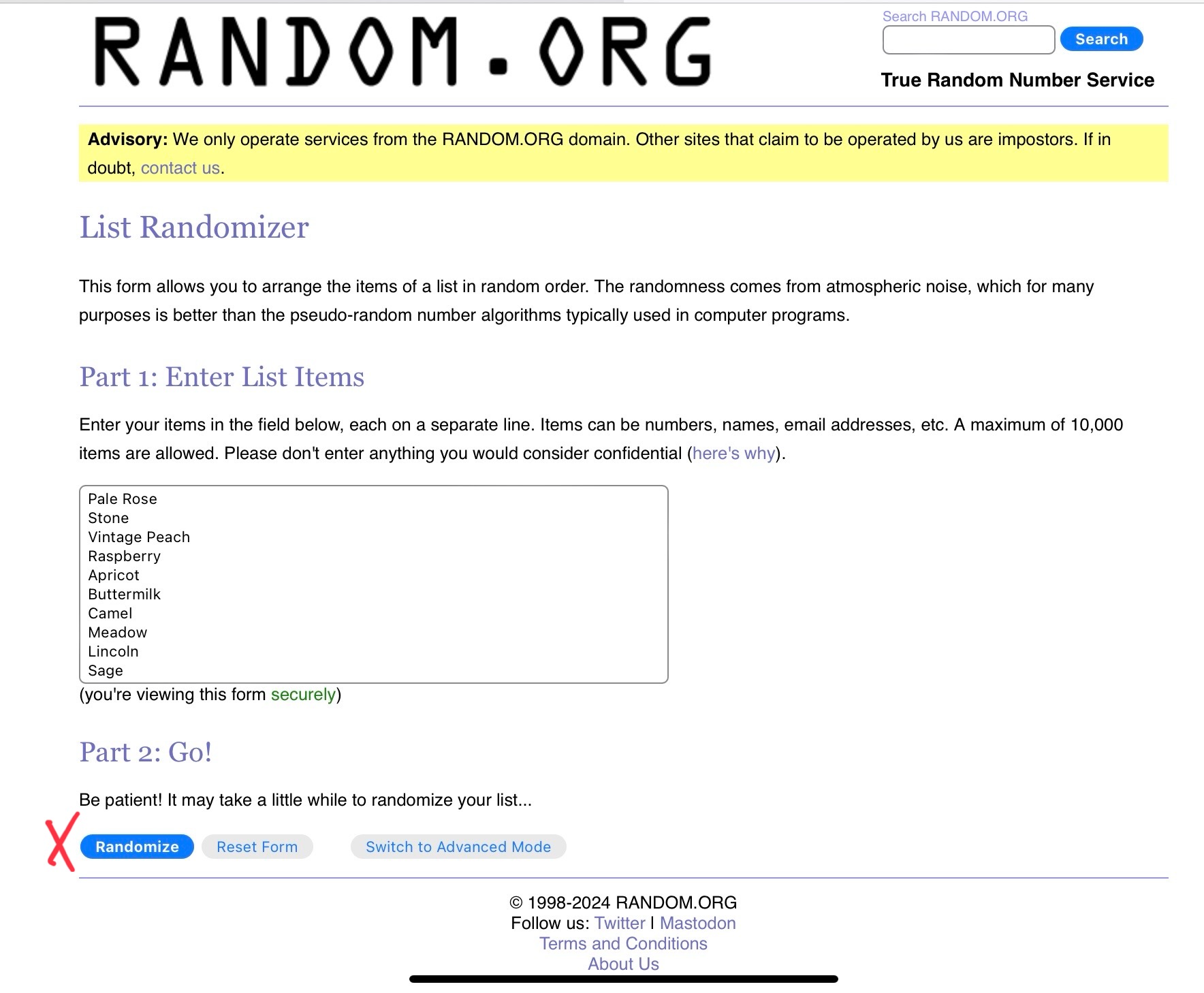
If you use random.org, you can either make your entries directly on their website or copy them from an existing list in Excel, Numbers, Word, Pages, etc.

Then just hit the button „Randomize”. Wait a moment. Copy the result back to your Excel, Numbers, Word, Pages or whatever. That’s all!

As I have seen, there are also other tools that have a random generator. These, of course, may work differently.

4. Arranging the squares

The result the randomizer gave me was – surprise – a list of the 25 numbers in random order: 19, 7, 13, 24, 4, 12 …

I arranged my squares exactly in this order.

I picked square #19 (from my list I knew it had the colour combination Storm Blue, Vintage Peach, Sage) and, following my layout grid, put it on place #1. Square # 7 (Pale Rose, Raspberry, Buttermilk) moved on place # 2, and so on …

Here is the result:
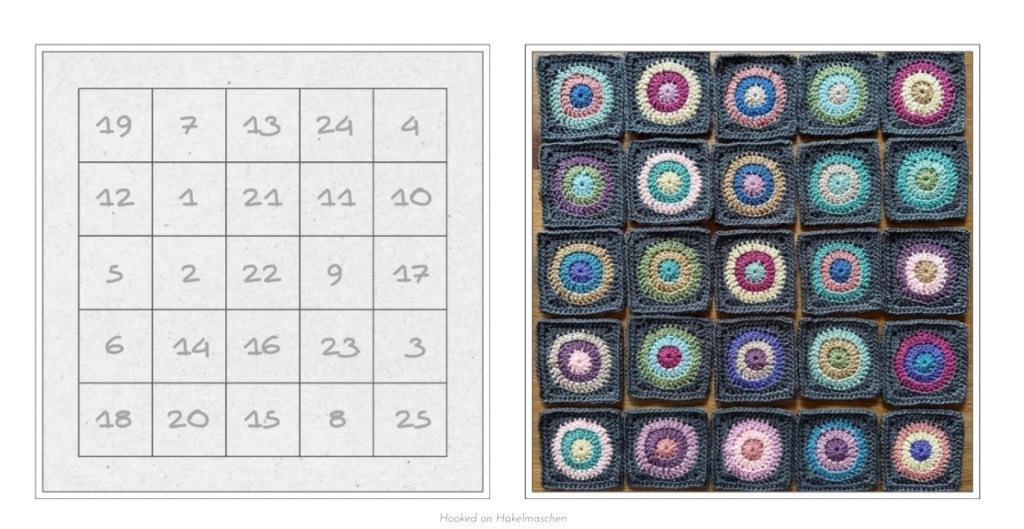
Random layout grid
Random Layout

Left side the layout grid with the numbers in the order the randomizer gave me. And right side the corresponding squares.

Not bad, is it?

5. Changes

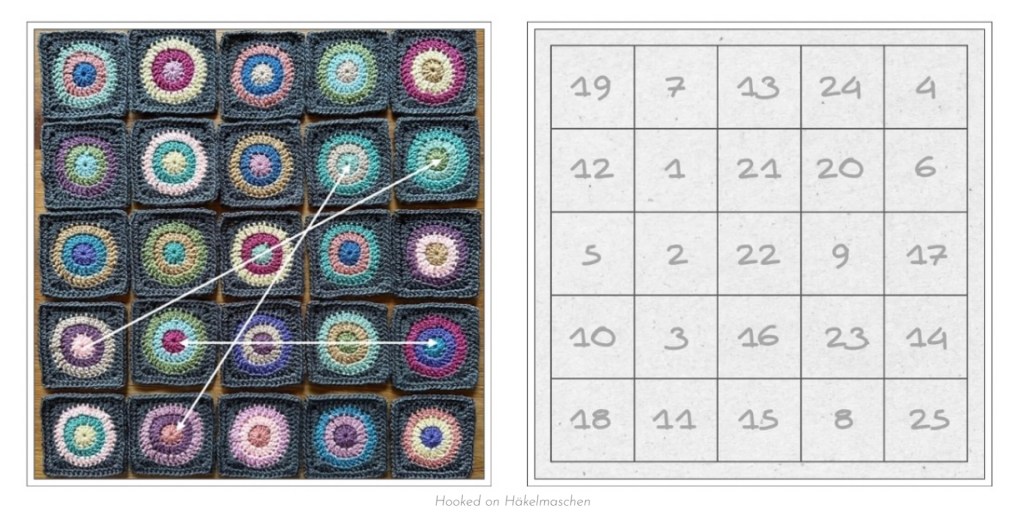
I only made 3 changes by switching some of the squares to make the colour arrangement a bit more balanced. And voilà …
Final layout grid
Changes and final layout grid

Left side the changes I made and right side the final layout grid.

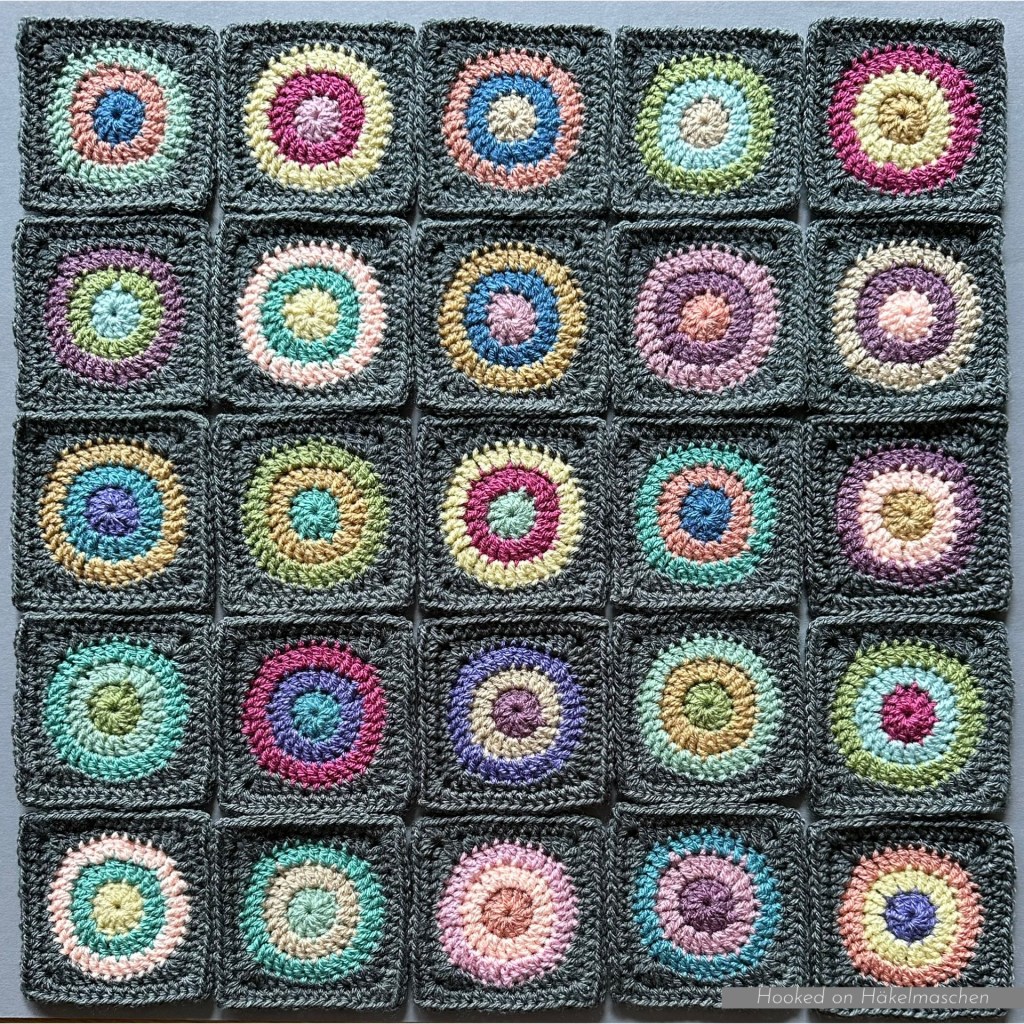
My final Layout
My final layout

Colour Details

For all those who are interested, I have listed all the colour combinations and the corresponding layout:

Listing of Colour combinations

All colours are from Stylecraft Special DK. For squaring the circles I used the colour Graphit.

My Conclusion

Even though I initially had my doubts, a colour combination created with a random generator works surprisingly well.

It is definitely a great way to arrange colours in simpler shapes, such as Granny squares, Triangles, Hexagons. Shapes, which you want to highlight the colours more than the stitches.

Presumably this method cannot be used for every design. I could imagine that it might not work so well with detailed and structured patterns. Afghan squares or blankets where the colours serve to highlight the design. However, I haven’t tried it yet.

And random placement of different squares etc. works great as well. At least it gives you a good basis on which you can continue to work.

And, the best thing is, if you really don’t like something, you don’t have to use it. And you can make changes at any time.

In any case, the randomizer helped me a lot and was a great support. I will definitely use it again!

The only thing I would perhaps change:
For a layout, I wouldn’t number my squares (only) in an Excel or Numbers table. I would simply pin small pieces of paper (in this case: yes!) with the corresponding numbers on them. That probably makes the subsequent sorting a lot easier.
Unfortunately, I only came up with this idea afterwards. My snuffy head was probably to blame :).
See you soon, hopefully with some further progress on my wall hanging 💕

I needed a bit of colour – Colour Experiment Part 1

Experimenting with Random Colour Combinations in Crochet

Lately I’ve been having incredible difficulties putting together the colours for a project. Ok, that’s never really been easy for me. But I’ve never found it as difficult as at the moment. I thought about making a new Gretchen but I am not even able to find two colours that would work together ant that I like. It feels like I’ve already used every colour combination before – I can’t think of anything new.
Maybe I just need to step out of my comfort zone and opt for colours I don’t normally use? Yes, maybe, but that’s really difficult!

Anyway, this gave me the idea to experiment a bit with colours and try something I’ve wanted to try for a long time

Random colour placement

I’ve read about it several times, but I’ve never gone into it in depth.

If you crochet simple shapes – such as grannies, circles or triangles and so on – and work with a lot of colours, there are countless ways to arrange these colours. And – you have probably noticed that too – you can achieve different effects with the arrangement of the colours. In my eyes a colourful granny blanket, for instance, looks best, when the colours are randomly put together. But how to achieve this?

To obtain random colour combinations, you can of course first list all possible combinations of the colours you are going to use. The easiest and best way to do this is probably with an Excel, Numbers, or Google spreadsheet. But I am afraid this can also get complicated. For instance: assuming you make a motif with 3 rounds, each round in a different colour (which should only appear once), and you use 5 colours, then there are already 60 possible colour combinations. The more colours and/or rounds, the more complicated the list becomes.

I haven’t tried this yet, so it’s just theory. But beyond that, I wonder what would happen if I couldn’t use all the colour combinations for my project. I would probably choose the ones I like best. Would that influence the overall impression?

However, I wanted to try something different for a random colour combination. I had read about a website that has a random number generator: random.org. They offer different services, including a list randomizer.

For my colour experiment I had thought about crocheting circles. Each circle with 3 rounds in different colours.

My colours and the random outcome

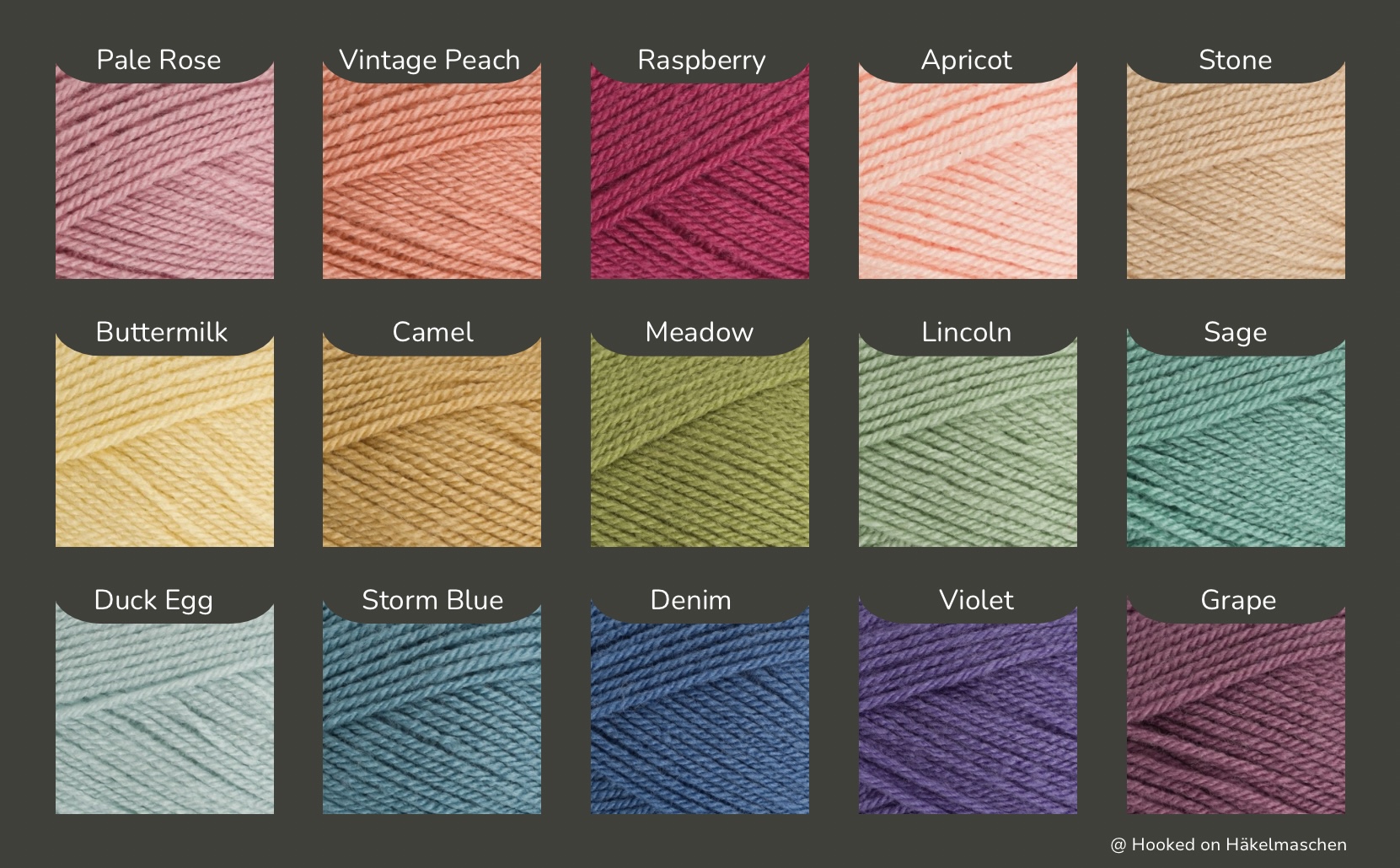
I picked up some of my little balls of leftover yarns and added some colours from my stash that I had never used so far, such as Stone, Camel, Lincoln and Violet. In the end I had these 15 colours that I thought might look good together.

All colours Stylecraft Special DK

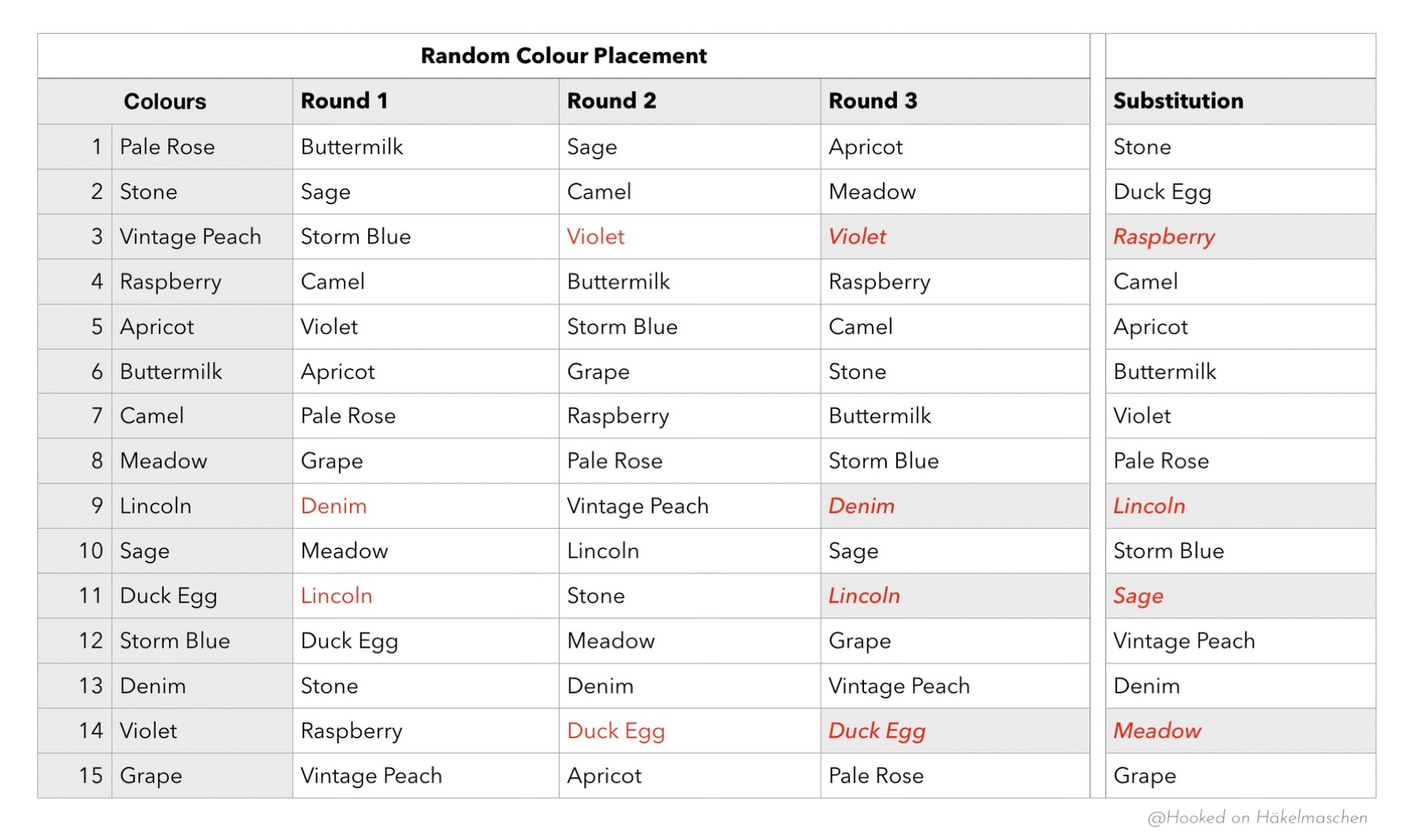
I listed all colours in a Numbers spreadsheet (shown in the picture below, first column). Then I copied this list to the list randomizer in random.org.

After hitting the button ‘Randomize’ I had the first result in no time – all my colours listed in a random order.
I copied this result back to my Numbers sheet, filling the column for Round 1 (see picture below).

Hitting the button ‘Again!’ in the randomizer and gave me another random list of my 15 colours. I copied this result back to my Numbers table filling the column for round 2.

Then I repeated this step once more to get the colours for round 3.

This way I got 15 unique colour combinations.

Unfortunately I had to realise that, based on the result, some colours would appear twice in one motif. Since I didn’t want this to happen, I repeated the steps described above a fourth time and entered the result in the ‘Substitution’ column. Now I was able to replace the duplicate colour with the substitution colour.
For example: instead of Storm Blue, Violet, Violet I used Storm Blue, Violet, Raspberry.

My Numbers Spreadsheet

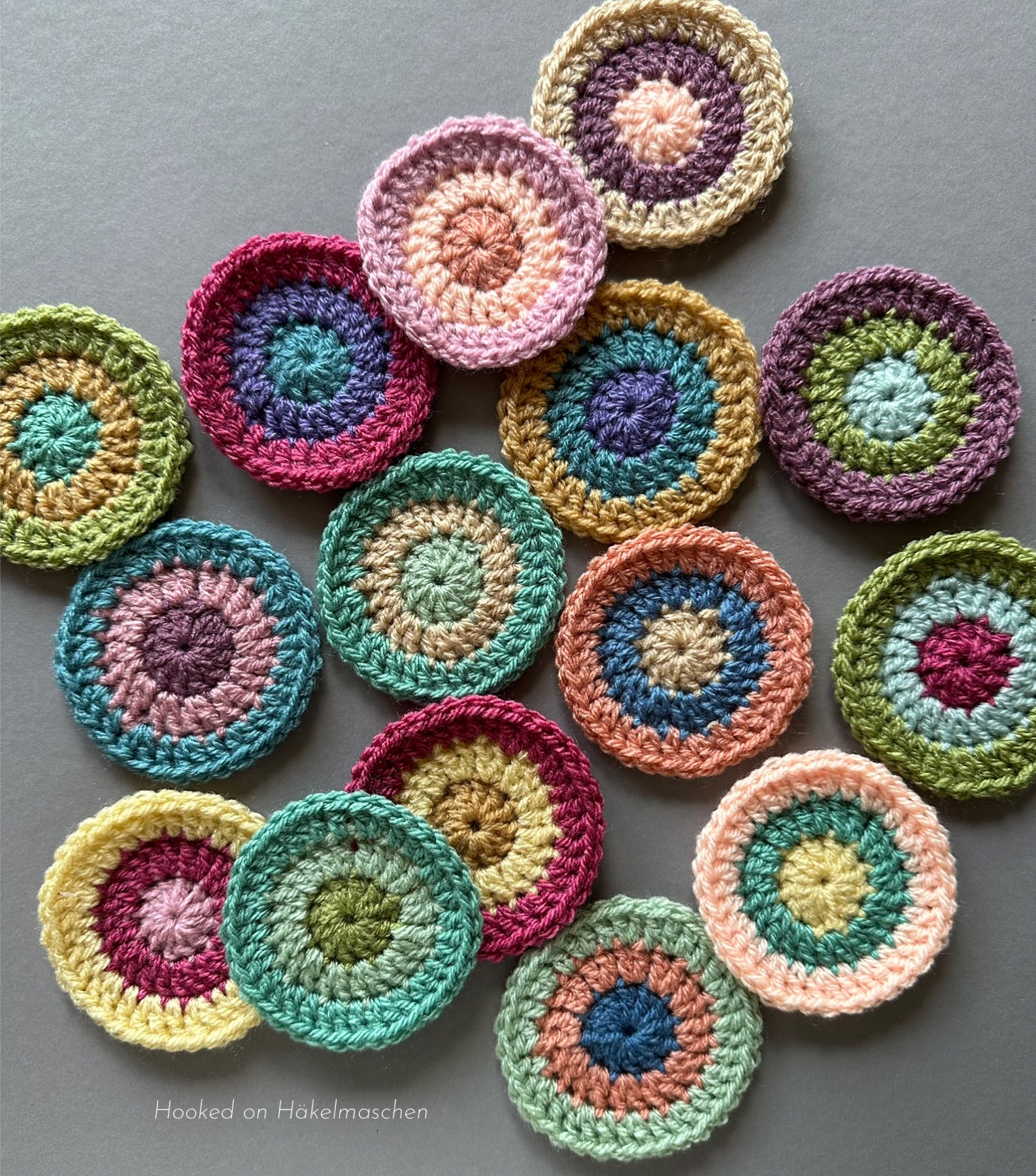
When crocheting, I strictly followed my list and this is the surprising result:

To be honest, I was VERY surprised at the result. There are colour combinations that I would never have put together myself. Nevertheless, I think every single one looks absolutely beautiful!

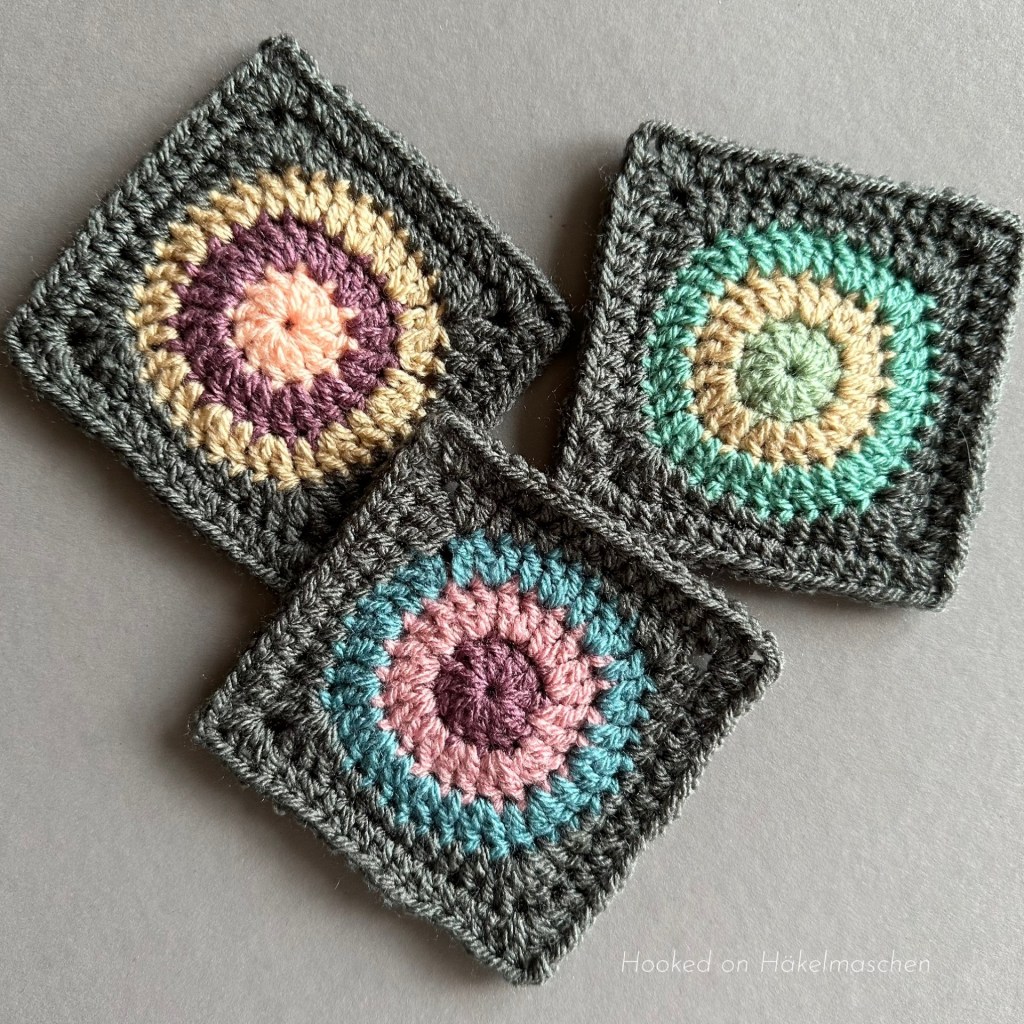
Afterwards I repeated my random selection – same steps as described above – and crocheted another 10 circles. You can see the result in the cover photo above. Here, too, I was not disappointed by a single one!!

My 25 circles are meanwhile all turned into squares. I used Stylecraft Special DK in Graphit as I thought a dark colour would showcase the colourful circles best.

Yep – a lot of tails to work away, but all done! My squares could do with a bit of blocking though. But so far I am very happy with my experiment!

Now I will have to think about the best way to join them AND what to do with them once they are joined. I can imagine either a wall hanging or a cushion cover. I’m not sure yet …

Anyway, I will let you know. And of course I will provide some information on how I made the circles / squares and what my layout looks like!

See you next time 💕

Oh look – A Snowbird …

Em … to be honest, I had no idea what kind of bird a snowbird is as we don’t have them in Europe. I had to ask Google and the answer was that nowadays many different birds in Canada are called snowbirds and indeed, Google showed me a lot of different pictures. But originally “Snowbird” was the name for a Junko. Do you know them?

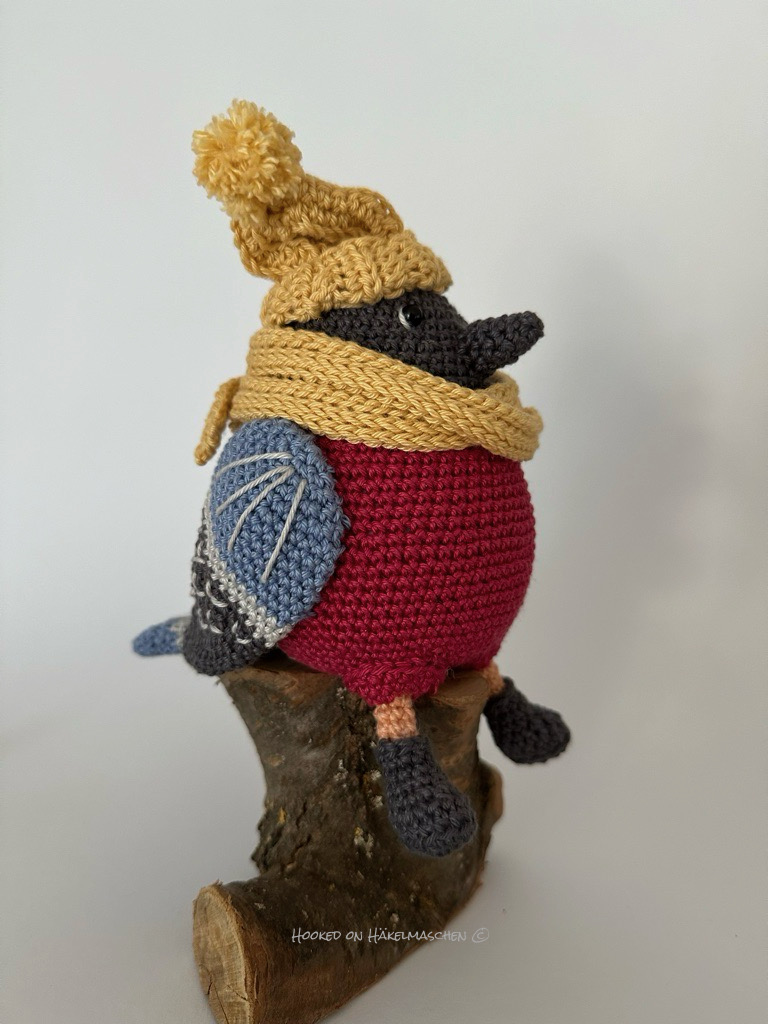
However, I would like to introduce you to my new flatmate: little Snowbird.

This cute snowbird is part of the pattern Winter Birds 2 from @natura_crochet. I spotted it on Instagram last year. It was sometime before Christmas, so I got it myself as a present.
The pdf is more like a booklet than a single pattern. It is beautifully designed and contains patterns for three different birds: Kingfisher, Waxwing and a Chickadee – plus the Snowbird as a bonus pattern. All birds are very colourful and wintery styled with hat and scarf.

I used Schachenmayr Catania and Wenco DIY (a German brand) with a 2,25 mm hook. Both are 100% Cotton sport weight (#2) yarn with a yardage of 125 m / 50 g.

On my desk: ready to assemble

My colours are:

  • 429 – Anthrazit / Catania
  • 434 -Nebel / Catania
  • 258 – Erdbeere / Catania
  • 206 – Honig / Catania
  • 51, blau / DIY
  • Head – Anthrazit
  • Body – Nebel, Erdbeere
  • Wings – Blau, Nebel, Anthrazit
  • Tail – Blau, Nebel, Anthrazit
  • Legs – Anthrazit, Honig, Erdbeere
  • Beak – Anthrazit
  • Hat / Scarf – Honig

I made some small adjustments to the hat and the scarf. I made the scarf a little shorter and narrower and the hat a little wider – it just worked better with my yarn.

I have to confess, I was a little hesitant about sewing the parts together. I don’t have much experience in assembling such small parts. So they So they have been lying in my basket for days (weeks?). But the placement etc. is well explained in the pattern and all went well!

I am absolutely happy with the result. Just started the Waxwing …

Have a lovely time 💕

Tunisian Crochet Heart

A while ago I came across this pattern on Ravelry: Tunisian Crochet Heart by Joy Clements from Crochet Road. Cute little hearts made in a combination of Tunisian and regular crochet.
I lately rediscovered my love of Tunisian crochet and dug out my Tunisian hooks, so of course this pattern caught my eye… But to be honest, what really convinced me to try it was a picture I saw on Ravelry: these little hearts are not only a perfect Valentine’s gift, they are also perfect as a small pincushion. Plus, big bonus, you also can clip on a few stitch markers. Very handy for me! This way I can have one or two stitch markers with me – just in case I need them unexpectedly – without having to carry the whole box.

The pattern

In my opinion the pattern is absolutely beginner friendly. Everything is explained very well along with a lot of pictures and videos. You won‘t even need a Tunisian crochet hook, a normal hook is absolutely sufficient.

The pattern has instructions for the heart itself which you can use as gift hanger, bunting or whatever comes to your mind. There are also instructions for joining two hearts to give it -stuffed with some fiberfill – a three-dimensional look. Last but not least you can create a tiny heart-shaped bag.

My hearts

These hearts are quick and fun to make. So I made some in different yarn weights and qualities. I decided to stuff mine with fiberfill. I only could not decide whether I prefer them more or less stuffed. So they all look a bit different.

My small hearts are made with Cotton sport weight yarn and my 3,00 mm Clover Amour hook. They measure about 5 cm / 2 inch.

Yarn and colours are:

  • Schachenmayr Catania (100% Cotton – 125m / 50 g)
    • 263 – Soft Apricot
    • 408 – Altrosa (dusky pink)
    • 258 – Erdbeere (strawberry / red)
    • 205 – Apfel (apple / green)
  • Scheepjes Catona (100% Cotton – 125m / 50 g)
    • 520 – Lavender
  • Wenco DIY (a German brand that I bought in a supermarket)
    • 51 – blau (blue)

I probably will gift the red and pink ones for Valentine‘s Day. The green and blue one will definitely be used as pincushion.

With my left over yarn (DK yarn) from my Legacy blanket the hearts turned out about 7 cm / 2 3/4 inch. I made them with a 4,5 mm hook, but this time with a Tunisian hook. I guess it will also work with a normal crochet hook – personally I just found it more comfortable with a Tunisian hook..

Yarn and colours are:

  • Drops Lima (65 % Wool, 35% Alpaca – 100 m / 50 g)
    • 100 – Off White
  • Drops Merino Extra Fine (100 % Wool – 105 m / 50 g)
    • 15 – Light Sea Green

I am just thinking about making some bookmarks using just a single heart. Maybe decorated with some embroidery? I probably will have to try it …

In case I have inspired you, the pattern for this little cuties is available on Ravelry.

If you love to crochet hearts just like I do, you might want to have a look at the ones I did last year.

Happy Valentine‘s Day ♥️

Something nice and small – Still feasible before Christmas

Are you celebrating Christmas and still looking for a little something to give as a gift or decorate? These two crochet patterns, Glittery Christmas Baubles and Sparkly Stars, are really quick to make and look fantastic.
I’ve had a lot of fun crocheting them over the last few days and have found them quite addictive. The yarn you use will make them look very different, so they don’t necessarily have to look Christmassy. It all depends on your preference.

Both patterns require very little yarn, so they are great for using up any leftovers.

Glittery Christmas Baubles

The pattern is from Ana Morais Soares from One Skein of Love.
As the name of the pattern applies, Ana has used glittery yarn in some parts. I did not have anything with glitter on hand – so mine are made with some leftover yarn from my Legacy Blanket.

A little side note: Yes, my Legacy Blanket is finally finished! To be precise, it’s been finished for about a fortnight now, but I haven’t managed to take some nice pictures yet. The weather here is mostly pretty grey at the moment – clouds, rain, or fog. I hope it gets better in the next few days!

Back to my baubles, I think they clearly show what I meant at the beginning – they look more rustic than glittery and Christmassy.

I’m totally in love with this look!

I used

  • Drops Lima (100 m / 50 g) – colour 100, Off White
  • Drops Merino Extra Fine (105 m / 50 g) – colour 07, Light Brown
  • Drops Merino Extra Fine (105 m / 50 g) – colour 15, Light Greyish Green

with a 3,5 mm hook.

The bauble itself consists of two halves that are sewn together. First, you crochet the two halves, then you join them together while inserting the bauble.
Ana used a Christmas bauble for this. Unfortunately, I didn’t have one that was the right size. So I put a polystyrene ball inside mine. It’s a 7 cm (2 3/4 inch) ball. The circumference is about 22 cm, just over 8.5 inches. It fits perfectly!

Of course, you can use various decorative stitches to join the two halves. Alternatively, if you prefer not to stitch them together, a crochet join, such as a simple zipper join, works very well.

I tried different joins, and the one shown on the left is my favourite.

It is made with slip stitches worked through the back loops. On each half, I inserted the hook top down, from outside to inside. I started with a slip stitch through the back loop of a stitch on the lower half, then slip stitched through the corresponding stitch on the upper half. And so on … It creates a nice kind of braided effect.

Sparkly Stars

Sparkly Stars is a pattern by Joy Clements from Crochet Road, which I spotted on Ravelry. These five-pointed stars are as quick to make and as addictive as Ana’s baubles. They can also be used simply as winter decorations.

Here, too, the final look can be influenced by the yarn and colours used.

The pattern offers two different sizes, contains detailed pictures and also a link to a video tutorial.

I used the same yarn and colours as for the baubles, but this time with a 4 mm hook. So again, no sparkle or glitter.

My small stars are about 9 cm and the tall ones about 14 cm.

Both patterns, the Glittery Christmas Baubles and the Sparkly Stars are available on Ravelry.

Glittery Christmas Baubles on Ravelry
Sparkly Stars on Ravelry

I will definitely make some more baubles and stars using different yarns.

Have a lovely time 💕

More Squares of my Legacy Blanket

Progress with my Legacy Blanket. The joining comes closer, 11 of 12 squares are finished now. All tails worked away and most of them already blocked!
I also revised some of my colour placements and am happy with the result!

Besides Pam just released the pattern for the Justyce Destany Border .

I was happy to help testing the border pattern. Although my blanket is not finished yet I am able to show you a sneak peek of the border.

For testing purposes I used two of my ›old‹ squares which I made right at the beginning of this journey: Drops Merino Extra Fine #50, Light Beige as main colour, #06 Brown Mix and #07 Light Brown for contrast. I discarded this colour scheme after I had worked the first two squares – somehow I didn’t like it. But – advantage – it gave me some ›leftovers‹ for testing the border.

And here some of my finished squares

Madux James

Brixton Carter-Lee

Marley Mae

Jalen Miles

Carter Jude

Olivia Grace

So far so good!
Lauren Rose (one of the revised ones) and Brood of Angels are still on the blocking board. The last one to finish is Macey Ann. Actually, Macey Ann was the very first Legacy Square I made. So it still has the ›old ‹ colour scheme and – besides now being part of my border patch – needs to be redone.

All patterns for the Legacy Blanket are available in Pam‘s Ravelry store.

Have a lovely weekend 💕

Happy Granny Square Day 2023

Today is Granny Square Day!

It looks like Granny Square Day has become a kind of tradition in the crochet world. Since 2014, every year on 15. August, people from all over the world post their (Granny) squares on social media, mainly on Instagram. The original idea was, that all the squares together on IG would look like a colourful Granny Square blanket. Just search for the hashtag #grannysquareday2023 and you will see what I mean.

Last year I posted Ana‘s Sweet Marigold Square. She designed it especially for the Granny Square Day and I had the pleasure to test the pattern. This year I decided to show one of my own designs.

One of my own designs sounds a bit like having a huge pool of designs to choose from – he, he.
In fact, I don‘t!
Sometimes it just comes over me and then I grab my yarn and hook and start combining stitches … I am still learning … Sometimes something emerges that I like and perhaps develop further. Sometimes I just discard everything …

This is how the small square here was “born”. Something I like and thought I could at least show on Granny Square Day. ( It is based on my very first square that I designed over a year ago, but never showed anywhere. )

So far it doesn’t have a name – and no finished pattern, only my notes. I do not yet know exactly what I will do with it.
It’s a 6″ square, maybe I’ll develop it further into an 11″ or 12” square? And combine both, the small and the big one to … ??? We will see!

First I need to write down the pattern properly and maybe take some detailed photos. And think about a name! So there is still a lot to do.

My sample is made with Hobbii Rainbow Cotton 8/6, a DK or Light worsted yarn. Colours are Jeans Blue (#29), Light Jeans Blue (#28) and Pearl Gray (#73).

I hope you like it!

HAPPY GRANNY SQUARE DAY!


Some Easter decorations

I am sure you all know the times when suddenly ‘life happens’. Well, it just happened to me – a bit unexpectedly! So during the last two – almost three -weeks I had only very little time to crochet and, to be honest, only little desire to do it.

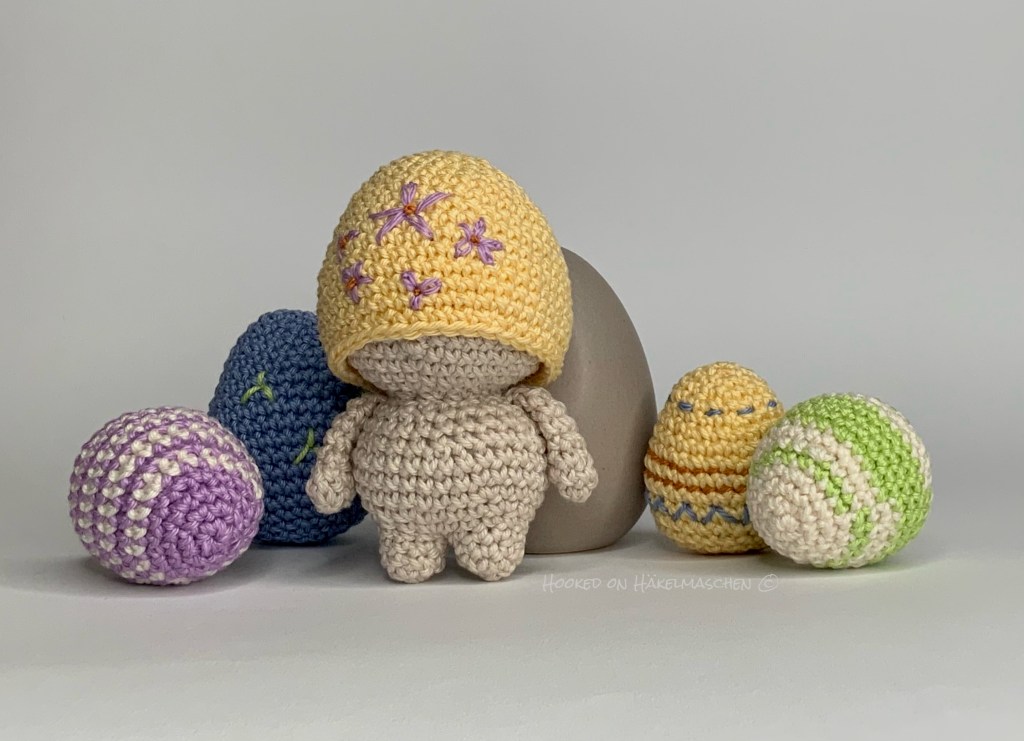
Nevertheless I’d like to show you some of my Easter decorations that are really quick and easy to make.

I made these back in 2021. Patterns are The Easter Dudes, a paid pattern by missBerlin and Easter Eggs, a free pattern by Tatiana Saienko from Planet Piu.

You can read all the details in this post.

And – as a kind of return to the world of crochet – I am just working on a 2023 edition.

As usual my Dude is made with Scheepjes Catona in the colour 505, Linen. But this time I decided to use the same colour for the Dude‘s Cap and the Easter egg – it is Schachenmayr Catania Trend in 507, Salbei (Sage).

I hope to get the Dude assembled today and then I will have to think about some embroidery. Still not my best discipline … so I guess it will be something simple and easy …

Have a lovely week 💕

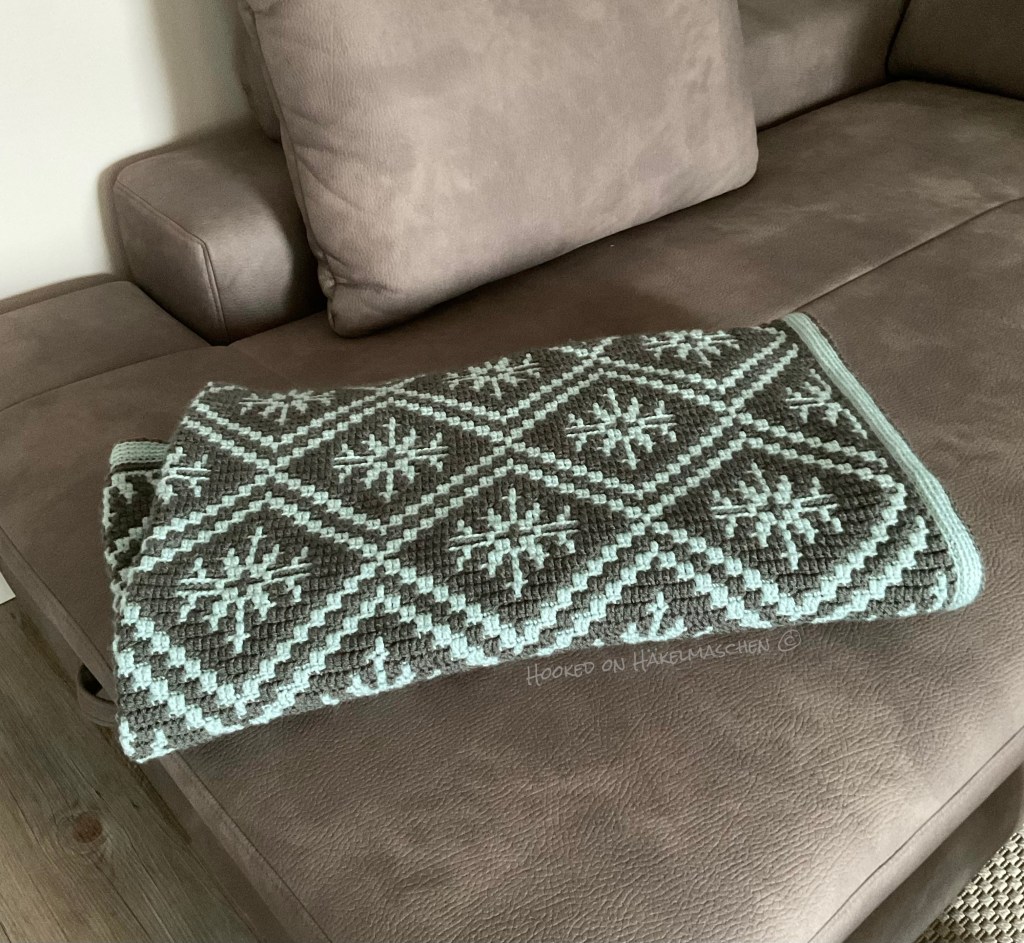
Midnight Snowflakes – My blanket is finally done

Unbelievable, but yes!
Today I gave the finished Midnight Snowflakes blanket to hubby. Just in time for his birthday next week!

Besides all the testing and other projects it took a little over a year to get it finished. I started it on 16. January 2022. And I still remember how hard it was to choose the colours! Oh dear! You can read all about my colour odyssey here.

I really love how it turned out, I loved working on it andI love the colours! Yet, I still can imagine it in white and grey …

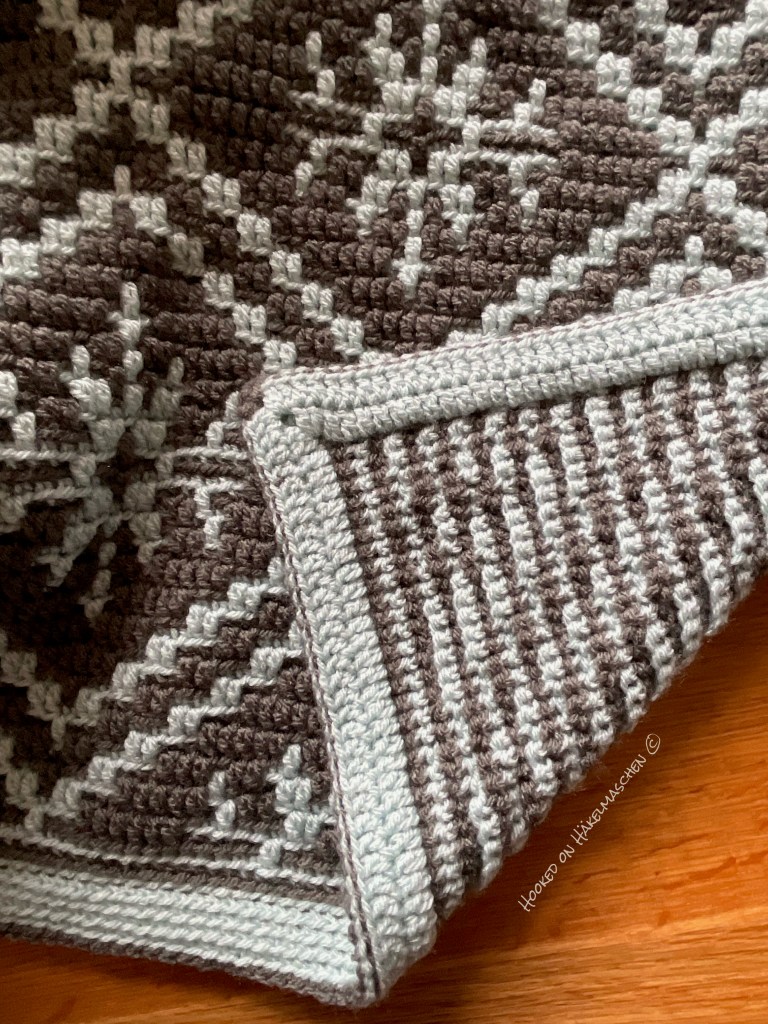
I used Scheepjes Color Crafter, in the colour Rotterdam and Stylecraft Special DK in Duck Egg. The border is made in Duck Egg – and the joining round in Rotterdam.

You probably know this feeling when a long project is finished. You feel a bit empty – at least I do. I have to think about something new to work on in between! Yet no idea what it will be…

If you got inspired – the Midnight Snowflakes pattern is available here

Have a lovely week!

Hearts, hearts, hearts

Are you looking for some quick makes for Valentine’s Day? I found some free patterns for crocheted hearts that are really quick and easy to make. They are perfect for lovingly decorating a gift!

It started when I was looking for a certain document in my ‘pattern stash’ last week and stumbled across a pattern I had saved – probably years ago: Crocheted Hearts by Schachenmayr. It was not the pattern I was looking for but it was that ‘oh- look what I have’-moment, so I grabbed some yarn….

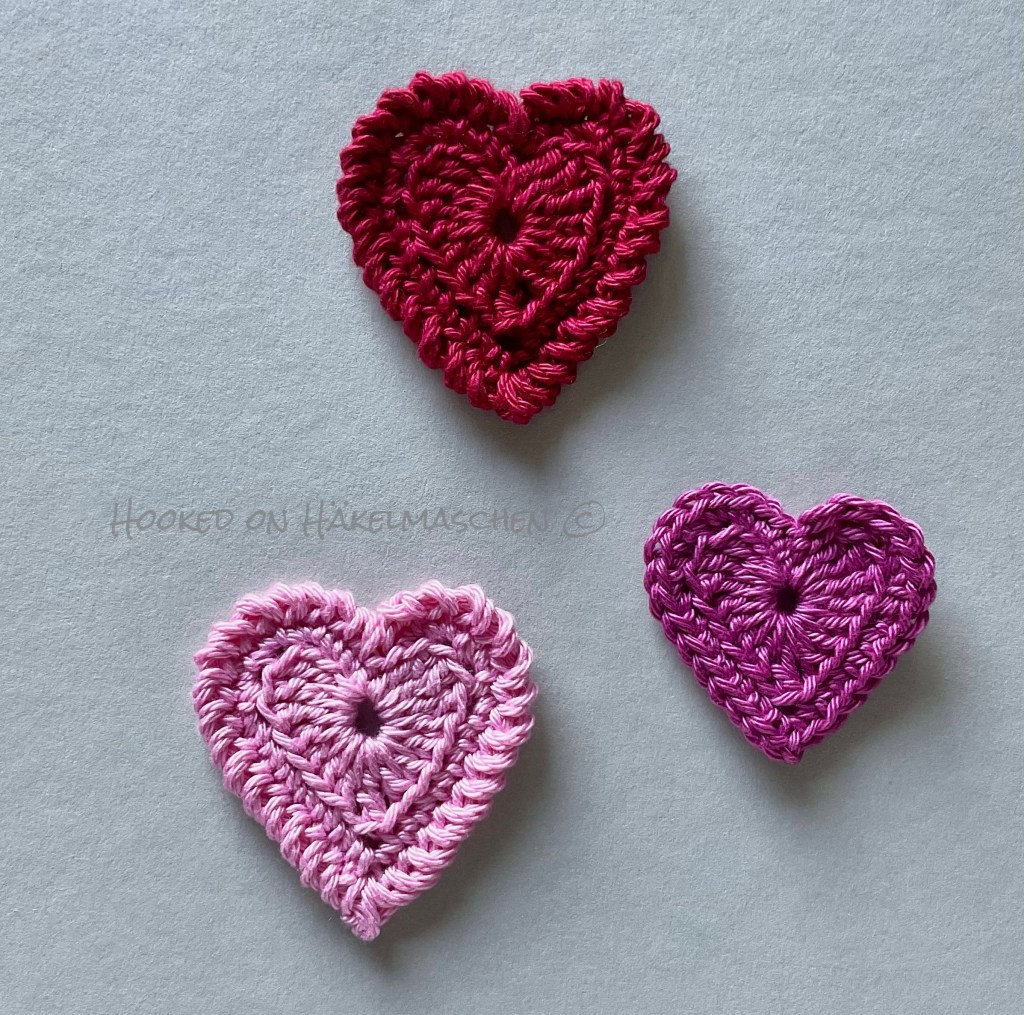
The two hearts in the bottom are made with the ‘Crocheted Hearts’ pattern from Schachemayr.
Edit September 2025: The pattern was available for free on their website. Unfortunately it isn’t any more. You can now find it here.

The Granny heart on top is also a free pattern: Heart Motifs by Emma Escott, available either on her blog Lululoves or on Ravelry.

I used Schachemayr Catania in the colours # 192, Weinrot and # 222, Orchidee (the two Schachenmayr hearts) and Scheepjes Catona, colour # 251, Garden Rose (the Granny heart).

Another lovely – and free – pattern I found is the ‘Heart and Soul Ornament’ by Maria Molodova. It is available in her Ravelry store.
Originally this heart is made with three rounds (I especially love the last one, twisted single crochet) but I think it also looks very nice when done with only two rounds or even only one. The tiny hearts in my cover picture are also made with this pattern.

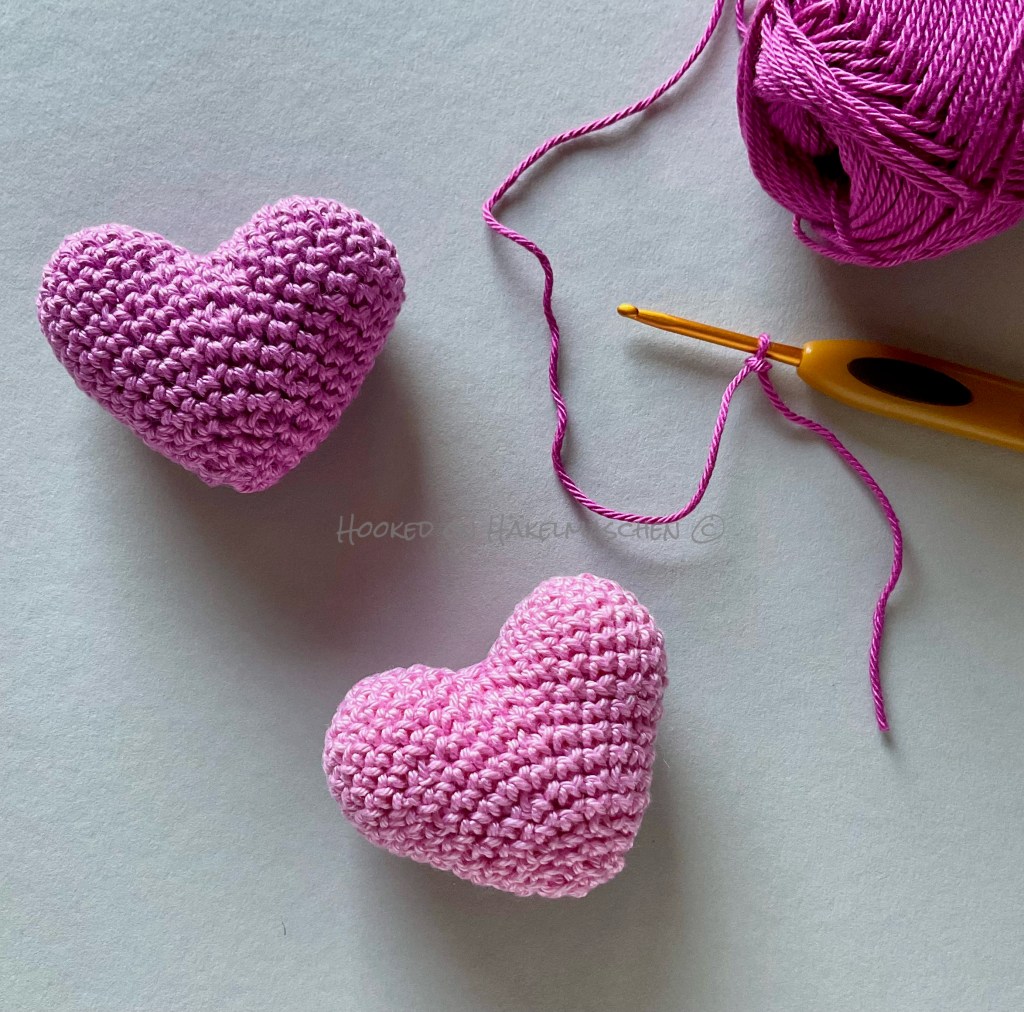
And last but not least: at the moment I am working on these little cuties: Little Amigurumi Hearts by Mari-Liis Lille (Lilleliis) which I saw on Instagram. You will also find this pattern via Ravelry.

Do you feel like crocheting some hearts? There are a lot more lovely patterns out there. (Unfortunately I don’t have the time to try them out all.) Have fun!