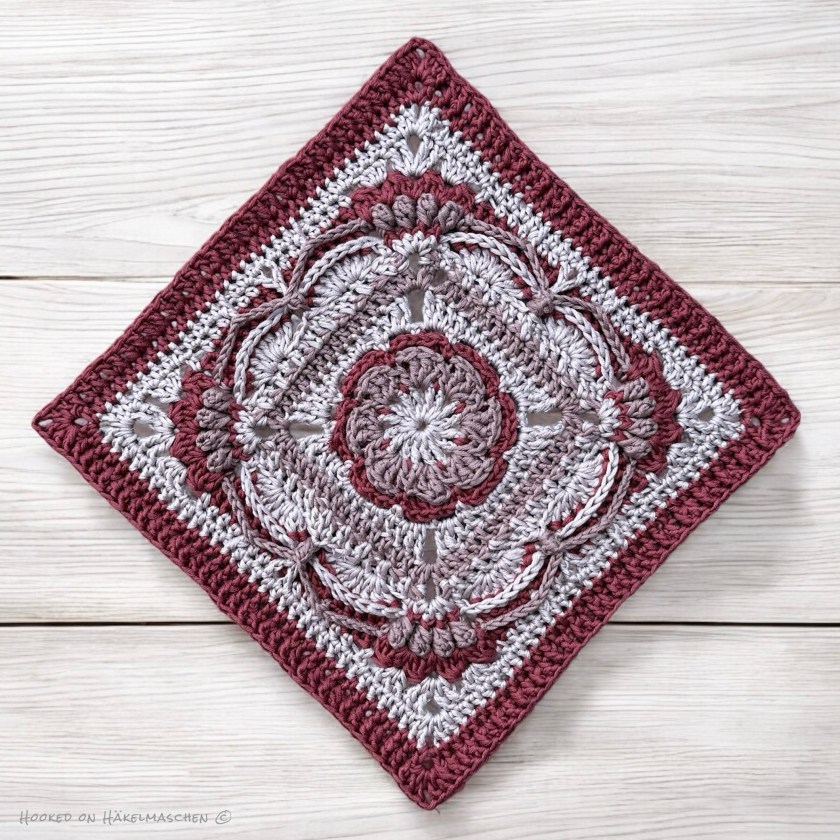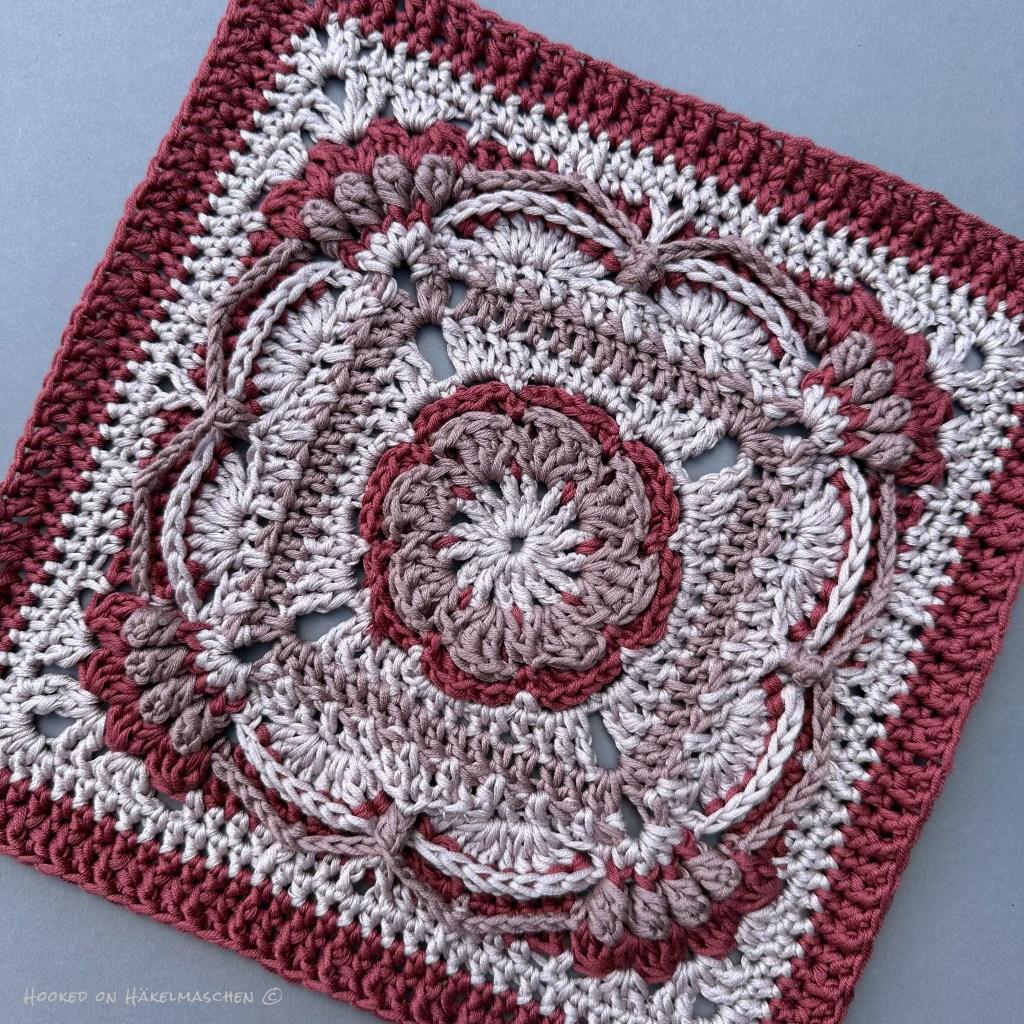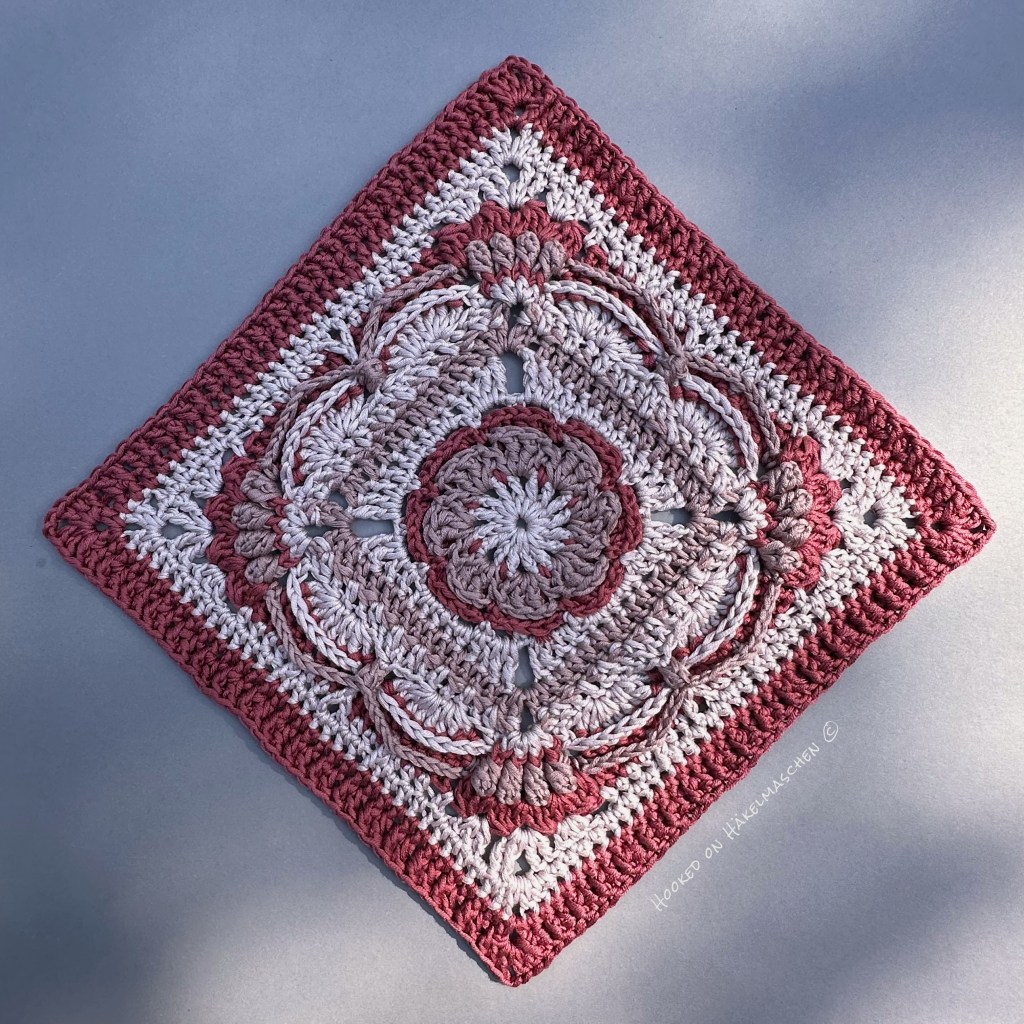
Pam Knighton-Haener from A Yarn of Serendipity just released a lovely new design: Dahlia of Yore Square, a beautiful afghan square – just look at that …

My test-version of this lovely square will follow in a few days. I am just preparing the photos!

Pam Knighton-Haener from A Yarn of Serendipity just released a lovely new design: Dahlia of Yore Square, a beautiful afghan square – just look at that …

My test-version of this lovely square will follow in a few days. I am just preparing the photos!

Last updated on January 10, 2026
About a week ago, we returned from a relaxing holiday on the North Sea coast. Those were wonderful days! The weather was cold but mostly sunny. So we had long walks on the beach … Sigh*

Back home – we live about 500 kilometres south in central Germany – we then noticed that spring is slowly arriving…
The birds start singing, the apple tree is showing tiny green leaves, and our little peach tree has the first pink blossoms. Spring time!
These first delicate shades of green and pink inspired me to bring some colour into our home as well.
Although I really don’t crochet much at the moment, I spontaneously thought of making something Easter-themed. The search for a pattern led me back to a site that I had actually discovered last year: Bomuldskys .
It is a Danish site, and Emilie, the person behind it, lives in Copenhagen. She offers both, paid and free patterns. I just LOVE her style and her designs, especially the greeting cards.
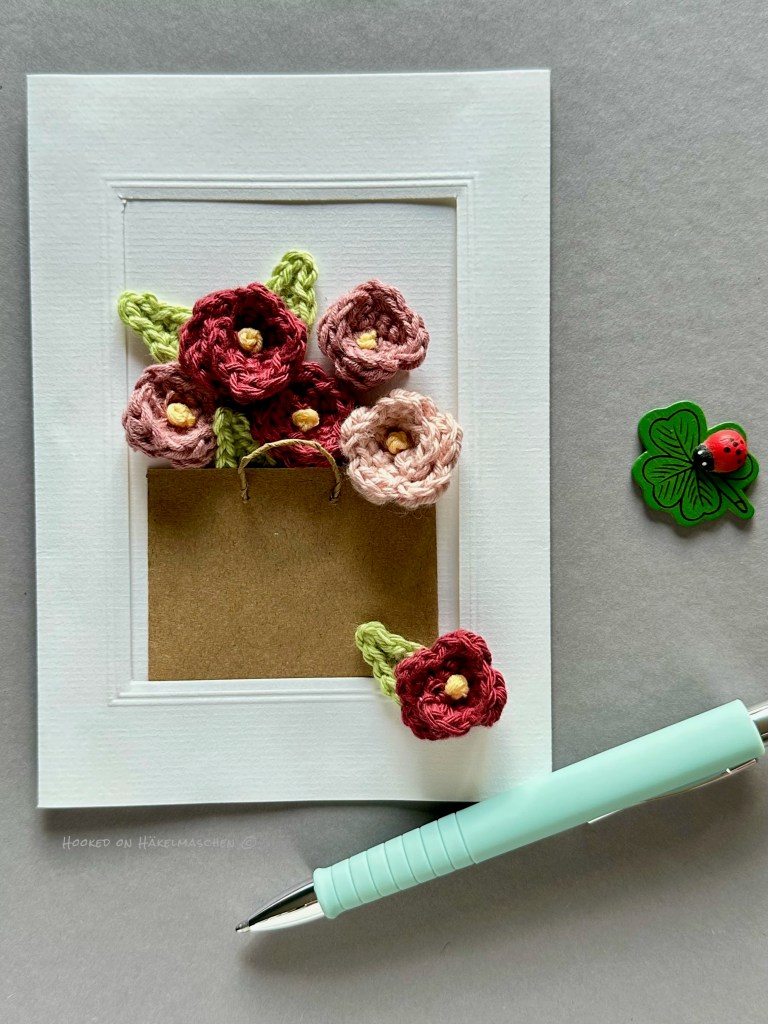
Last year I already fell in love with one of her Christmas designs. Due to my eye problems, however, I didn’t have the patience to make it. This time Summer Flowers caught my eye. It is a pattern for a greeting card that shows a bunch of roses, tucked in a paper bag. The pattern is available for free on her website and I just had to try it!
The pattern is written in US terms. It contains the instructions for the small and the large flowers, as well as the leaves. The instructions only require a few basic stitches. I found it easy to understand and I think it should be doable even for beginners. And it’s really quick and easy to make!
I used a mixture of different cotton yarns from my stash. All are classified as sport weight (#2) yarns. I worked them with a 2.5 and 2.75 crochet hook.
Please note: you will find some detailed notes about the hook sizes at the end of this post.
Please note: I got the Cotton King some time ago as part of a colour pack from Hobbii yarn shop but it looks like the brand doesn’t exist any more.
For the greeting card I made
I found a suitable card and paper (for the little bag) in the stationery shop. The card is a craft card with a window on the front where you can place a photo or similar. The pattern calls for an A6 card, mine was a bit different, about 12 x 17 cm (4 3/4 x 6 3/4 inch).
For the assembly of the flower bouquet I orientated myself on the instructions and the photo from the pattern.
I first made the little bag and glued it on using a craft glue. Afterwards, I arranged the flowers and leaves until I found a position I liked and glued them on.

I absolutely love the result, although I think that my ‚bag’ turned out a little too big.
I will probably use it as birthday card for a dear friend. But it would also make a nice Easter card, wouldn‘t it?

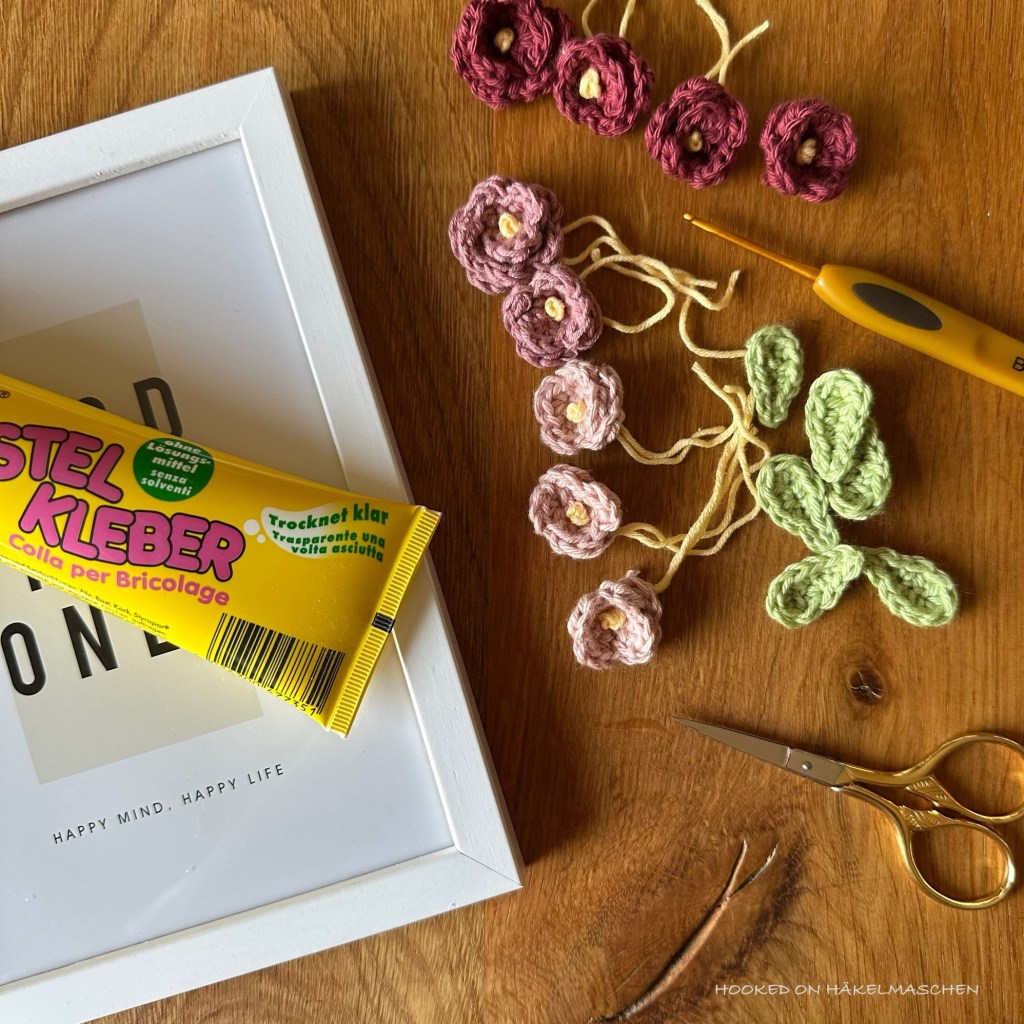
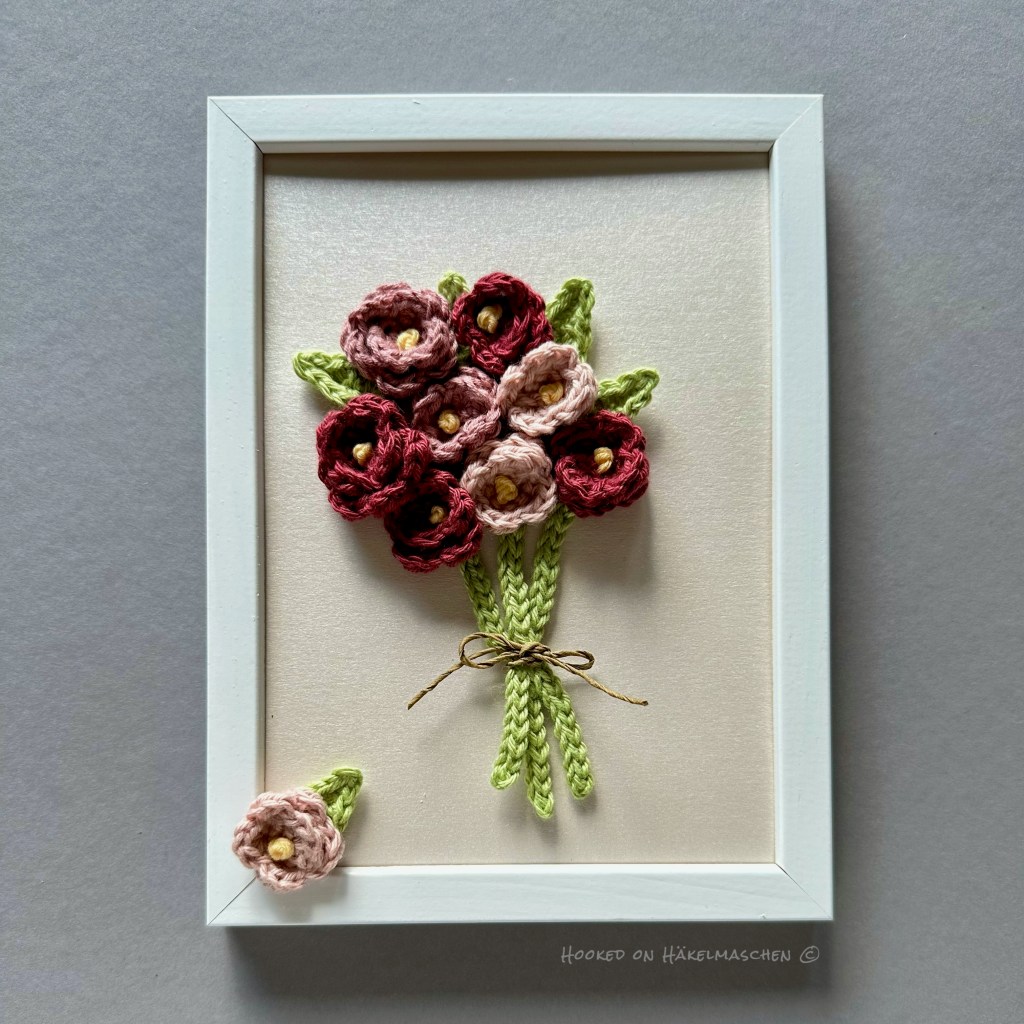
The flowers and leaves are really quick and easy to make! This made me want to do more, so I crocheted some more flowers and leaves and made a
I used the same yarn and colours as for the card. I made another
The little stems were not part of the pattern.
I just made a chain in a suitable length (mine are between 18 and 20 chains long) and slip stitched all the way back in each chain.
For the collage I got a white picture frame that is 13 x 18 cm (5 x 7 inch) in size.

First, I disassembled the frame, removed the glass, and cut a piece of cardboard to the right size. I then inserted the cardboard into the frame to create a nice background for my bouquet of flowers.
The further process was basically the same as for the card. I first arranged the flowers and leaves until I liked the placement and colour distribution. Then I glued on the individual parts. I started with the stems and then worked from the bottom upwards.
According to the instructions, a 2.0 mm crochet hook should be used. I understand the intention behind it. Amigurumi etc. Are often worked with a smaller crochet hook to obtain the necessary stability. Still, 2.0 mm seemed to me personally too small for the yarn I used. Especially as both yarns tend to split a bit when a small hook is used.
But please, don’t get me wrong! I love both, Hobbii Rainbow Cotton and Drops Safran. I especially like their softness and the matte look. I just find it difficult to work them with a smaller hook than recommended on the label.
For the card, I therefore crocheted the flowers with a 2.75 mm hook. This is the size I normally use with this yarn. At first they seemed a bit loose to me. So I went down to a 2.25 mm hook when I made the flowers for the collage. There were pros and cons: I preferred the structure of the flowers made with the smaller hook. But the ones made with the bigger hook were easier to shape.
I think you can’t see any difference in the end. So both seems to be ok.


I hope I was able to inspire you a little for a beautiful and quickly made spring decoration.
Have a nice time 💕
You might be wondering why it’s been so quiet here – so here’s what’s been going on. I’m still dealing with some health issues. As I mentioned last year, one of my eyes has been troubling me. About four months ago, my vision suddenly worsened, and my ophthalmologist diagnosed an oedema – a kind of swelling inside the eye.
I’m now receiving injections as part of the treatment (right into the eye – definitely not my favourite experience!). After each treatment, I have to give my eye several days of rest, which means no reading, no sports, no bending over, and so on. Needless to say, this limits what I can do with my crochet projects.
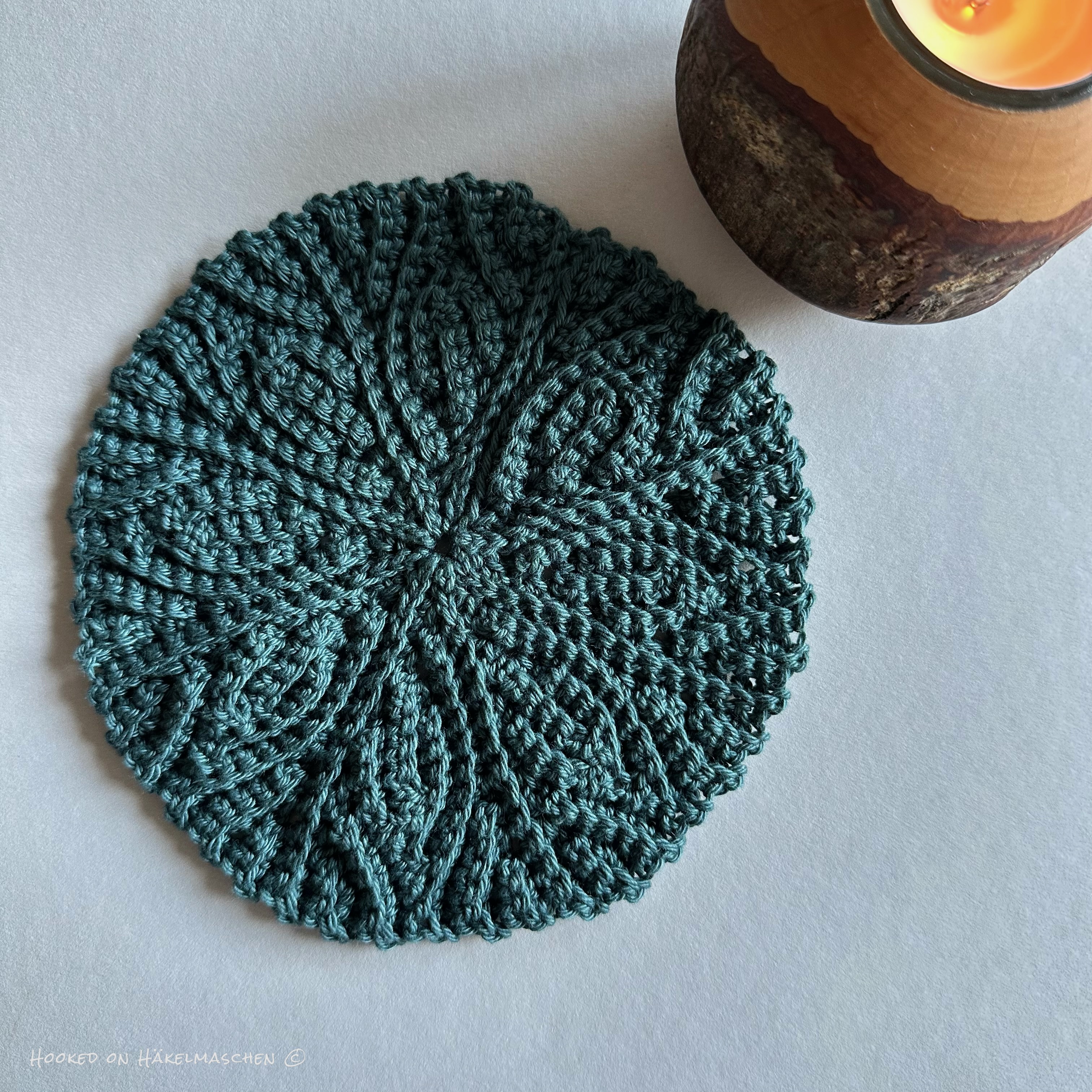
Still, I’m feeling hopeful! Subjectively, the treatment seems to be helping, but focusing on anything for too long remains a challenge. So I’m taking things slowly and sticking mostly to smaller projects for now. And yay – slowly but happily – I finally finished a set of coasters!
What’s more, this project taught me something completely new: short rows in crochet. Until now, I had only known short rows from knitting – where I‘ve often used them for shaping sock heels.
Despite the differences between knitting and crochet, the idea behind short rows is pretty much the same in both: as the name suggests, only part of a row is worked, which helps you create specific shapes. But before this project, I had never tried them in crochet at all.
Last December, I bought an eBook from Tatsiana of Lilla Bjorn Crochet, who hosted a mystery make-along with four delightful patterns: Gift Coaster, Gift Bauble, Gift Mandala Garland, and Pixel Coaster & Purse. Even though the MAL has ended, the patterns remain available on Ravelry – either individually or bundled as an eBook.
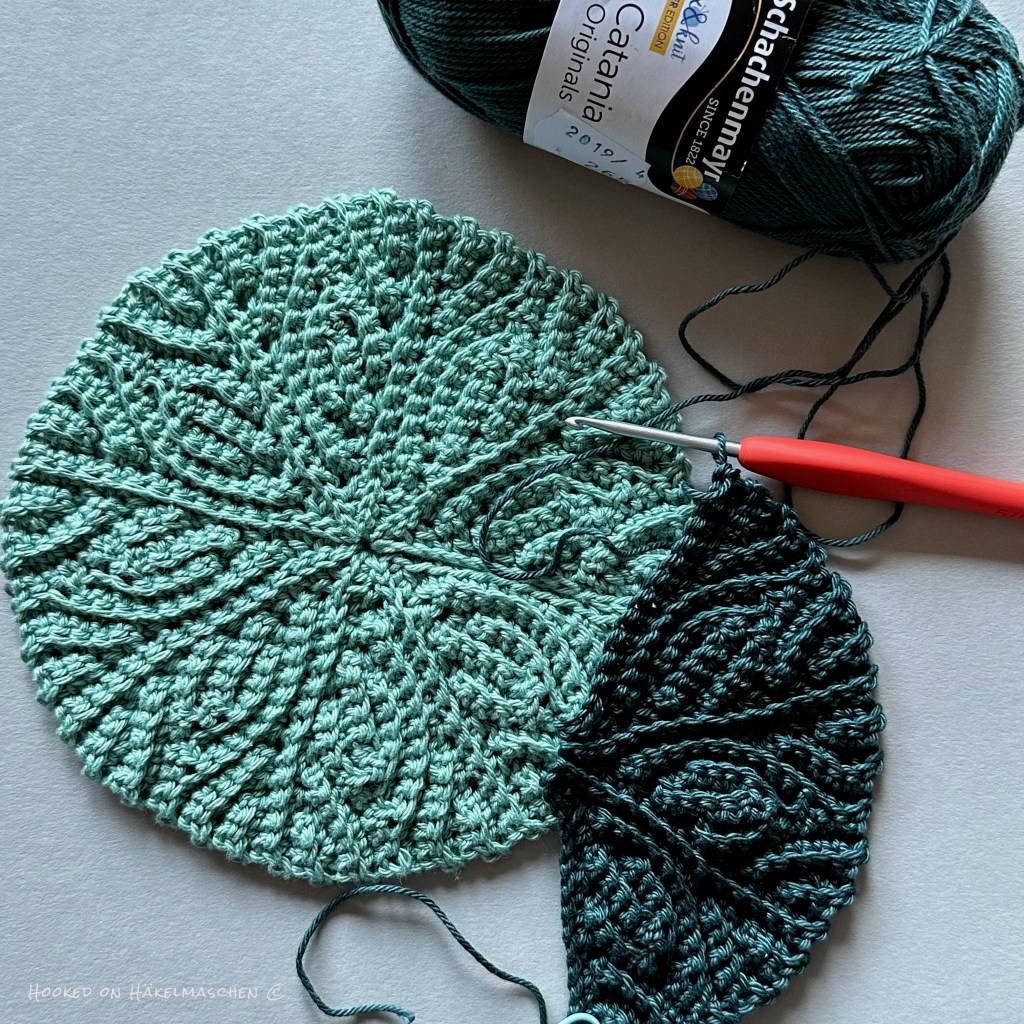
Although I got the eBook in December, it wasn’t until now that I finally had the time and energy to start one of the projects. I chose to begin with the Gift Coaster, which happens to use short rows.
I am absolutely fascinated by the effects you can achieve with short rows and working in the back loops.

The coaster consists of eight sections, crocheted one after the other to form a circle. The instructions are very detailed, and the PDF even includes a photo tutorial showing exactly where to place the stitches at the transition from short to full rows.
If you prefer visual and spoken guidance, there’s also a link to a video tutorial. Personally, I normally don’t like watching videos. But I found this one very helpful, especially the section about the joining at the end to finish the coaster.
For my samples, I used Schachenmayr Catania yarn with a 3 mm hook. Catania is 100 % mercerized cotton with 125 m / 137 yds per 50 g. It is classified as a #2 Fine / Sport weight yarn.
My colours were 0244 Agave and 00507 Salbei (Sage) – a combination I absolutely love.

Salbei was from a limited edition back in 2022, so I’m not even sure if it’s still available!
My coasters finished at about 15 cm in diameter, just as they should.


I’m completely happy with how they turned out!

I was just going through my emails and came across a slightly older email from Pam. It was from September last year and she was telling me that the book 60 Quick Granny Squares would be available on Amazon from the beginning of November 2024. Ugh, I had completely forgotten! Time to catch up!
I don’t normally write book reviews and I don’t want this to be one either. Actually it is more about some desings by Pam Knighton-Haener from A Yarn of Serendipity – a designer for whom I sometimes test.

Back in 2023 she was asked by a book publisher if she could design some 6 inch squares.
She said yes and five of her designs are now presented in this book.
I would like to introduce them – or rather my test versions of them. But first a word about the book
Unfortunately I don’t own it yet, so I can’t say too much about it. But I took a look at the extensive reading sample on Amazon. So I can at least give a brief summary:
In the preview I especially love the fact that all 60 designs – created by different designers – are shown there at the beginning! (A lot of books don’t offer this.)
All designs feature Cascade 220 Superwash yarn. It is a DK (#3) yarn, 100 % wool, with a yardage of 200 m / 100g. AND all designs look very beautiful!
The patterns are both, written and charted. Some of the squares are more beginner friendly, others a little more challenging.
In addition to the patterns, the book also describes various techniques and gives helpful tips. E.g. how to start a square, how to change colours, how to join the squares, and so on.
And there are some projects at the end for which the squares can be used.
A book that is definitely worth a second look!
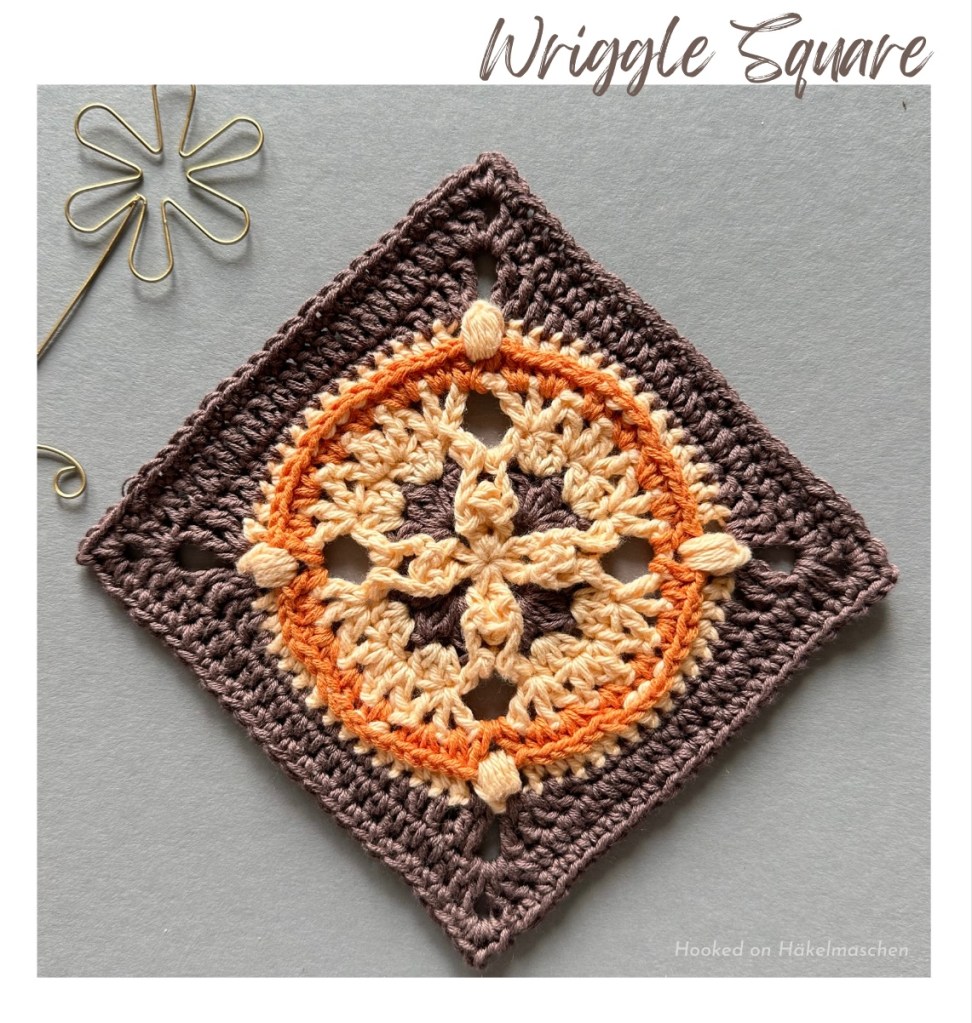
As said before Pam designed five squares for this book: Shift, Sunflower Sizzle, Wriggle, Running Routes and Sol. I had the opportunity to test these designs back in 2023.
Even though the squares are actually designed for a Double Knit yarn, I used a different yarn for my tests. Two to be precise:
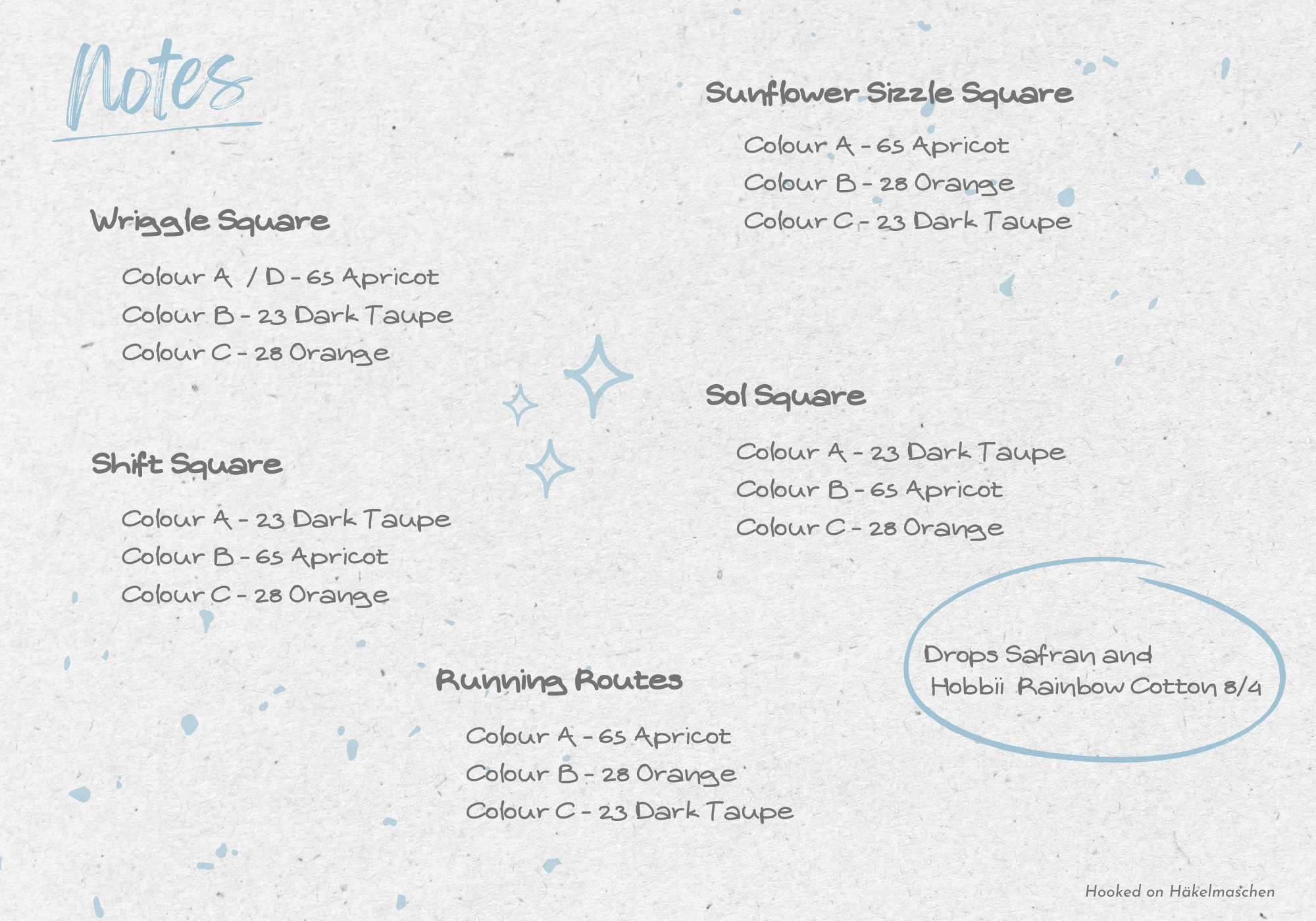
Drops Safran and Hobbii Rainbow Cotton 8/4.
Both are sport weight (#2) yarns in 100 % Cotton and have a yardage of 160 m / 50 g.
Unfortunately I had not noted the hook size I was using. I assume it was a 2.75 mm hook, I’m not sure though. Due to the thinner yarn my squares turned out about 4.5 inches, which is about 11.5 cm.
For all 5 designs I used the same three colours:
Dark Taupe and Orange from Drops Safran and Apricot from Hobbii Rainbow Cotton.
A bit 70s style but I still like them!
And here the colour details …

I lately reworked three of the squares with a different yarn. Just to see how the squares will look in 6 inch / 15 cm and – to be honest – first of all to try a new colour combination.
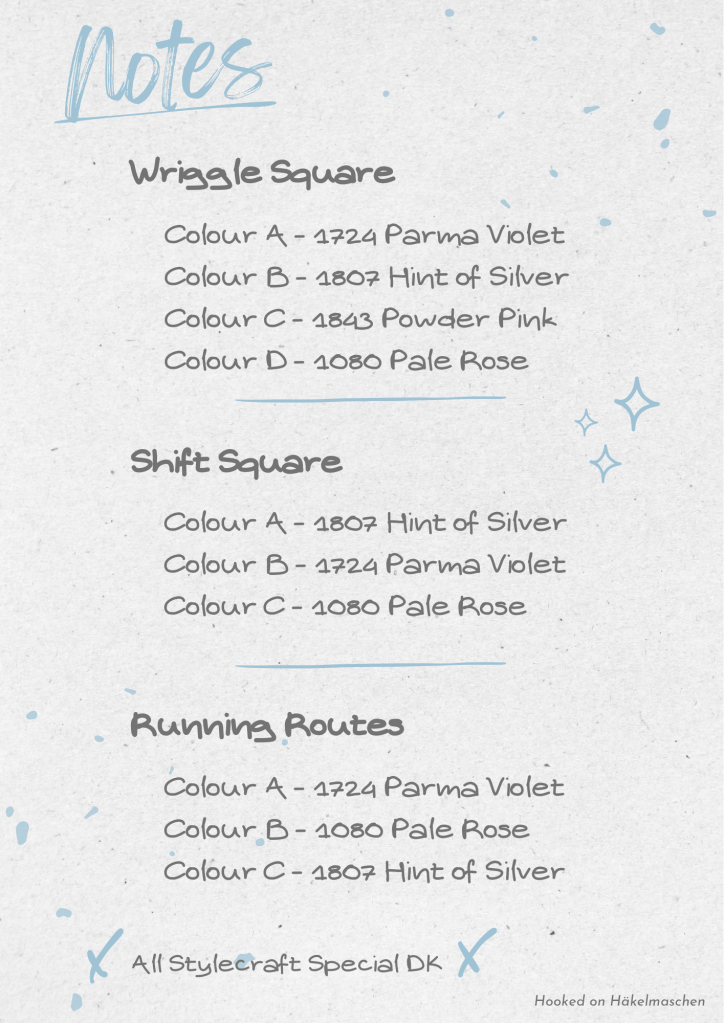
I used Stylecraft Special DK and a 3.75 mm hook for the new versions. They became pretty much exactly 6 inch / 15 cm tall.
The colours are completely different though – using pink and grey tones instead of brown and orange.
Here my new colour combo in Hint of Silver, Pale Rose, Parma Violet and Powder Pink:
Lovely aren’t they? I especially love the combination of Pale Rose and Parma Violet. What do you think?
To catch up completely I will now hop over to Ravelry to add my versions to the projects. I just saw that the book is also presented there. Some designers have already added their designs.
By the way Ravelry: if you take a look at Pam’s designs there you will probably notice that these 6 inch squares combine really well with her 12 inch squares. Perhaps this will lead to ideas for a new project? I’ve had something in mind for a while, but unfortunately haven’t found the time to realise it yet. Hope to manage it soon! I will let you know!
Have a lovely time 💕

It is already mid January and I hope you had a great start in the new year! Hubby and I got off to a very cosy start.
However, right at the beginning of January, we started renovating another room in our house – very much in keeping with the theme of “new beginnings”. And a never ending story …
Yet, within all the renovation stuff, we have a new wall decoration in our living room! But these are not the result of our renovation work but of my colour experiments last year.

You may remember that last year I experimented a little with random colour placement. This project really opened my eyes to new ways of combining colours.

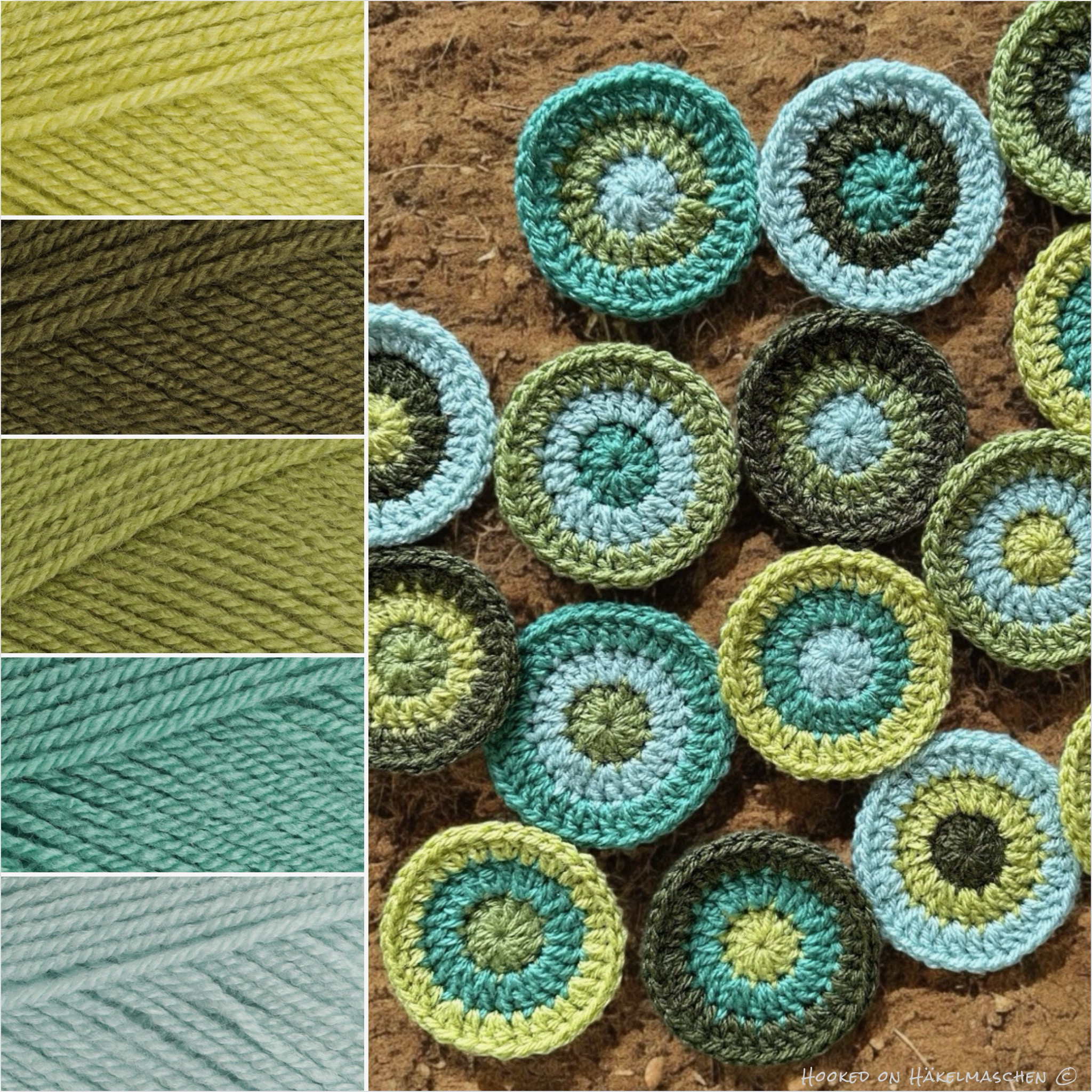
I started by selecting yarn in 15 different shades from my Stylecraft Special DK stash. Mostly leftovers from other projects.
But instead of manually compiling all possible colour combinations in a table, I tried an online random generator, Random.org . They offer a lot of free services, including a list randomizer. It works wonderfully for generating random colour combinations. I described in detail how this works in an earlier post. You can read all about it here
I needed a bit of colour – Colour Experiment Part 1
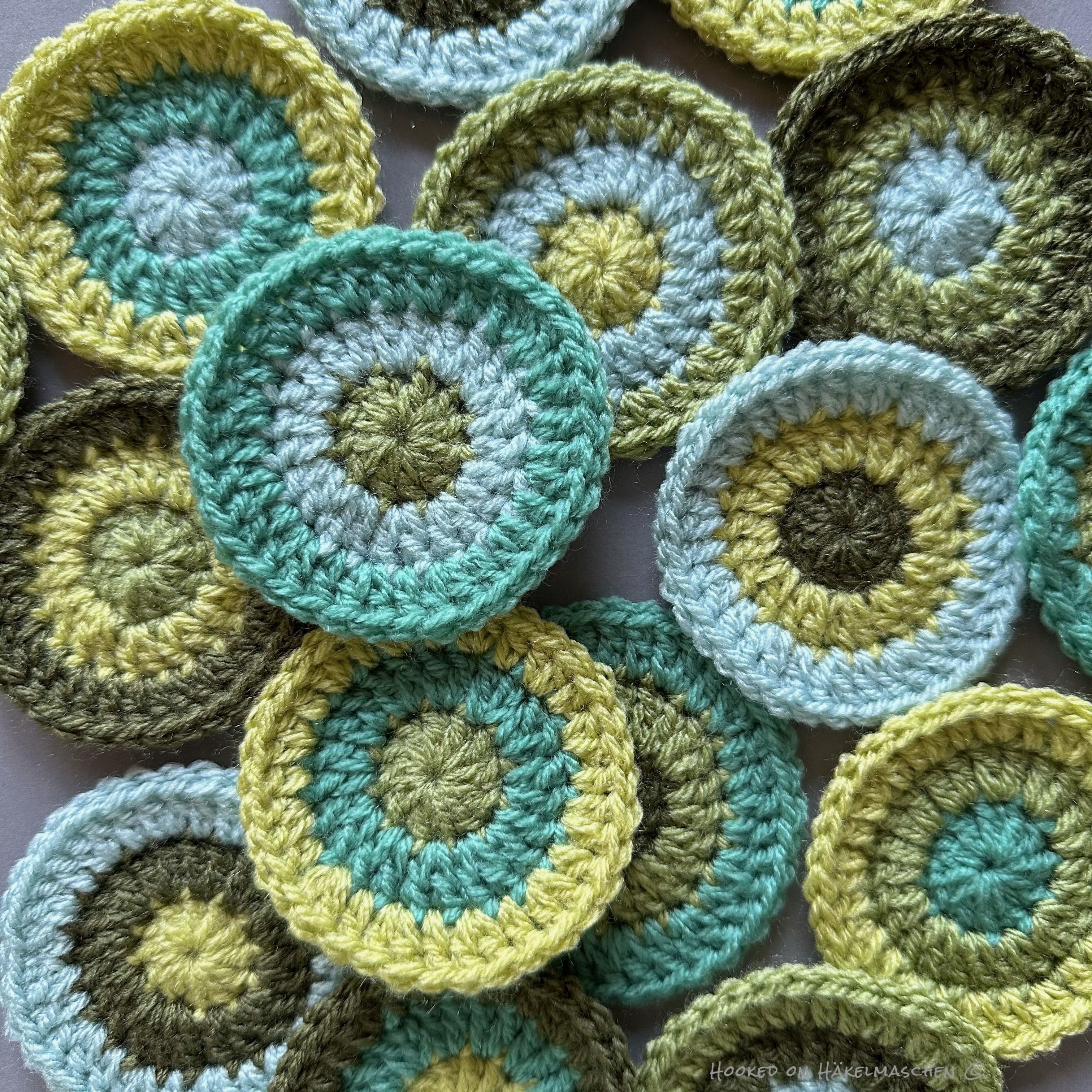
To try out the random colour combinations, I started crocheting little circles. Each with 3 rounds. In doing so, I have strictly adhered to the results that the random colour generator had given me. I only replaced a colour if it would otherwise have appeared twice in a circle. In the end, this resulted in 25 colourful circles, which I then turned into small squares. I joined them in a 5 x 5 layout. The arrangement of the squares was also generated by using the random generator.
Details on my colour placement and layout can be found in this post
Random Layout – Colour Experiment Part 2
After adding a small border my finished panel was about 52 x 52 cm.
At first I had thought of making a cushion cover out of it. But then I decided to use it as a wall decoration.
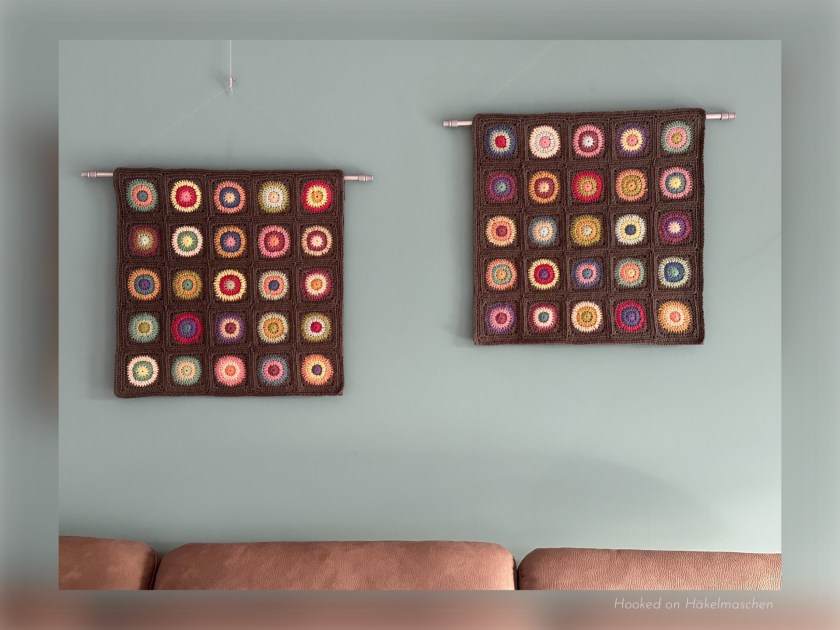
Overall, I was so thrilled with the result that I have since made a second panel.
I used the same colours and the same process as with the first panel. The colour combinations are completely different, but it looks just as great.
Here the results:

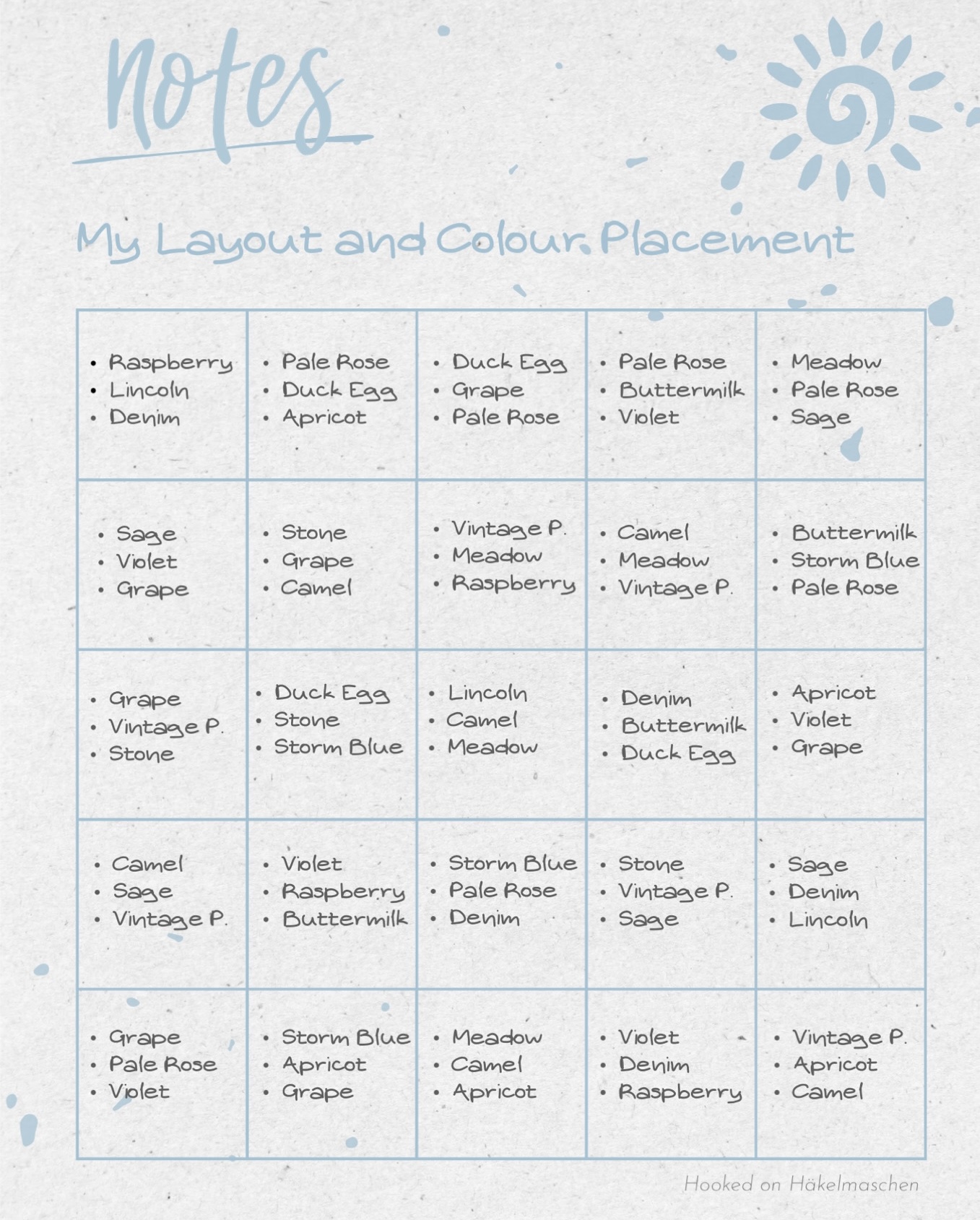
The table below shows the colour combinations that I have used for my second panel. The colours are listed for each circle in the order of rounds 1, 2 and 3. As for my first panel each circle was squared with two more rounds in the colour Graphite.
At the same time, the table shows the layout in which I have arranged the squares.

I had already listed the pattern for the squares, joining, and border in a separate post. If you are interested you can find it here
Step by step – A new wall decoration – Colour experiment Part 3
But in addition, I have now written down the pattern again and summarised it in a pdf file. Besides the actual pattern, this document contains the colour combinations and layouts for both panels.
So you can also download the complete file here.
Please note: Some left over yarns and 1 ball of Stylecraft Special DK for squaring and joining are sufficient for one panel.
I hope you like it as much as I did!
Have a lovely time 💕

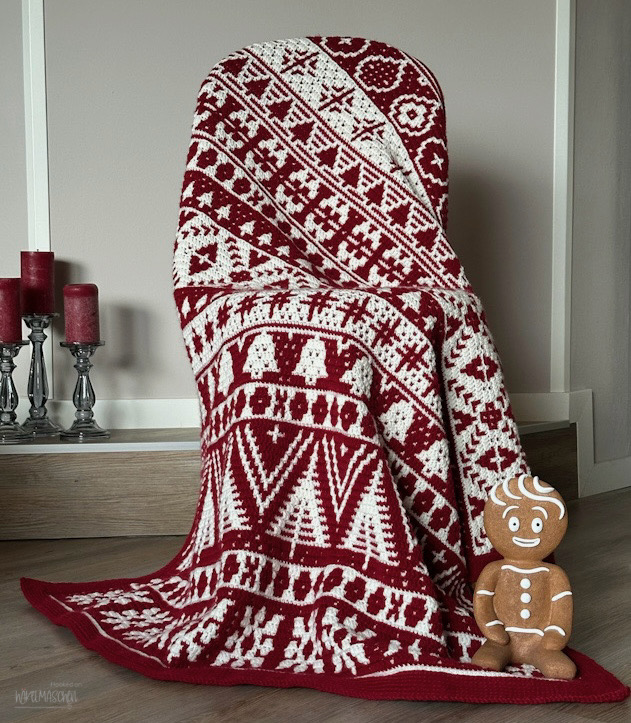
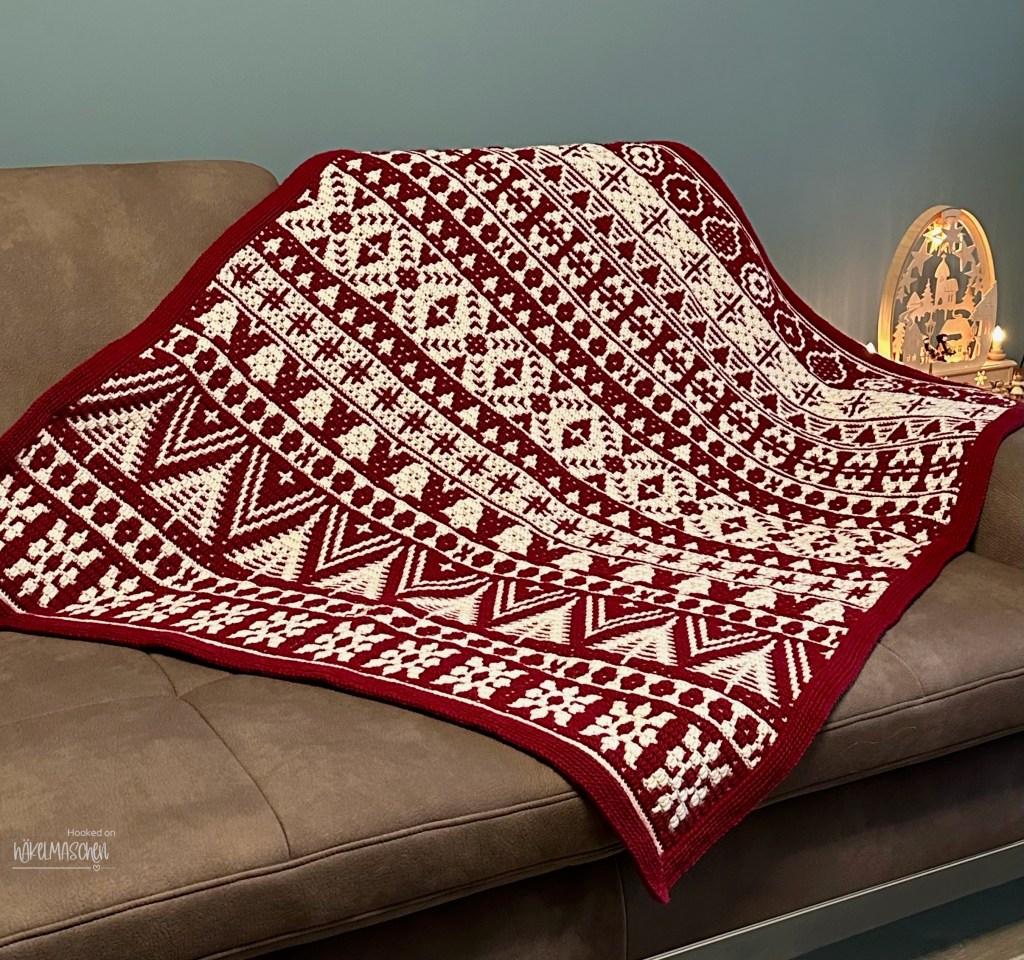
Last weekend I made the last stitches on my Winter’s Love blanket. YAY – it is finished!
I really enjoyed working on it!
Winter‘s Love is the current Cal (Crochet-a-long) by Ana Morais Soares from One Skein of Love. The Cal already started on 22. November 2024. It is divided into 4 parts and part 4 – the last one – will already be published on Friday (13. December 2024). Time flies …
But it is never too late to get the pattern. It’s perhaps a little late to get the blanket ready for Christmas. But starting it at Christmas and finishing it for next year is certainly a very nice idea too.
In case you are interested, the pattern is available here.
During the last weeks I had the pleasure of testing this lovely pattern. I had a late start though. Due to our holidays I was only able to start working on it in the second half of October. Besides my normal life (and some health issues) it took me about 7 weeks to finish it. Late for the test – but nevertheless, 7 weeks are not too bad for finishing a blanket, I think. I am not a fast crocheter anyway!
It is the first time I have used Yarnsmiths Create DK. Yarnsmiths is an own brand from Wool Warehouse in the UK.
Create DK is an 100 % Acrylic yarn. It comes in 100 g balls and has a yardage of 290 m / 100g. It is currently available in 120 colours.
I decided to go with Claret Red (3090) and Off White (3045) for my blanket.

In total I needed
4 balls Off-White
6 balls Claret Red
I really like the quality of Create DK. It has a consistent thickness and is soft and smooth. It was absolutely fun to work with! I will have to get some more colours.
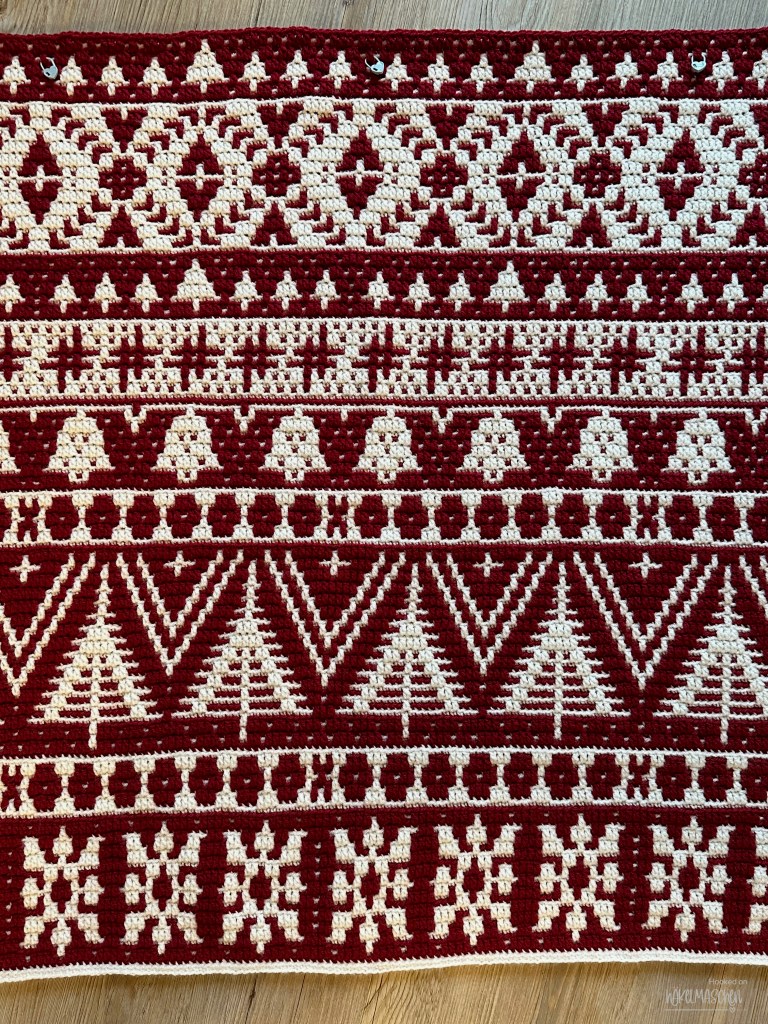
My finished blanket is about 120 x 150 cm. That’s about 47 x 59 inch. I worked with a 4 mm hook.

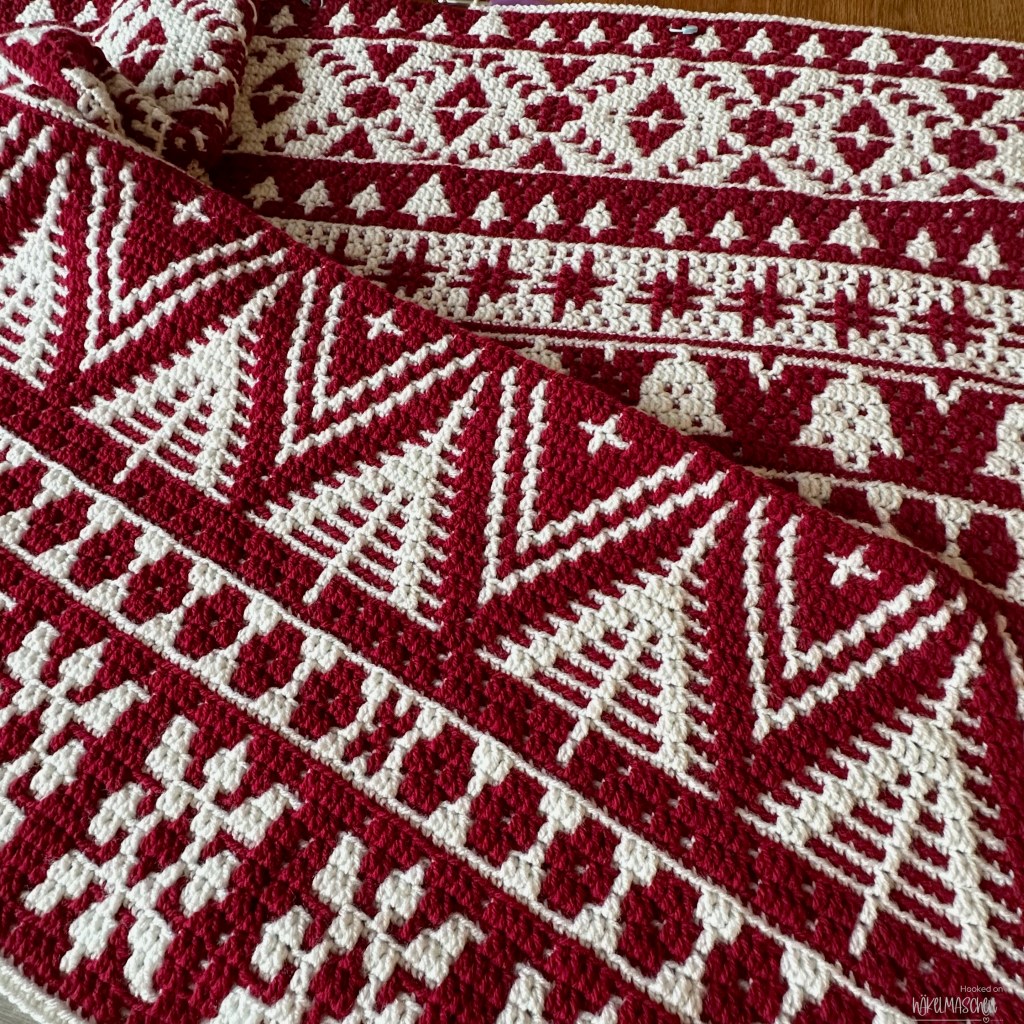
After a first try (in the photo the strip on top), I decided to start my blanket with a dark background, having the motifs in white.
That means I started the foundation row in Off White (C1) and used Claret Red as C2.
I kept this scheme for the first 8 patterns of the blanket. For the last 3 patterns, however, I decided to swap the colours.
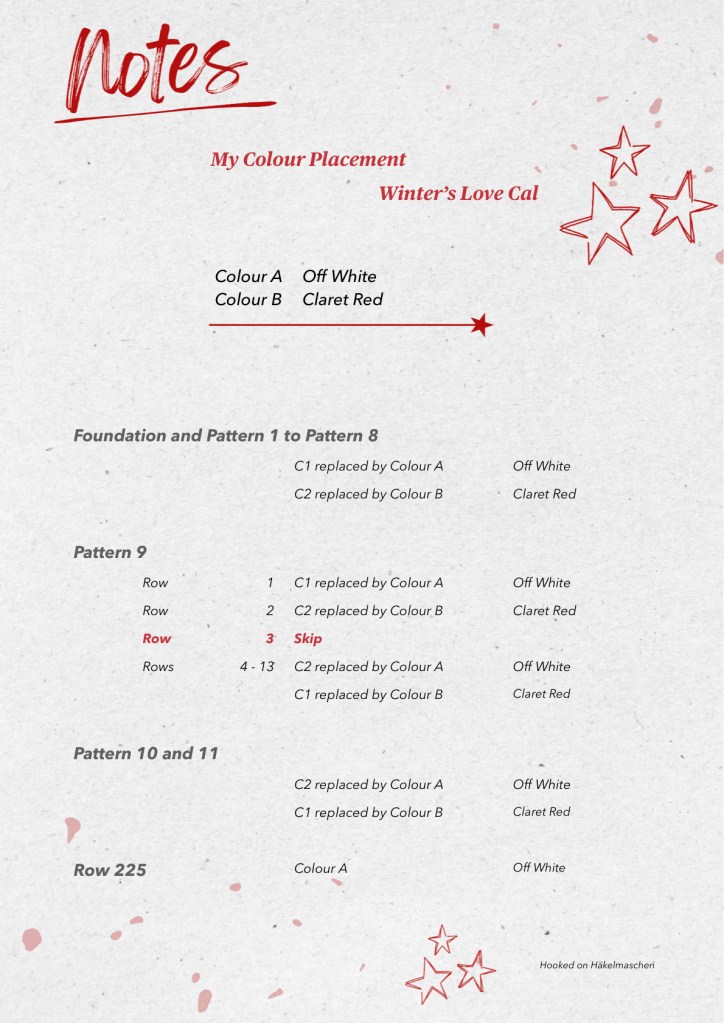
I have already written about the reasons for this in my previous post. There you will also find detailed information about what exactly I did to swap the colours. Besides there is also an overview of my detailed colour placement for all patterns of the blanket. Only the colours of the border are not listed there. Now, the slip-stitch round, front- and back layer and the joining round were all worked in Claret Red. That‘s it.
But, to make it easier, I have now also summarised my entire colour placement in a pdf file. So, if you are interested you can download it here


Well, that’s the end of another big crochet project. After that, I always have the feeling of falling into a kind of big hole. Do you know that?
I still have no idea what I’m going to do next. Unfortunately, I’m having problems with one of my eyes at the moment (and a few appointments at the eye doctor). So I think it’s going to be something small. Maybe some Granny Squares? Or something small for Christmas? Hm, let’s see!
Wish you a lovely time 💕

My previous posts about Winter‘s Love
About a fortnight ago I showed you my current test project: Winter’s Love Cal. A new overlay mosaic pattern by Ana Morais Soares from One Skein of Love.
At that time, I had just finished about 2/3 of the blanket.
In case you missed my previous post you can read about it here
In the meantime the Cal started. Ana just released part 2 of the pattern. And yes, I am almost finished with my blanket!
All tails are knotted and cut! All slip stitches to start the border are done! And last night I started with the back layer of the border.

When I started my blanket a few weeks ago, I decided to replace Ana’s beautiful green (C1) with Off White and the cream (C2) with Claret Red. So I had a dark background and white motifs.
I really love the way how this turned out!
However, when I reached pattern 9, I had some doubts about my colour placement.
Due to my colour scheme the trees in pattern 9 were shown in white. In my opinion this didn’t go so well with the white baubles in pattern 8. I had already finished half of the pattern when I decided that it would be better to swap colours. That meant I had to go back some rows! I kept row 1 (Off White) and row 2 (Claret Red) in my old colour scheme. Then skipped row 3 of the pattern. It is a plain row of single crochet, so it did not influence the pattern. But this made it possible to continue in row 4 with Off White instead of Claret Red – and voilà, the colours had changed!
Changing the colour also had the advantage of giving the last pattern a dark background again. I liked that better as well.
Please note: If you decide to do the same for your blanket, you will have 1 row less in the number of rows. This also means that you will have 1 stitch less on the long sides when you crochet the slip stitches and the border.
Unless you do it like me. After I finished the last pattern, I added a row of single crochet in Off White. This way I started and finished the blanket with the same colour. But to be honest, it wasn’t the look that convinced me to do it. It was simply the fact that my slip stitches then had a contrasting background on both short sides. My eyes couldn’t have coped with anything else.
And here is my colour placement in detail

And a word about the yarn amounts:
So far I have used 4 balls of Off White and also 4 balls of Claret Red. There is nothing left from these balls. So with a different tension you might run short with these amounts.
Yarn is Yarnsmiths Create DK from Wool Warehouse in the UK. I worked with a 4 mm hook.

That’s all for today! I’m off to do a bit of Christmas decorating. And continue working on the border! Have a lovely time 💕

Now it’s that very special time of the year again! In the northern hemisphere, winter is lurking just around the corner. Christmas is just over 5 weeks away. And Ana from One Skein of Love has just introduced her new Winter CAL (crochet along): Winter’s Love!
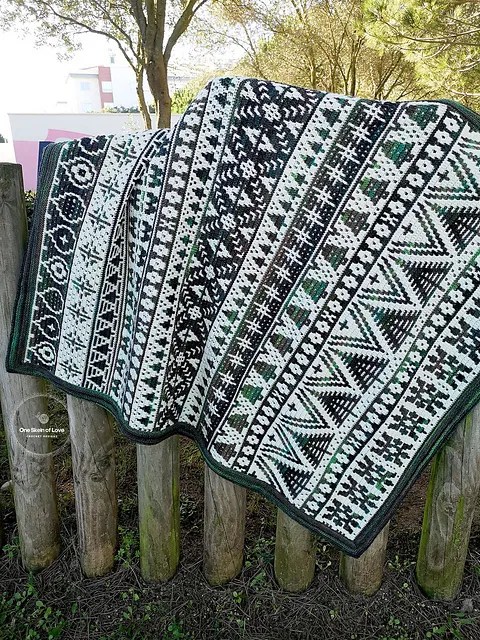
Winter’s Love is another blanket design in Overlay Mosaic. It matches her earlier winter designs – Winter Wonderland, Wintry Forest and Magic Winter – perfectly.

Lovely, isn’t it?
The Winter’s Love Cal will start on Friday, 22. November 2024.
It is divided into four parts.
Part 1 will be released on Friday, 22. November 2024. Parts 2 – 4 follow at intervals of one week each. So the dates are
All information about the CAL is already available on Ravelry. After you purchased the pattern you can download an introduction file with all relevant notes. Yarn amounts, size and gauge, pattern notes, abbreviations, tutorials and so on.
I promised Ana in October that I would test the pattern. I’m sorry to say that I am not finished yet. Life and, unfortunately, my health got in the way a bit.
Luckily I’ve already done a good bit that I can show. And of course I’m hurrying to finish as quickly as possible.

This time I am trying something different: Yarnsmiths Create DK.
Yarnsmiths is a relatively new yarn and an own brand from Wool Warehouse. (My favorite online yarn shop. Unfortunately located in Great Britain.)
Create DK is a 100 % Acrylic yarn. At the moment it comes in 120 different shades. I guess many of them are similar to the colours from Stylecraft Special DK. But there are also some special ones. It’s definitely worth a look!
The yardage is 290 m per 100 g ball. Recommended hook size is 4 mm.
It works up nicely! I like it and will definitely try some more colours.
When I saw Ana’s new design for the first time I instantly thought of classic colours.
So I had originally planned to use white, red and grey to give it kind of a Nordic look.
I ordered some Off-White, Claret Red ans Storm Grey. I primarily wanted to use the off-white as a background colour and make the motifs in red. A little grey in between.
After my yarn arrived, I initially followed Ana’s pattern just replacing her cream coloured yarn with Off-White.
After the first few rows, however, I changed my mind. The claret-red fascinated me and I considered swapping the colours.
The picture below shows both versions. The sample on top is my first one, using Off-White as background. The other one (with the little blue stitch marker) is the one with swapped colours.

What shall I say? I didn’t have to think for long! The one with the swapped colours was my favourite and became my final version. Without the grey though.
Throughout the pattern I use Off White as colour C1 and Claret Red as colour C2.
This is what I have so far. I just reached the end of part 2. 150 rows are done.


Now on to part 3. Another 75 rows to go.
I’ll keep you updated on my progress

And just a side note on my yarn order:
Yep, after years of abstinence, I finally dared to order from Wool Warehouse in the UK again. I hadn’t ordered there since the Brexit (the UK’s exit from the European Economic Union).
I knew that I would have to pay extra taxes. Ok, but unfortunately, I had read a lot about people from Europe who had to pay horrendous amounts. So I really wasn’t sure how everything would work.
I am happy that I finally tried it! It is nothing to be scared of!
My order was delivered by DHL. The parcel was not tracked. That was a bit of a pity because you never know when you can expect delivery. But it arrived within a week or so. I got a note from DHL and had to pick the parcel up in the post office. There I paid the import sales tax. This corresponds to the usual 19% VAT here. And I also had to pay a small handling fee to DHL. But in total the price was still reasonable.
The only thing I have to make sure of is that my order does not exceed € 150. Then there are no customs duties and I only have to pay the import VAT. I really wish I had tried it earlier!
I’m happy to finally be able to show you my version of the Mystified Square.
It is the new design from Pam Knighton-Haener / A Yarn of Serendipity. The pattern has just been published. AND: it has been chosen by the Ravelry BAMCAL group as their block of the month for November.
Have you heard of BAMCAL on Ravelry?
If not, BAMCAL stands for Block-A-Month Crochet-A-Long. This is a Crochet-Along organised every year by a special group on Ravelry.
The CAL runs throughout the year. Each month 3 different Afghan squares are featured. Two squares, a 6 inch and a 12 inch, are chosen by the mods. A third is chosen by the group members in a poll. All patterns are free – at least for the month they are chosen for.
You can choose to do one or all of them – it’s up to you. At the end of the year you can combine all your squares into a blanket. Or make anything else you can think of.
I absolutely love this idea! Maybe I should join in next year?
The Mystified Square is designed for Aran / worsted weight yarn (#4). But it will also work very well with other yarn weights. Of course, using a different yarn weight will affect the final size.
With worsted weight yarn, the finished square will be 11 or 12 inches (28 or 30,5 cm). This depends on whether a 4.5 or 5 mm crochet hook is used.
The pattern is classified as mid-intermediate. It uses various stitches, including some special ones. But no worries, they are all very well explained. And a picture tutorial helps with each round.
The design comes in two colourways, each with 5 different colours. Of course, you can also create your own colour scheme. I bet it would also look great in just one colour!
The pattern is available on Ravelry.

I already tested this pattern for Pam some weeks, or rather months, ago. I think it was in early August.
Of course, everything had to be kept secret until the pattern was finally published. Hard time :-)
As always, I did not use the suggested Aran yarn. I still don’t like working with it and feel a bit uncomfortable using a 5 mm hook. So, this time I decided to use up some Hobbii Rainbow Cotton 8/6 (a #3 yarn) from my stash.
I used colourway 2, but replaced the colours as follows
Unfortunately it looks like two of my colours are already discontinued. At least I couldn’t find them in the actual Hobbii shop.
I like the way the colours come together. I just noticed that they are a bit difficult to capture in a photograph. The Dark Old Rose in particular is a little reluctant to show its true beauty…
Using a 3,75 mm hook my square turned out to be about 25 cm / 10 inch.

I really enjoyed working on this pattern and am happy with the result!
Are you going to try the pattern? If so, have fun 💕

In the last few weeks I have been experimenting a bit with random colour placement.
I wanted to try if a random colour placement, generated by a list randomizer from the internet, really would work. And I was curious to see whether the result would look really good in the end.
I started my „experiment” by putting together 15 different colours – mostly leftovers. All 15 looked good together. However, I personally wouldn’t place some colours right next to each other. For example, Camel and Vintage Peach or Sage and Meadow.
For a first try, I crocheted some circles. Each one with 3 rounds and each of the three rounds in a different colour. To generate the random colour placement, I used the list randomizer on Random.org.
What can I say, I was absolutely happy with the first results!

In the end I had 25 colorful circles that I wanted to keep using. So I decided to turn them into squares and combine these into a wall decoration.

The colours for the circles were picked from these 15 colours, all from Stylecraft Special DK. To square the circles I used Stylecraft Special DK in the colour 1063 Graphite.

This graph shows the colours I used for each circle. They are listed in the order for rounds 1, 2 and 3.
The chart also shows the layout I have chosen for my wall hanging.
The layout is also based on the random generator.
If you want to know how this works and what exactly I did, you can read about it here:

There are a couple of different ways to crochet circles and turn them into squares.
I have tried several of them while I made my circles / squares. The way described below is what worked best for me. It is adopted from a method for crocheting circles that Polly Plum describes on her site.
This gives the circles a very neat look. Another advantage is that you can easily crochet over most of the yarn ends. Simply start a new round at a position opposite the end of the previous round. You can crochet over the starting tail for half a round. Then, crochet over the tail from the previous round.
I started by making all 25 circles first. Each circle consists of 3 rounds in the colours A, B and C. A, B and C change for each circle, as shown in the layout chart above.
Colour D – the colour to square the circles – stays the same throughout.
Using a 3,75 mm hook my squares are about 10 cm / 4 inch each.

Joining, em, yes …
If you follow my blog, you know that I haven’t joined many squares so far. So I first had to find out what options are available, and tried several different joining techniques.
In the end, I decided on a kind of slip stitch join. I’m not sure if there is a special name for it. I have seen this join in various places with sc, hdc, or even dc. I finally opted for a simple slip stitch. This produces a really nice flat ridge.
With this join, the actual stitch is only crocheted in one of the two squares to be connected. The opposite square is joined by pulling the loop through the corresponding opposite stitch. It may look a little complicated at first, but I’m sure you’ll find the rhythm after a few stitches.
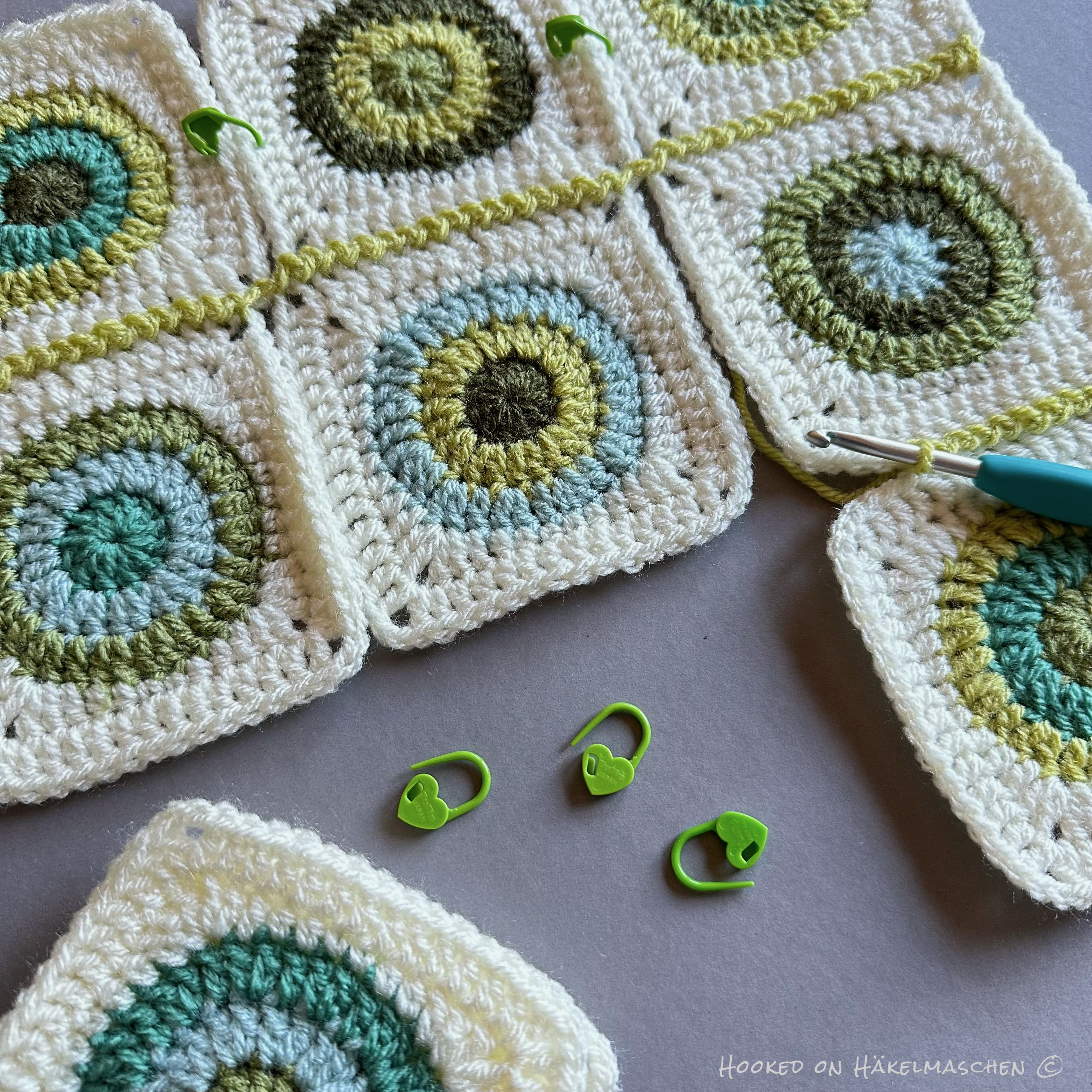
I first worked the horizontal joins, afterwards the vertical joins. If you like to follow my joining method, here is what to do:
First arrange the first two rows of squares according to your planned layout. The right sides of the squares should be facing you.
The join is only worked through the back loops (the inner loops). The hook is always inserted from top to bottom (from the right side of the square to the wrong side).
Tip:
Make sure not to twist the squares while connecting them. It is helpful to use a locking stitch marker especially when joining the first two rows of squares. This helps to hold them together.
And take care to work the join not too tight. Best is to go up a hook size. I used a 4.5 mm crochet hook for mine.
Referring to the graph above: Work from right to left (provided you are right-handed, like me). Start with joining square F to square A, square G to square B and so on.

For the vertical join repeat the same steps as before, also working from right to left. I started with joining square V to square U. At the transition from two squares to the next two squares, simply work over the existing horizontal join.
Work away all tails.
For an explanation on how to work these stitches have a look here
So far all my crocheted wall hangings a made from patterns using Overlay Mosaic. This technique gives the panel a bit of weight. The dropped down dc practically double every row. Additionally, the double border adds some weight and you can also easily stabilise the panel with rods. So it’s no problem to hang it up nice and straight.
That’s exactly what I missed when I was thinking about mounting my new panel! Using an Acrylic yarn made it very light weight and I was afraid that it might not hang straight.
So, I got myself some felt – 4 mm thick and anthracite-coloured. I cut this to size and pinned my panel in place. I let the felt overlap a few cm at the top edge. This was later used to create a tunnel for the mounting.
I sewed the panel in place along the edges using a running stitch.


Now that I’ve finished, I think the panel could also have been sewn on with a sewing machine. But, I hadn’t worked with felt of this thickness before, so I just didn’t dare. Especially as I was so short on felt that I didn’t have a test piece. Lessons learnt!
After sewing, I folded the upper overhang of the felt back at the edge. I fixed it on the backside with some suitable glue. This created a tunnel through which I can push the rod for hanging. Finished!
My panel measures about 52 x 52 cm / 20 1/2 inch.

I think I will make another one. Same colours, different placement. And of course I will use the randomizer again for the placement of the colours and for the layout. I am already curious how it will look like!
So long – Have a lovely time 💕