

Last updated: 30 June 2026
I first wrote this article back in 2021 while I was working on my Winter Wonderland Blanket. At the time, I was answering the same question over and over again: “How much yarn do I need if I use a different yarn?”
So the title may be a little misleading. This article is about calculating the amount of yarn you’ll need when substituting one yarn for another. It does not explain whether a particular yarn substitution is suitable for your project.
I’ve updated the article to make it clearer, but the idea behind it is still exactly the same.
Before we get to the main topic, I’d like to tell you how I learned – more or less the hard way – what yarn weights and yardage actually mean.
Different yarn weights – my personal nightmare
The different yarn types, weights and yardages can be very confusing.
I still remember very clearly when I took up crocheting again around 2011. That was also when I began using English patterns. Most of them called for yarns that weren’t available in Germany. So I had to replace them with other brands.
Unfortunately, I had no idea what kind of yarn a pattern called for. I didn’t know what terms like DK, Aran, Sport Weight or Fingering actually meant, nor did I know what I should pay attention to when choosing a substitute.
At first, I thought that the crochet hook size stated on the label was the deciding factor. Believe me, it wasn’t. At least, not on its own.
When I chose my yarn based on that, I often ended up with too much or too little yarn and/or my crochet piece wasn’t the right size because my yarn was too thick or too thin.
After making a few disappointing purchases, I started ordering yarn from overseas. That way, I was able to use exactly the yarn specified in the instructions.
And that’s also how I discovered that there’s a system abroad that classifies yarns into different groups or weights. Until then, I didn’t know that such a system existed in other countries.
I then looked up the Craft Yarn Council’s standard yarn weight system, and things became a bit clearer to me. Suddenly, terms like DK, Aran and so on started to make sense. They indicate the yarn weight, i.e. the thickness of the yarn. And this weight also affects the length of the thread. A finer yarn has to be longer than a thicker yarn to weigh the same. It sounds perfectly logical now, but it had never occurred to me before.
For example: DK yarn (#3) has a yardage of between 240 and 300 metres per 100-gram ball while Aran yarn (#4) offers only 120 to 240 metres for the same weight. The thread of a DK yarn is finer and longer.

With this in mind, I have changed my personal approach to choosing a suitable yarn. When I’m shopping in Germany and the yarn label doesn’t include a yarn weight category, I simply rely on the yardage per ball.
No matter what yarn weight I’m looking for, I simply note down the corresponding yardage and crochet hook size and compare these with the details on the yarn label. If both match, I can be fairly sure that the yarn is suitable.
But the yardage is also useful if you want to use a different yarn weight to the one specified in the pattern.
Changing yarn weights
Before replacing one yarn with another, you should be aware that this may also affect the finished size of the project. Namely, whenever not only the yarn brand but also the yarn weight changes.
Your first instinct may be to buy exactly the same amount of yarn, simply by matching the total weight in grams. That can work if you’re simply changing brands. However, once the yarn weight changes, it usually doesn’t.
Let us say your are planning to make a blanket and the pattern calls for 11 balls, 1,100 g, of Stylecraft Special DK. The size of the blanket doesn’t bother you. You’d like the blanket to be a little heavier, so you decide to substitute Stylecraft Special DK with Stylecraft Special Aran.
If you buy 1,100 g of Special Aran, you will definitely have too little yarn.
Fortunately, experience shows that projects with roughly the same stitch count often require a similar total yardage, regardless of whether the yarn is finer or thicker. That’s why yardage is usually a much more reliable basis for calculating yarn substitutions than weight.
And you can easily work it out:
Step 1, look at the amount of yarn needed according to the pattern and calculate how many metres / yards this will be:
- multiply the number of balls by the yardage of one ball. This will give you the total yardage needed.
Step 2, take a look at the yarn you plan to use. What is the yardage of one ball?
- Divide the total yardage from Step 1 by the yardage of one ball of your chosen yarn. The result tells you how many balls you’ll need.
If you’re working with several colours, repeat these two steps for each colour.
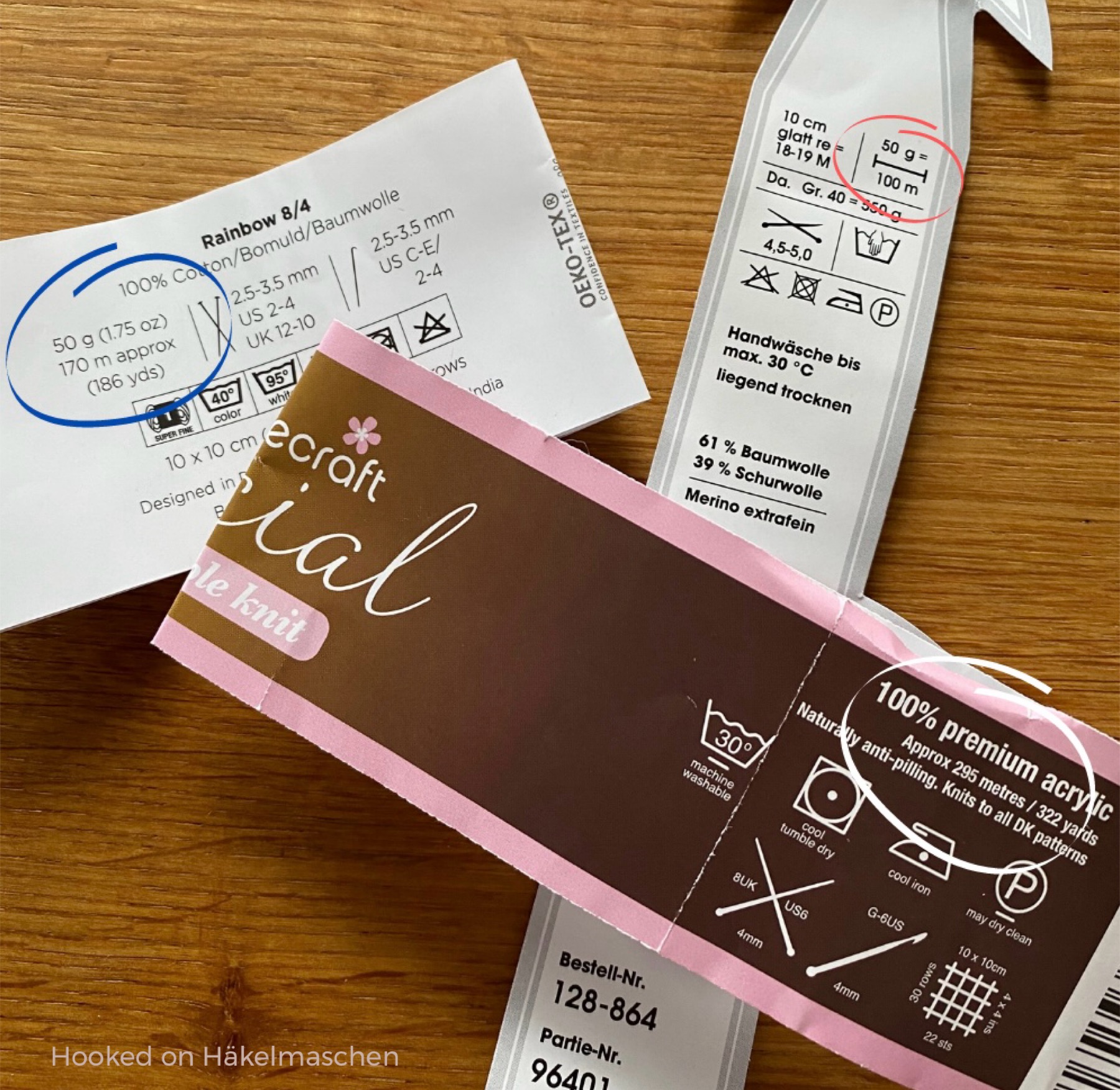
To visualise this calculation, please just look at the picture below.

So far, this method has never let me down!
At least it works for classically twisted yarns. Modern yarns with a completely different structure might be different.
Many patterns will list the yardage alongside the details of the yarn used.
If this information is missing, the yardage is always indicated on the yarn label. Or simply search for the yarn online, either in an online shop or directly on the manufacturer’s website.
And finally, keep in mind that changing the yarn weight will almost certainly affect the finished size of your project. For projects where size really matters – especially garments – I wouldn’t recommend changing the yarn weight unless you’re also confident adjusting the pattern.
I hope this was helpful 💕

Share & Print:


One thought on “Good to know – How much yarn will I need if …?”