
Recently I have often had to answer the question of how much yarn you need if you want to replace the yarn used in the instructions for a pattern with a different one. I would therefore like to tell you what problems I had with it at the beginning and how I now calculate my individual yarn needs.
Usually, the yarn used and the amount required are included in the pattern. So far so good. The problem often starts when you want to use a different brand or – even worse – a different weight of yarn for your project.
Different yarn weights – my nightmare
All the different yarn types, weights and yardages can be very confusing. I still remember well when I started crocheting again about 10 years ago, I was helpless when it came to choosing the right yarn. That was the time when I started working according to English patterns and most of them called for foreign yarns. Brands like Stylecraft, Scheepjes and Caron, to name only a few, were not available in our German retail stores. So I had to replace them with other brands. In Germany, there is also no system that classifies the different yarn weights. Only in the last few years the American system has been adopted by some companies. So I was really lost as I had no idea what was meant by terms like DK, Aran, sport weight, fingering and so on.
At first I thought that the needle size indicated on the banderole was decisive. Believe me, it isn’t.
Picking a yarn based on this often meant that I had too much or too little yarn and/or that my crochet piece was not the size I wanted because my yarn was too thick or too thin.
After getting it wrong several times, I started ordering my yarn from foreign online stores to get the exact yarn that was called for in the pattern. This is how I discovered that there is a system abroad that categorises yarns into different groups.
It was only after I had done a little research into the different yarn weights that I realised that the thickness of the yarn also affects the length of the thread.. This is actually logical, a thinner thread must be longer to weigh the same as a thicker one. A thicker one will be shorter instead. I had just never thought about it.
An example:
DK yarn (#3) has a yardage of between 240 and 300 m per 100 g ball, while Aran yarn (#4) has only 120 to 240 metres for the same weight.
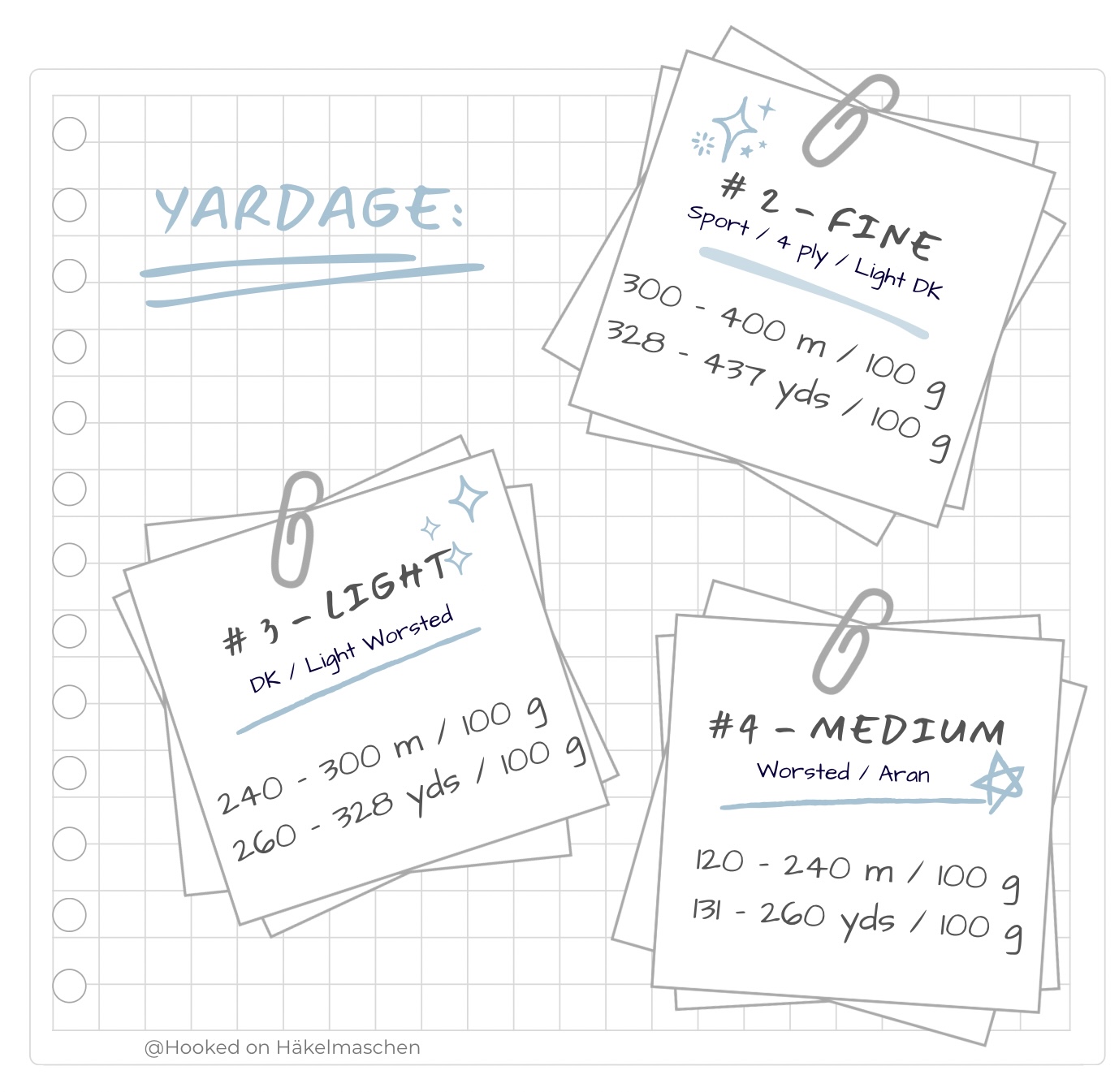
With this knowledge, I have changed my personal system for selecting a suitable yarn. If I shop in Germany and the yarn label doesn’t say what thickness / yarn weight it is, the yardage helps me. I just have to remember the running lengths of the different yarn groups and I will know that a ball with, say, 145 metres per 50 g is a DK weight because it will have 290 metres per 100 g.
But I have learnt even more. The yardage is also helpful if I want to use a different yarn weight to the one given in the pattern. Here is an example:
Changing yarn weights
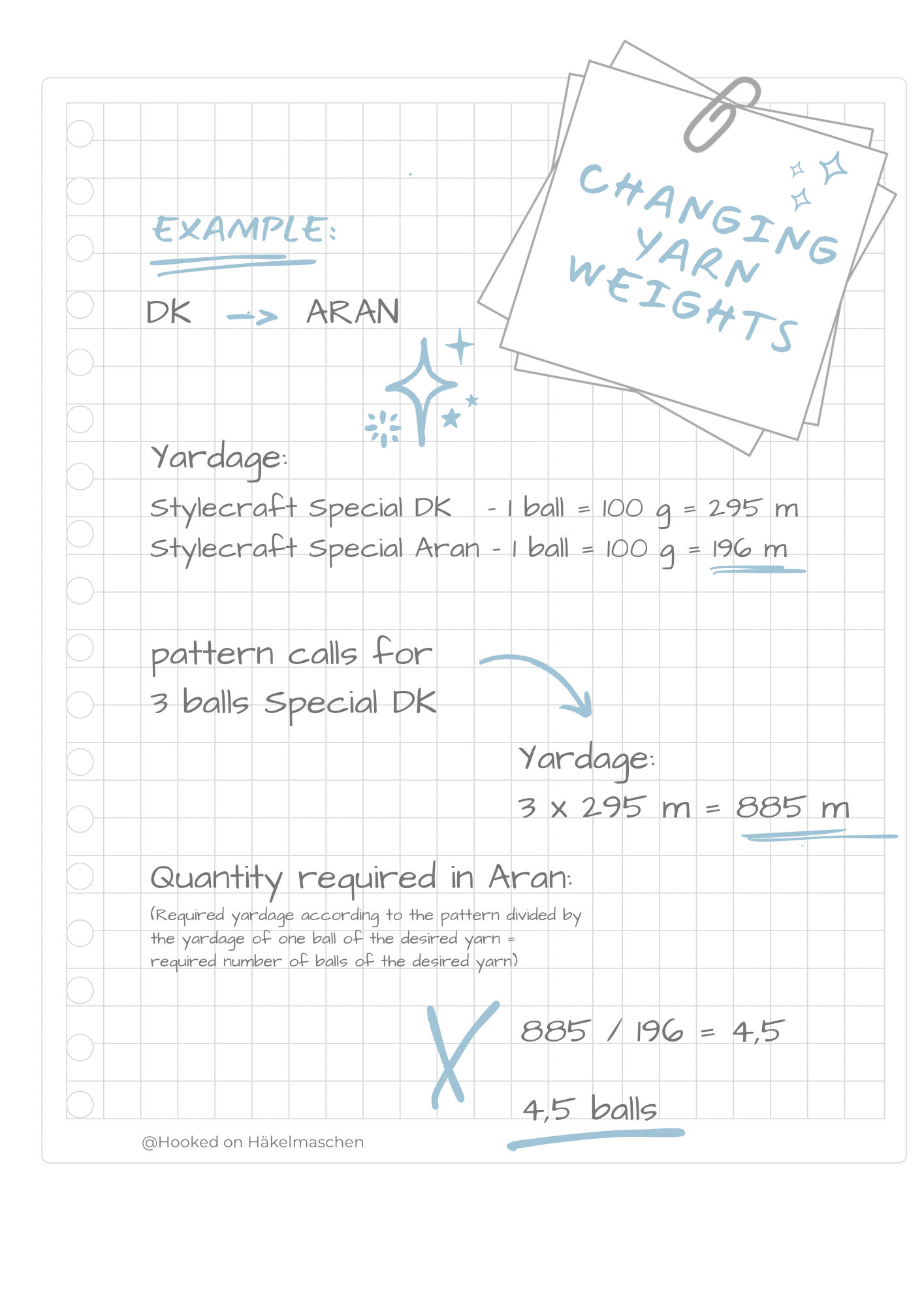
Let us say your pattern calls for 3 balls of Stylecraft Special DK but you would like to use Aran because you like your piece to be a little thicker. 3 balls Special DK are 300 g but if you buy 300 g Aran, you will definitely have too little yarn. How much do you need then? I calculate it using the yardage.
Simply look at the amount of yarn needed for the pattern and calculate how many metres or yards it will be. To do this, multiply the number of balls by the length of one ball. This gives you the total yardage you need.
Now take a look at the yarn you want to use. What is the yardage of one ball? Divide the total yardage you calculated earlier by the yardage of one skein of the yarn you want to use and you will know how many balls you need to buy.
If you need more than one colour, repeat this for each colour.
To visualise this calculation, please just look at the picture below.
I never went wrong this way! At least it works for classically twisted yarns. Modern yarns with a completely different structure might be different.
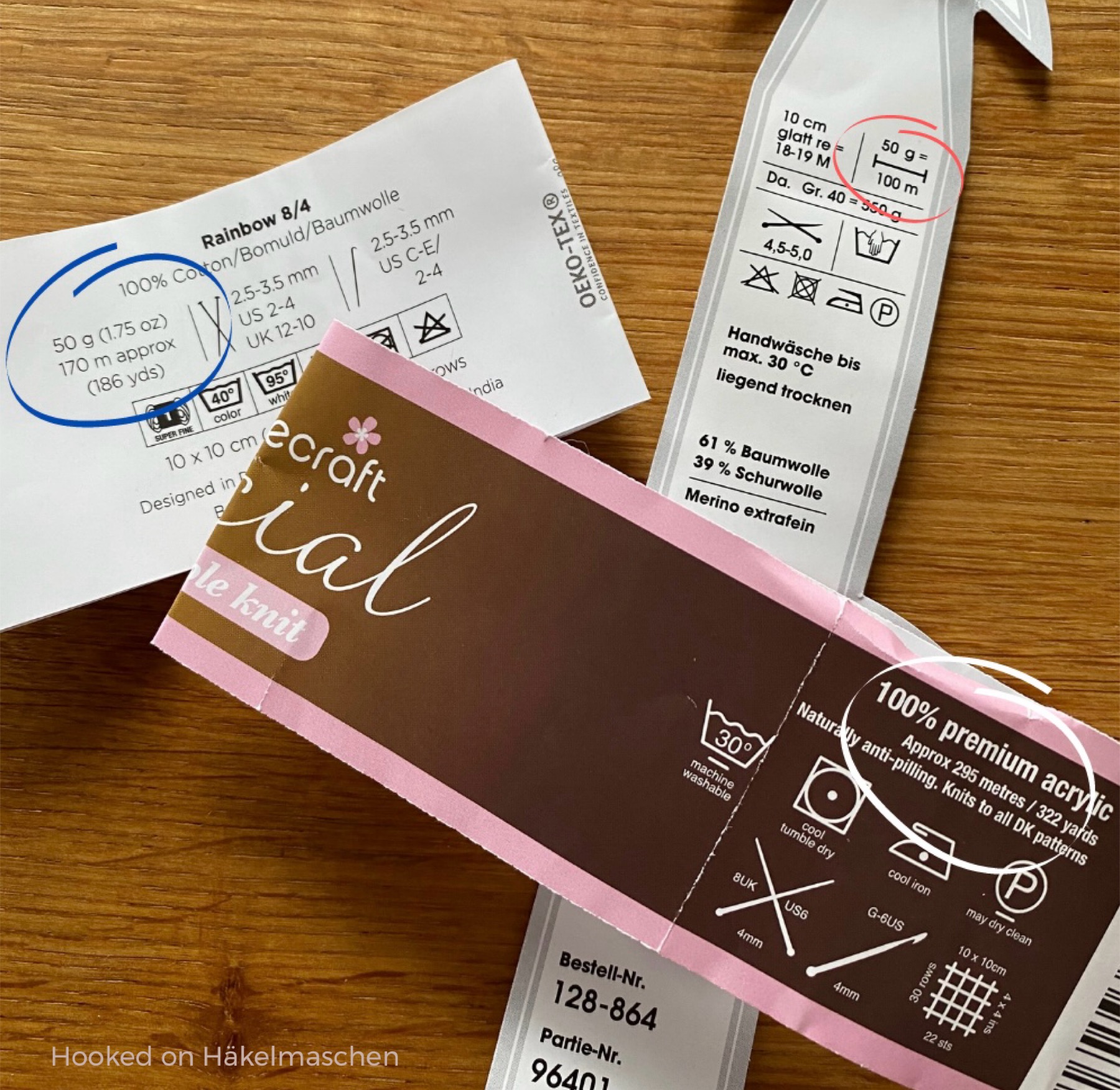
The yardage of a yarn is always is indicated on the label.
In many patterns, the length of the yarn is given together with the information on the yarn used. If this information is missing, simply search for the yarn in the internet, either in an online shop or directly at the manufacturer.
But please bear in mind that changing the yarn weight will affect the size of your project. For garments such as jumpers etc, I would advise against this unless you also know how to adjust the pattern.
I hope this was helpful 💕

 Hooked on Häkelmaschen