Aureole Mandala

Pam Knighton-Haener from A Yarn of Serendipity just released a new pattern – Aureole Mandala.

My first Mandala

Unbelievable, the Aureole Mandala is the first mandala I have ever crocheted!
I have wanted to do something like this for a very long time. At the back of my mind, there is an idea to decorate a wall in our living room with colorful mandalas…
So I was happy when Pam came up with her pattern for testing.

My test version is made with Drops Safran. It is a sport weight yarn and has 160 m / 50 g. It is just a tiny Aureole Mandala. With my 2,75 mm hook it turned out about 17 cm in diameter, that is just under 7 inch. I will see if I can find a suitable ring to attach it. It will make a lovely wall decoration. I love the colours!

  • Colour A – # 23, Brown
  • Colour B – # 11, Strong Yellow
  • Colour C – # 71, Marzipan
  • Colour D – # 28, Orange

The pattern is rated as intermediate and available as a free pattern in Pam’s Ravelry store.
As always there are explanations for all the stitches used and helpful and detailed pictures for each round.

My second Mandala

Quite a good result: shortly after the first Mandala was done, I made a second one – hehe.
Pam had just hosted an Aureole Mandala CAL in her Facebook Group. The pattern was split into two rounds a day. So I joined in and made a second one.

This time I used a mixture of Drops Paris, Drops Love You 8, and Cotton Aran from Paintbox. All three are Aran or worsted weight yarns with 75m / 50g (Drops) and 85m / 50g (Paintbox).
Those who know me know that I am not a fan of this yarn weight. I always have a hard time with it, and I always find that my stitches look a bit messy. Well…

By mistake, this time I used a 5.0mm instead of my 4.5 mm hook. When I realised that in round 7, I decided to continue with it. It actually worked out quite well. After blocking my Mandala measures about 27 cm / just under 11 inch.

The colours for the one above are:

  • Colour A – # 17, Off White – Drops Paris
  • Colour B – # 609, Light Caramel – Paintbox Cotton Aran
  • Colour C – # 19, Apricot – Drops Love you 8
  • Colour D – # 62, Sage Green – Drops Paris

Aureole Mandala is really fun to make!

If you have always wanted to try a pattern of Pam, this one is a good opportunity!

Happy hooking!

Old photos and a lot of Dudes

Unfortunately, I still don’t spend much time crocheting – most of the time I sit at the computer or tablet.

During the last weeks I have translated Ana’s Go with the Flow pattern, did some kind of tech editing on another pattern .
Besides I wrote down a pattern for a shawl I made for myself some time ago. The pattern is currently in the testing phase and of course I will present it here as soon as it is ready.

And every spare minute – and I definitely have too little of that – I am sorting through my old photos and revising some of the older blog posts here.

When I started with this blog I didn’t think of putting a watermark on my photos. From a legal point of view, watermarks are not really necessary, because every photo I have taken belongs to me and I have all the rights to it. No one may publish it without my permission!

Unfortunately, some of my photos have already been found on other, sometimes dubious, websites where people try to earn money with patterns that are not theirs.
This is so annoying, especially for the designers concerned!!
I know that a watermark on the photos won’t save me from that in the future either. But it makes it easier to prove and I just feel safer doing it. Especially as some of my photos – mainly with blankets – are not so unique. I have seen photos from Winter Wonderland blankets, done in my colourway, where I first had to think about whether they were mine or not. So I just make the effort!

But I digress!

Dudes, Dudes, Dudes

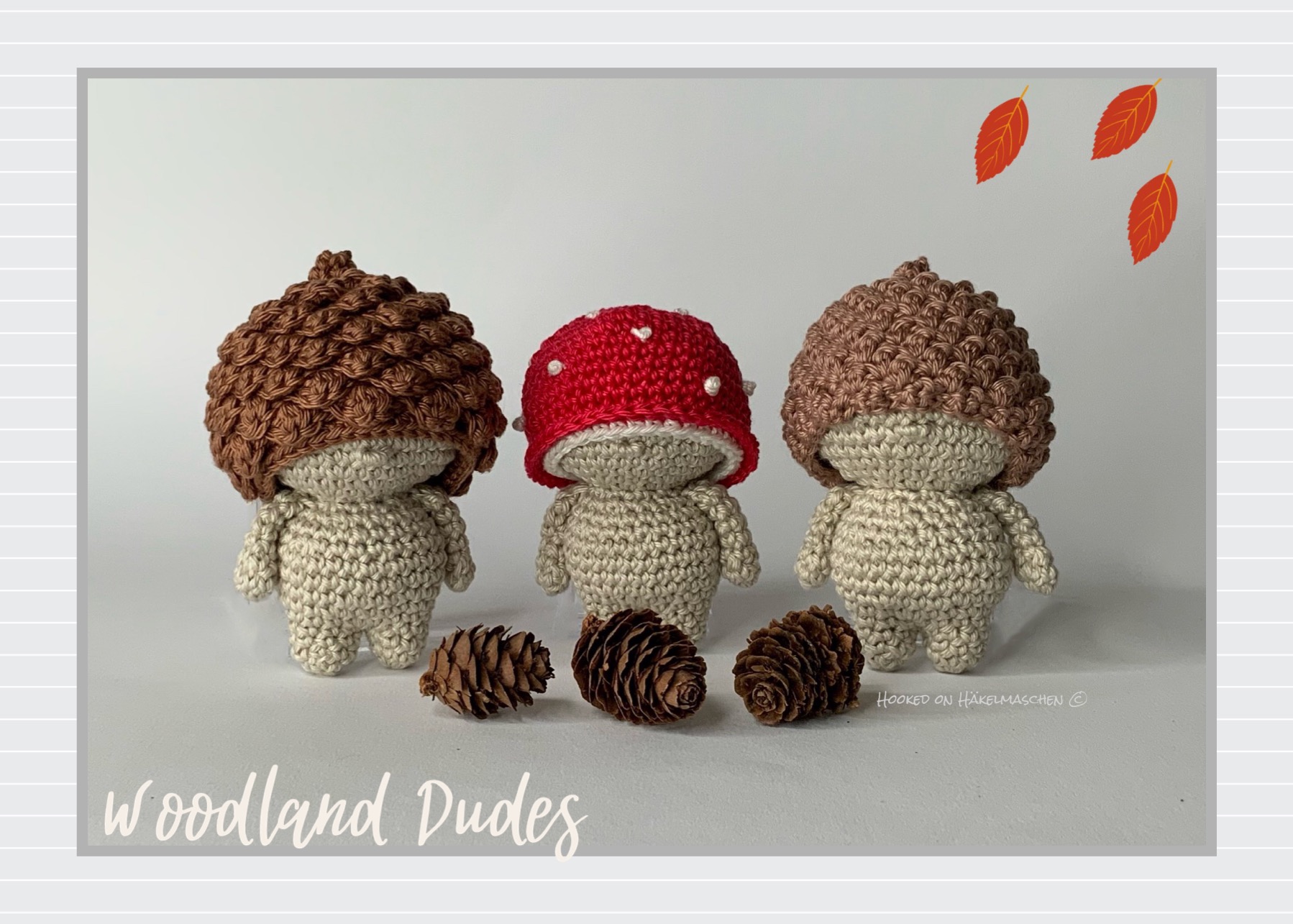
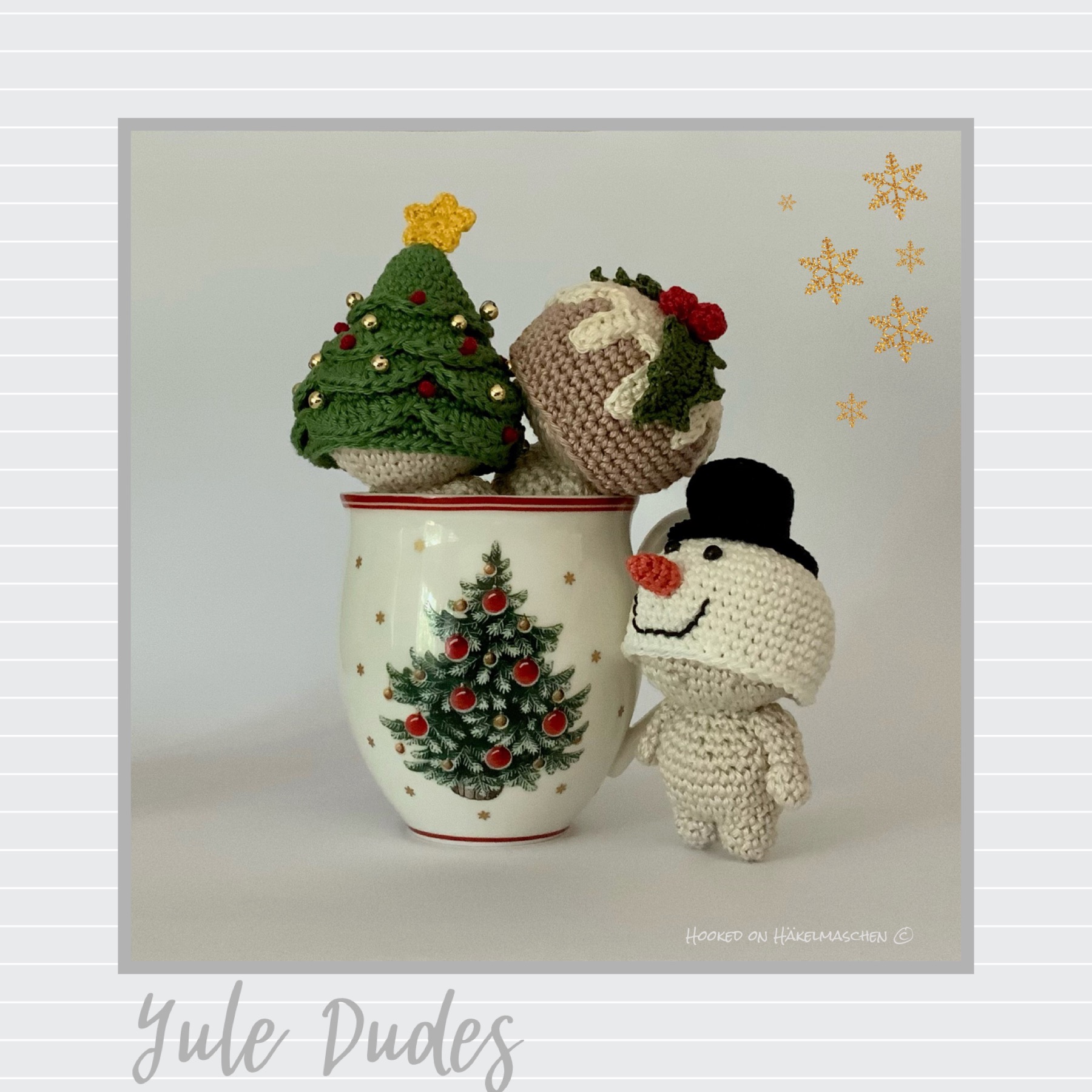
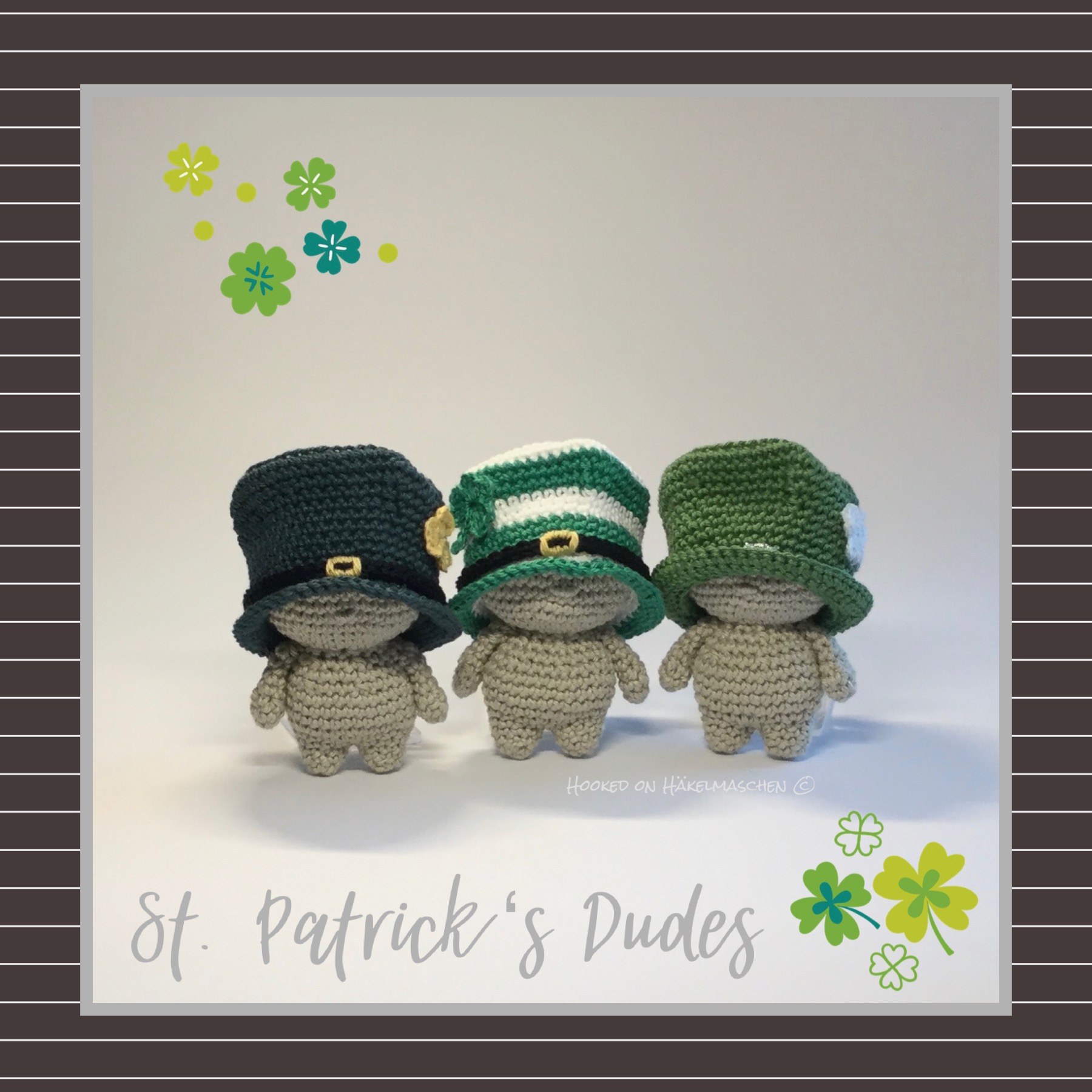
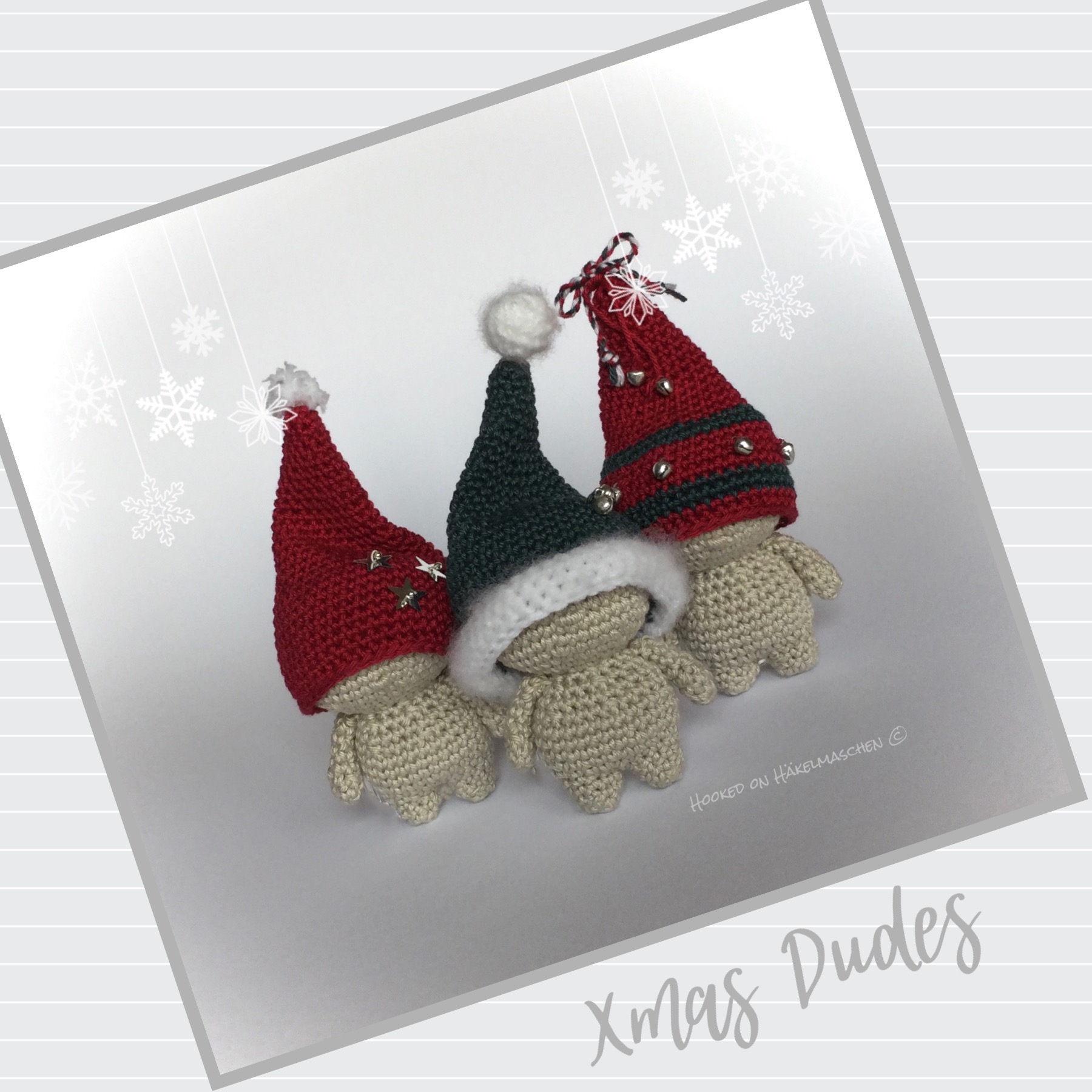
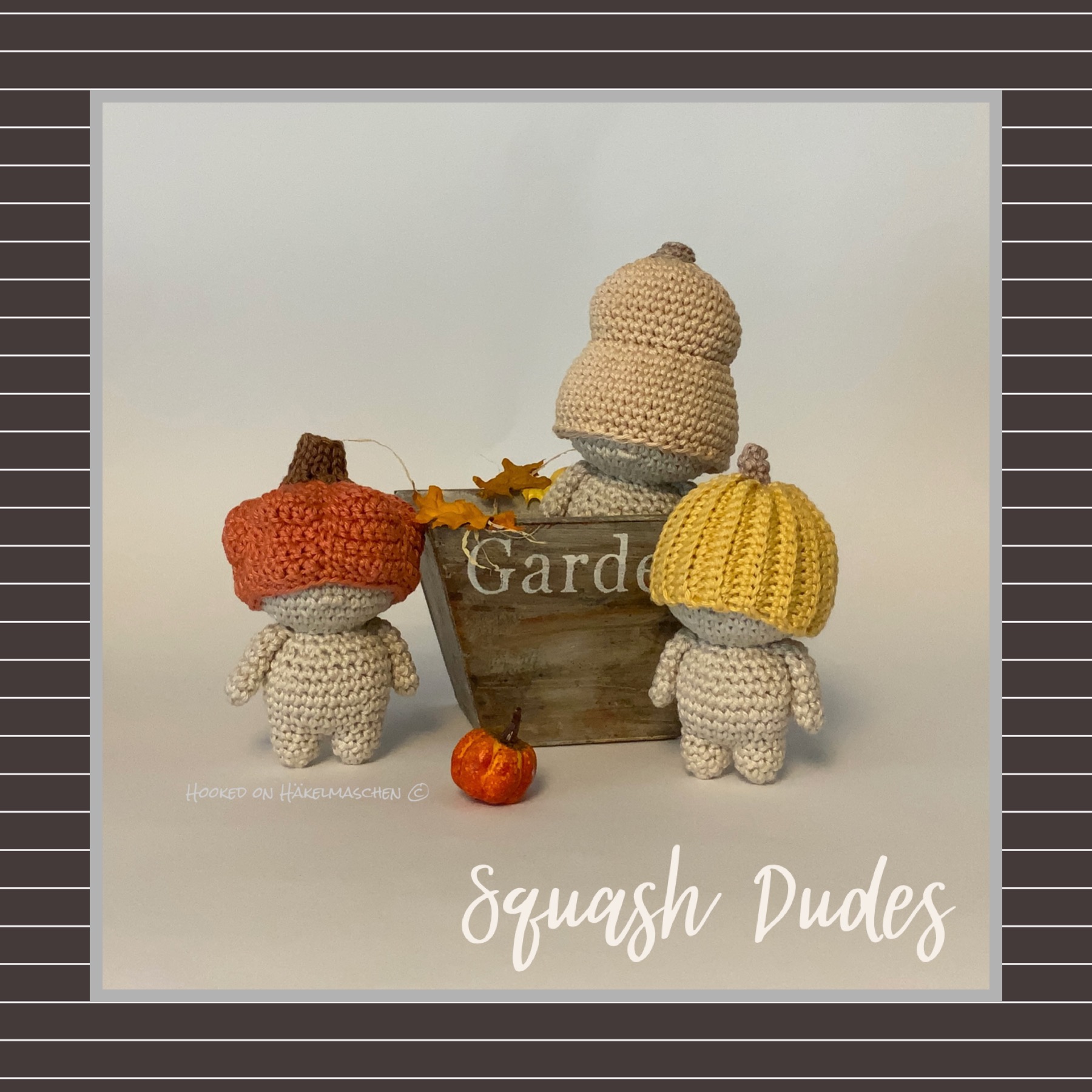
While sorting my photos I realized how many of the Dudes patterns I tested during the last years. The Dudes are very, very cute Amigurumi designed by Dana from missBerlin.

She writes about these patterns:

The little Dudes live among us, but only a child at heart can truly see them. They are bald and shy, so they cover their heads and half of their faces with whatever they find in their surroundings.
These endearing amigurumi/crochet dolls are faceless little fantasy creatures. They are educational dolls for learning and for play-therapy, as well as unique collectible decorative figurines. The Dudes’ minimalist features, inspired by the Waldorf approach, are designed to stimulate the imagination, and their pocket size is suitable for those little hands to make the perfect companions.

I think it was back in 2019 when I fell in love with her designs, discovering the Pumpkin Dudes.


Maybe you have already seen some of the designs I tested for Dana here on my blog – the Succulent Dudes, the Suga’ Dudes or the Carnival Treat Dudes.

All the others I never wrote about, because I tested them before I started this blog. It’ a shame! So I thought I could at least share some photos here.

Here my collection – so far …

Theses cuties are all made with #2, Sport weight yarn and around 10 cm tall. I mostly use a 2,5 mm hook, sometimes a 2,25. My favorite yarn for the Dudes themselves is Scheepjes Catona in the colour 505, Linen. For the caps I either use Scheepjes Catona or Schachenmayr Catania. But any other yarn works as well.

The first Dudes pattern I tested were the Woodland Dudes.

The Cap of the PineCone Dude is still one of my favorites.

But I also love the Cactus Dudes, the little Pumpkins, the Seashells (which I haven‘t made yet) and well … all the others. Each one of them was so fun to test!

Each pattern has instructions for the Dude and comes with 3 different, themed caps. Some of the caps are really easy to make, for others you will need a bit more concentration, but every step is explained very well.

In case I could inspire you: the patterns are available in Dana‘s Ravelry or Etsy shop . Or just have a look at my Ravelry projects where I have partially listed additional info.


Go with the Flow

Ana from One Skein of Love just released the pattern for her latest design: Go with the Flow – a blanket made in Overlay Mosaic technique. The pattern is available in her shops.

Picture by Ana Morais Soares / One Skein of Love

Isn’t it lovely?

Actually, I didn’t want to test this pattern.
After the death of my parents-in-law we are still sorting out and dissolving their household. They didn’t live nearby and it’s a longer drive every time – so I don’t have much time at the moment … But I couldn‘t resist …

The pattern has a small repeat and so I was able to make something I wanted to do for a long time: a cover for my iPad.


I used Stylecraft Special DK with my 4,0 mm Clover Amour hook. The colours are Graphite (1063) and Pale Rose (1080). Ok, perhaps a cotton yarn would have been better for this purpose. But I didn’t have any matching yarn on hand and I also think that the colour combination suits the pattern very well.

I used Graphite as colour C1 and Pale Rose as C2. To avoid the yarn tails on both sides I just worked the body of the cover in the round.

For me, 72 stitches made a perfect size in width. Especially as I wanted the cover to be a bit bigger so that my pencil would also fit in.

Unfortunately I have no ‘work in progress’-pictures, but here a short summary of what I did.

Body and flap of the cover

  • Width of the cover
    • 72 stitches, worked in the round = 9 repeats (no border stitches, no extra stitches)
  • Height of the cover
    • rows 1 – 22 / 1 time
    • rows 23 – 30 / 3 times
    • 46 rows in total
  • Flap
    • in continuation of the pattern but only worked over 17 stitches (1 repeat, plus extra stitches, plus border stitches) and worked in rows
    • rows 199 – 219 of the pattern / 1 time

Border

To attach a small border I prepared the edges of the flap in the same way as it is done for the blanket. My slip stitches (only around the edges of the flap) are made in Pale Rose. For back and front layer I used Graphite.

  • Back layer
    • The back layer was only worked on the sides and the top of the flap. Therefore it was worked in rows with turning the work in between.
      row 1: double crochet worked in the back of the slip stitches, (2 dc, ch 2, 2 dc) in each of the 2 corner spaces
      row 2: single crochet in both loops, (1 sc, ch 2, 1 sc) in the corner spaces
  • Front layer
    • The front layer was worked in rounds over the flap and the upper edge of of the cover. To get a rounded transition from the flap to the upper edge of the body, I skipped the first / last stitch of the upper edge (directly after / before the stitches of the flap) in each round.
      round 1: single crochet, over the flap worked in back loops of the slip stitches, in the corner spaces (1 sc, ch2, 1 sc) like explained for the border of the blanket. Over the body worked in back loops of the stitches of the last round.
      rounds 2 and 3: single crochet worked in back loops, (1 sc, ch2, 1 sc) in the corner spaces of the flap.
  • Joining
    • Back and front layer of the flap are joined with a row of slip stitches in Pale Rose. To get a consistent look I continued the slip stitches over the body. A small loop on the upper edge of the flap, made with some chains, serves as buttonhole.

Finishing

I closed the bottom of the cover with some whipstitches and a sewed on a button.

If you want to make one for your own

To get the measurements for a cover that fits your Tablet I would suggest that you make a little swatch first. For this, two or three pattern repeats should be enough. Then you can work out how many repeats you will need in width and also estimate how many rows / repeats you will need in height.
Or – and that was my way :) – you just cast on some chains and put them around your tablet. (I suppose this method will even work better with foundation single crochet but FSC still is not MY thing.) Just keep in mind that your total number of stitches has to be a multiple of the stitches of a pattern repeat.
After you have crocheted a couple of rows, put your tablet next to it and check now and then if you have already reached the required height. It doesn‘t sound very professional but it worked perfectly for me!

Two more points are important:

When starting the flap double check that the pattern is continued as it would be in a blanket. And, before closing the bottom of the body make sure that the flap is in the middle of the backside and take care that the pattern is centered. That‘s all – have fun!


Jewel Square

Last updated 12 May 2026

Ta-Dah … – another new design by Pam!

Already in April, Pam Knighton-Haener from A Yarn of Serendipity released a new design: another beautiful Afghan square, the Jewel Square.
Fortunately I was able to help to test this pretty pattern – I am a bit late with this post though.

The Pattern

As with most of her patterns, Pam has used Aran / worsted weight yarn (#4) for this design. The finished size will be 11 or 12 inches (about 28 or 30 cm), depending on the hook size you use (4.5 or 5 mm hook).

As always, the pattern is very clearly laid out with detailed stitch explanations, helpful pictures for each round, and two different colour ways.

My Yarn and Colours

I used Hobbii Rainbow Cotton 8/4 and a 2,75 mm hook. The finished size of my square is about 20 cm / 8 inch.

As colours, I’ve chosen a soft, light grey, two different blues and a mint tone.
I bought the blue and grey tones a while ago. I planned to use them for all of Pam’s pattern tests and eventually piece the squares together into a lovely blanket – some day…. So far, it never came to it.

I still really love the shades of blue. But at the time I opted to pair them with grey as a neutral colour as the contrast with white just seemed too hard to me. Now, however, I find that this colour combination can sometimes look a bit dreary and dull, especially in photos.
So I decided to spice up the colour scheme a bit while I was working on the ‘Jewel Square’. That’s why I added the mint green.

At first, I wasn’t sure for a long time whether this was really a good idea. Perhaps it would have been better to use dark blue again instead of mint green? But now I quite like the contrast. It’s a lovely touch!

My Colourplacement

I followed Pam’s colour way 1 using the following colours

Colour A 25, Pastelmint
Colour B – 29, Jeans Blue
Colour C – 97, Mist
Colour D – 28, Light Jeans Blue

All from Hobbii, Rainbow Cotton 8/4 (Fingering weight – 170 m / 50 g)

The only change I made: I swapped the colour D for A in round 11.

In case I’ve made you curious: the pattern is available in Pam’s Ravelry store and all her other places.

Pattern Link

Jewel Square on Ravelry

Dancing Diamonds

Dancing Diamonds crochet blanket: discover my four-colour version, yarn details, colour placement and the story behind this special blanket.

Last updated: 22 July 2026

I originally published this post at the end of April 2023, shortly before the Dancing Diamonds CAL started.
I shared some initial information about the CAL, the colours I had chosen and an early look at my blanket. All other information, such as the yarn amounts I needed, details about my colour placement and photos of my finished blanket were spread over three other posts.

Now that the CAL is long over, I’ve refreshed this post to give it a new structure and to summarise all the information that is still relevant today.

The Dancing Diamonds CAL

Photo by Ana Morais Soares / One Skein of Love

The Dancing Diamonds CAL, which took place in May / June 2023, was designed by Ana Morais Soares from One Skein of Love.  The overlay mosaic blanket features seven different patterns that can be combined in various ways.

Ana used Durable Cosy Fine, a blend of cotton and polyacrylic, for her blanket. It is a #4 (Aran/worsted weight yarn) with 105 m per 50 g. The finished size of her blanket is approximately 100 cm x 130 cm.
The pattern is written in English (US terms) but there are also translations into Spanish, Dutch, French and German available.

Back in 2023 I was a member of Ana’s testing team. In addition to testing this pattern, I also handled the German translation.

To me Dancing Diamonds will always be the “blanket of my heart”.

Shortly before the Dancing Diamond test started we lost my mother-in-law. And, after a long life together — they had been married for over 70 years — my father-in-law followed her only 4 weeks later.

I still miss them sorely!

But it also makes this blanket very special to me — I will always associate it with memories of them.

Dancing Diamonds, overlay mosaic crochet blanket, finished blanket displayed on a bench

My colour story

Looking back, I think this is why my colour choice for Dancing Diamonds came straight from my heart. I still remember that day quite well:

Actually, I’d imagined completely different colours for this blanket. I wanted to make something really colourful – just to cheer myself up a bit!

So I spread out a mountain of yarn on the dining table: Spice, Saffron, Tomato, Clementine – Vintage Pink, Apricot, Powder Pink, Pale Rose – Plum, Grape, Raspberry, Burgundy, Violet and some neutrals like Cream, Mocha, Buttermilk, Silver and Grey.

When I started combining the colours, hubby looked over my shoulder and started rearranging everything…
Usually, putting our heads together leads to good results, but this time it came to nothing! He didn’t agree with my ideas, and I didn’t agree with his.

Just as I was tidying up the table, saying, ‘I’ll have to sleep on it first’, my eye fell on a ball of Mushroom which I’d actually used for another project. Somehow, four colours ended up in my arms – Mushroom, Grey, Raspberry and Pale Rose.

Dancing Diamonds, yarn samples Stylecraft Special DK in the colours Grey, Mushroom, Raspberry and Pale Rose

I was not sure if it would work, but I started crocheting with these colours the same evening.

I never thought of combining Grey and Mushroom before, but I absolutely love the result!

Dancing Diamonds overlay mosaic crochet blanket, work-in-progress first rows, displayed on a table

My colour placement

In the Dancing Diamond pattern, six colours are originally used. As I only used four colours, I couldn’t just replace one colour with another colour, but had to reconsider pattern by pattern. However, I have not made any changes to the basic colour placement or the arangement of the patterns. Only for the border I deviated a little from Ana’s pattern. Since I used less colours overall I thought it would look better with just one stripe of Raspberry than two.

Dancing Diamonds, preview Colour Placement Guide

If you would like to recreate my blanket, you will find my colour placement guide at the end of the post.  There, I’ve set out for each pattern how I’ve substituted the colours.

My finished blanket

I finished my blanket in May 2023. Worked with Stylecraft Special DK and a 4 mm hook it measures about 90 x 120 cm.

Yarn amounts

Dancing Diamonds, table yarn amounts used

I am still happy with how my blanket turned out and I still love the calm and gentle-looking combination of Grey and Mushroom!

Even now, this blanket always brings back warm memories. Despite all the sadness of that time, it also reminds me how comforting crochet can be. Crocheting really does soothe the soul.

Get the Colour Placement Guide

Get the pattern

Dancing Diamonds pattern on Ravelry

Efflorescent Square

Last updated 12 May 2026

Another test for Pam

Pam Knighton-Haener from A Yarn of Serendipity just released one of her new designs: Efflorescent Square. I am happy that I was able to test it!

Efflorescence demonstrates the growth and beauty of nature’s flower bloom and the personal growth and splendor of human love.

Pam

My test piece is made with Drops Safran. It is a sport weight cotton yarn (#2) with a yardage of 160 m per 50 g.

It was the first time I’ve used this yarn and I am very happy with this choice. It is a soft yarn and nice to work with. I definitely will get some more colours. It also will be a good match with my Hobbii Rainbow Cotton 8/4!
As recommended on the yarn label I used a 3 mm hook. But it should also work with my 2,75 mm hook that I usually use with Hobbii Rainbow Cotton 8/4.

I didn’t follow one of Pam’s colour ways this time, but created my own. Therefor I have listed the colours for each round below.

Here are the details of my version:

Pattern

Efflorescent Square
Available on Ravelry (link below)

Designer

Pam Knighton-Haener from A Yarn of Serendipity

Technique

Traditional crochet

Yarn and Hook

Drops Safran
Clover Soft Touch, 3 mm

Colours

A – 28, Orange
B – 10, Vanilla Cream
C – 23, Dark Taupe
D – 18, Off White
E – 11, Sunshine
F – 65, Pistachio

Colours per round

Round 1 – A, Orange
Round 2 – B, Vanilla Cream
Round 3 – C, Dark Taupe
Round 4 – D, Off White
Round 5 – E, Sunshine
Round 6 – A, Orange
Round 7 – F, Pistachio
Round 8 – B, Vanilla Cream
Round 9 – D, Off White
Round 10 – D, Off White
Round 11 – A, Orange
Round 12 – D, Off White
Round 13 – D, Off White
Round 14 – D, Off White
Round 15 – A, Orange

Finished Size

about 21,5 cm / 8,5 inch

Pattern Link

Efflorescent Square on Ravelry

Radiance

Radiance is the newest pattern from Ana from One Skein of Love. She released it last week and I was just able to finish my test version and take some pictures.

The original pattern is for a blanket made in Overlay Mosaic technique. Ana’s blanket is about 100 cm x 134 cm. With a repeat of only 24 stitches the size of the blanket is easy to adjust. As usual her pattern has written instructions in US terms, a chart and a lot of row by row pictures.
Ana used one solid colour and a colour changing yarn. You can have a look at her design in her Ravelry store, and of course you can get the pattern there too.

I turned my test version in a cushion cover.

It is worked over 3 pattern repeats in width and 4 repeats in height.

For the border I first added a row of slip stitches on the long sides of the panel. Then folded it in the half (so that there are 2 repeats from the height in front and two in back) and sewed the sides together.

I added a border on both sides, hiding all yarn ends and the my sewing. The border is made of 6 rounds single crochet in back loop.The opening at the bottom is – em, will be – closed with a zipper.

I used some left overs from my Midnight Snowflakes blanket – Scheepjes Color Crafter in the colour Rotterdam and Stylecraft Special DK in Duck Egg.

It‘s a perfect match.

Wooly Friends

One of my crochet tests from 2022 I haven’t shown you yet: Wooly Friends.

I tested this lovely pattern already in April last year. Actually it is a pattern for a baby blanket. It was featured (with UK terms) in issue 125 of Simply Crochet Magazine. Ana now published the pattern herself and it is available in US and UK terms in her Ravelry store.

Through testing, I have meanwhile collected a lot of blankets – although I have already given many away. That’s why I often think about what else to make out of a pattern. With this one I had immediately a bag in mind for all my different projects – but with only a vague idea of how to do it. In the end it took almost 3 months (including holidays and other tests) to get it done, but I am more than happy with the result!

How my bag came to life

Yarn and colours used

Stylecraft Special DK (100g = 295 m) in the following colours


1820 Duck Egg
1067 Grape
1099 Grey
1203 Silver
1061 Plum
1218 Parchment

and a 4 mm hook

I started the bag with two identical panels, worked over 4 repeats.

Pattern Sequence for the panels

  • Foundation Row
  • Pattern 1
  • Pattern 2
  • Pattern 1
  • Pattern 3
  • Pattern 1
  • Final row of the pattern
  • plus 4 additional rows, just single crochet worked in back loop

Colour placement

  • Foundation Row
    • C1 – Grey
  • Pattern 1
    • C2 – Duck Egg
    • C3 – Plum
    • C4 – Silver
  • Pattern 2
    • C1 – Grape
    • C2 – Parchment
    • C5 – Grey
    • C6 – Duck Egg
  • Pattern 3
    • C1 – Grey
    • C2 – Parchment
    • C5 – Grape
  • Final Row (pattern)
    • C1 – Grey
  • Additional Rows
    • Plum
    • Grey
    • Duck Egg
    • Grey

My panels were about 40 cm in width and 42 cm in height.

At this point I first thought about joining the two panels (with all the tails inside) and lining the bag. But then I decided to give it a little more storage space for yarn. So I made an additional smaller panel that now serves as bottom and sides of the bag.

I worked this additional panel over 235 stitches in single crochet. Like in mosaic technique: each row starting and ending with a border stitch, all the other stitches worked in back loop only, cutting the yarn after each row.
The tails on both sides are hidden in a small double border: front and back layer made with 3 rows of back loop single crochet.
The final bottom/side panel is a little (4 stitches in total) shorter than than the main panels.

Colour sequence for the additional panel

  • Grey (Foundation)
  • Grey
  • Plum
  • Duck Egg
  • Grey
  • Grape
  • Duck Egg
  • Plum
  • Parchment
  • Grey
  • Grey


Joining

I finally joined the panels with the slip stitches for the double border, just working through both layers- bottom/side panel and main panel – at once.
I have to confess: this was not my favorite part as it took a lot of patience and a lot of time to catch the correct stitches at the same time!

On the upper edge I skipped the middle 39 stitches with a chain to make the handles.

Double Borders

Front and back layers of the borders were made with 3 rows of back loop single crochet, three single crochets worked in one stitch for the corners (note: it‘s always good to use a stitch marker to mark the middle stitch).
At the upper edges the double border was just continued over the chains to form the handles.
All slip stitches and borders were made in Plum.

As I said, I am more than happy with the bag. After it was finally finished, I immediately started using it. Since then it has not been empty for a single day!

Oh Xmas Tree

Post revised in December 2025

Have you already seen the new pattern by Ana Morais Soares from One Skein of Love?

Oh Xmas Tree is a lovely overlay Mosaic pattern designed as cushion cover. The pattern is available in Ana’s Ravelry shop.

The panel fits beautifully with the Wintry Forest pattern.

Using DK yarn it will be about 40 x 40 cm (16 in). You can either sew it onto a cushion cover, like Ana did, make a wall hanging out of it, a placemat or whatever else comes to your mind.
It works up quickly and is great to use up some leftover yarns.

I made my test version with Cabaret from Stylecraft yarns combined with Stylecraft Special DK in Cream.
Cabaret was one from my extensive single-ball-of-yarn-collection. I ordered it years ago to check quality and colour but never found a project to use it. I am afraid it’s discontinued meanwhile. The colour was Forest Glade – changing in different green shades with a silver metal thread running with it. Unfortunately, you can’t really see the glitter in the photos.

I’m not sure yet what I’m going to do with my panel. I was thinking of sewing it onto a fabric bag. Let’s see if I can find something suitable.

The picture above shows Ana’s work – photo credit goes to her. Below you can see my test version.

Have fun!

Wintry Forest – Final details on my wall hangings

Today part 2 of Ana‘s Wintry Forest Cal was released. I hope you enjoy following along.

In the meantime I have summarised the details of my colour placement in a pdf document. There you will find the colours I used for the individual patterns. Besides I listed the additions I have made to create the three panels.

You can download it here.

All the general information about the yarn used and detailed yarn amounts for each colour were already listed in my previous post.

If you have any questions please feel free to leave a comment or send me an email.

Happy hooking 💕