Again a bit off opic – My Detour in Stranded Knitting

In this post I share my first experiences with stranded colourwork and the challenges of knitting with two colours. After a lot of experimenting, I found a method that works well for me and makes knitting feel relaxed again. My Christmas stocking turned into a practice piece, but two Christmas baubles and a small new project came out of it.

My Progress in Colourwork

Last month I shared my excursion into knitting – more precisely into stranded colourwork, a technique that was completely new to me. I started practising it by knitting a Christmas stocking. If you missed that post, you can find it here.

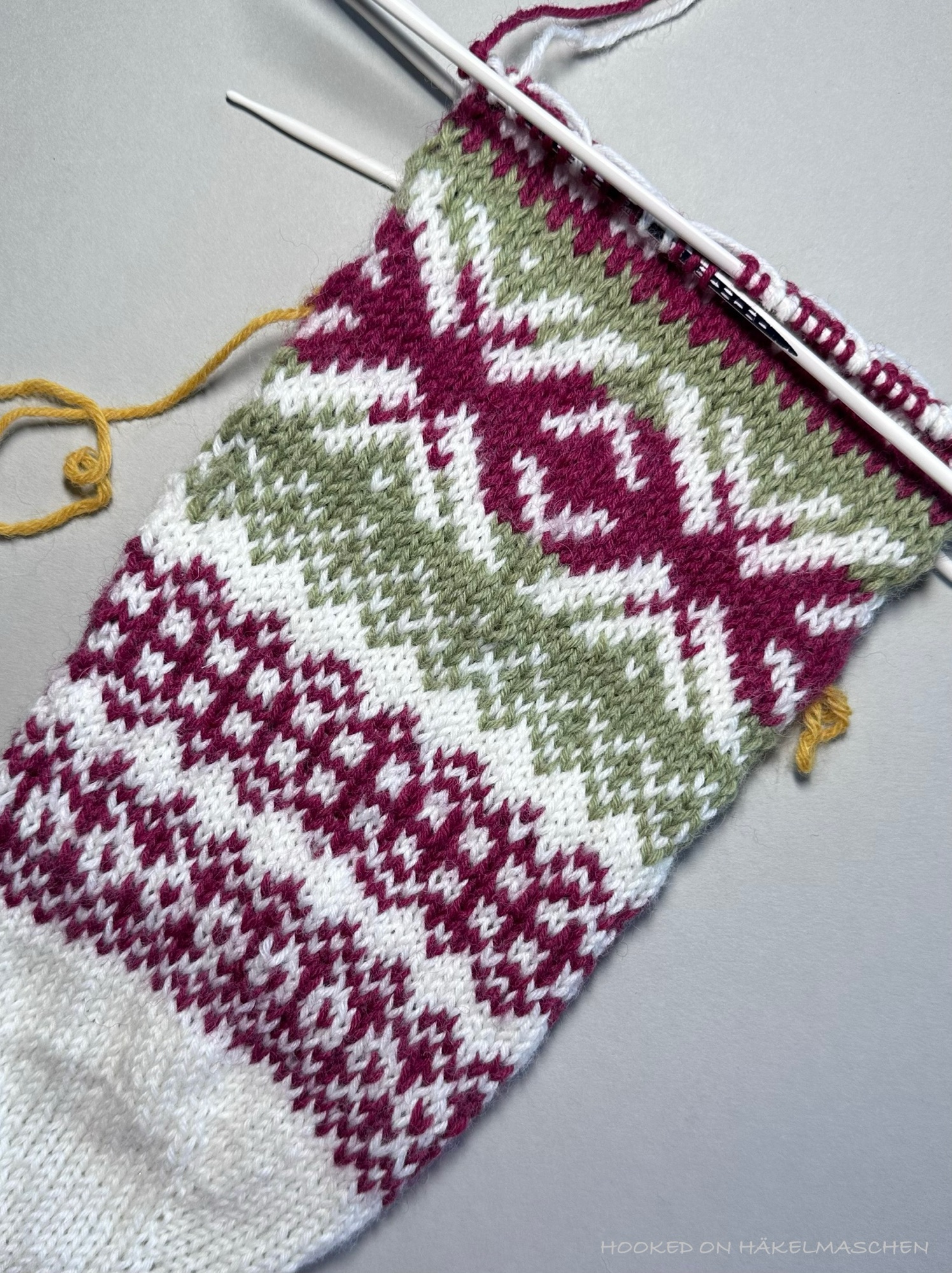
Even back then I wasn’t sure whether the stocking would be finished in time for Christmas. I’m quite proud of how much it has grown since then – and yet I’ve decided not to finish it.

That may sound frustrating, but it really isn’t. By now, I truly enjoy knitting with two (or more) colours. Getting there, however, took some effort.

Learning Colourwork the Hard Way

I learned to knit decades ago, using the continental style. That means I usually hold the yarn in my left hand, wrapped once or twice around my forefinger. When it comes to knitting with two colours, there are countless ways to manage the yarn – and even more tutorials.

I watched many of them. And I tried many of them.

None of these techniques worked for me in the long run. Either I felt like I was about to break a finger, or after just a few stitches everything got hopelessly tangled and I had to stop and rearrange the strands. I found it exhausting – and I was close to giving up.

An Aha Moment

My turning point came almost by accident. While reading about colour dominance (a topic you inevitably encounter when dealing with colourwork), I watched a video by Arne & Carlos about tension. In that video I noticed how Arne knits with two colours.

I tried his way – and so far, it works surprisingly well for me.

I now knit with just one strand at a time, as I’m used to, and pick up or drop the second colour only when needed, usually with my right hand. It doesn’t feel slower at all. My tension isn’t perfect yet, but it’s much more even, my fingers no longer get tangled, and knitting feels relaxing again.

When Practice Shows

Of course, all that experimenting turned my Christmas stocking into a real practice piece – and unfortunately, it shows.

If you look closely, you can clearly see the improvement over time: the stitches in the later sections, starting after the first green part, are much more even than at the beginning.

That alone wouldn’t have bothered me too much. But I also discovered a few mistakes in the early part of the pattern. That was the deciding factor.

The stocking is a thing of the past.

From Stocking to Christmas Baubles

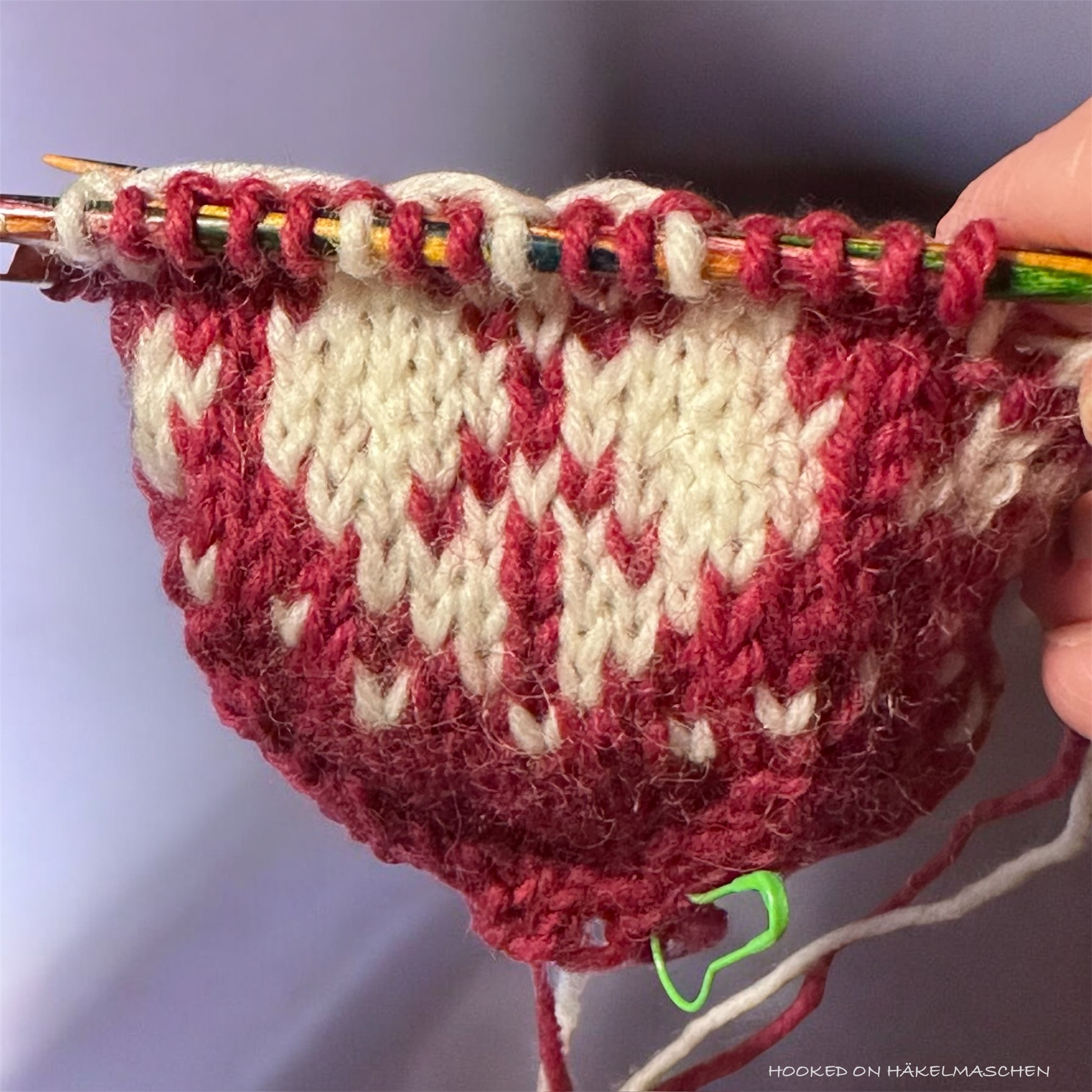
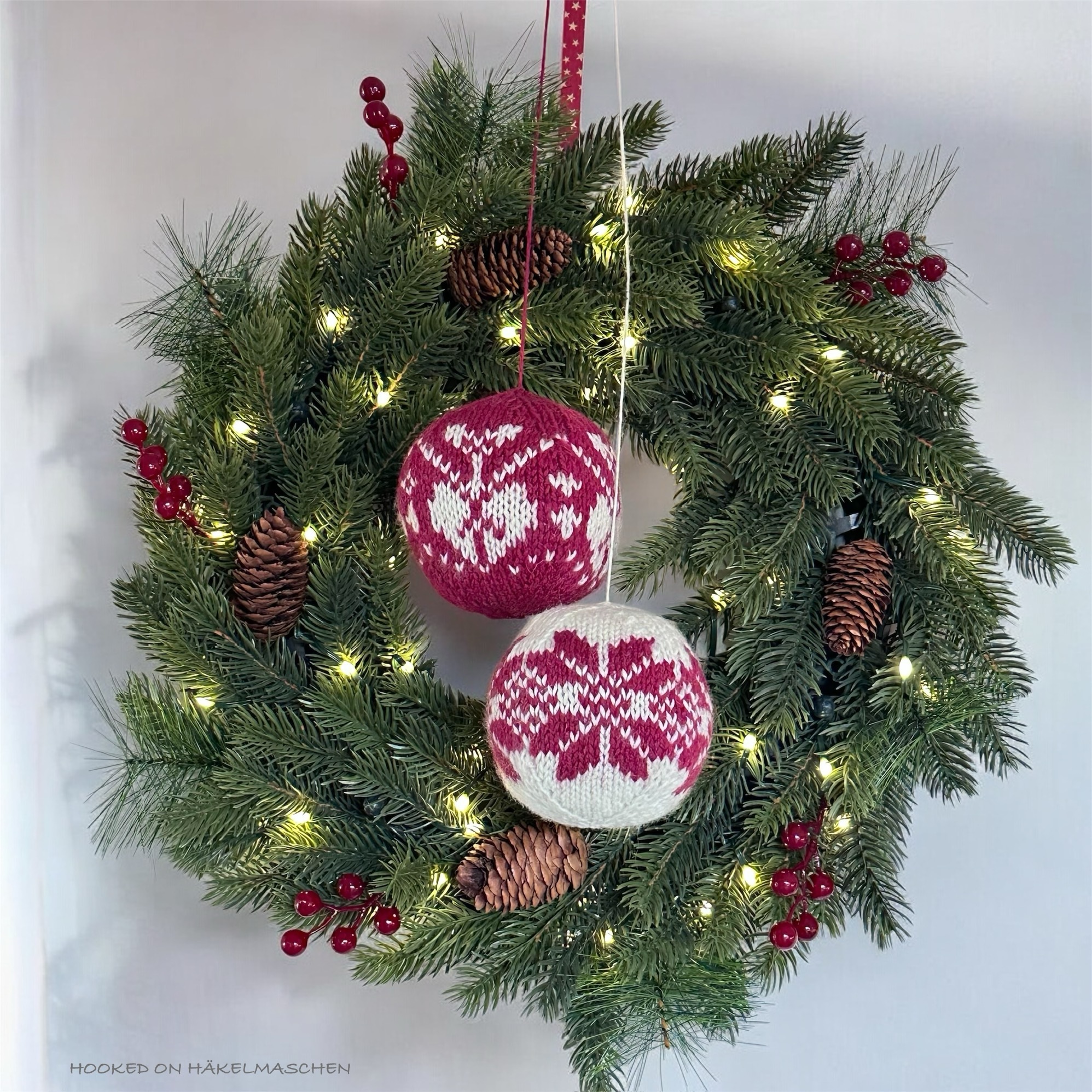
Instead, I knitted two Christmas baubles – and I love the result.

Like the stocking, the bauble pattern is by Arne & Carlos. It’s their 2021 design and includes a basic pattern for a Christmas bauble plus 24 different motifs. So far I’ve made two of them: motif #19 on the left and #24 on the right

A Small, Last-Minute Project

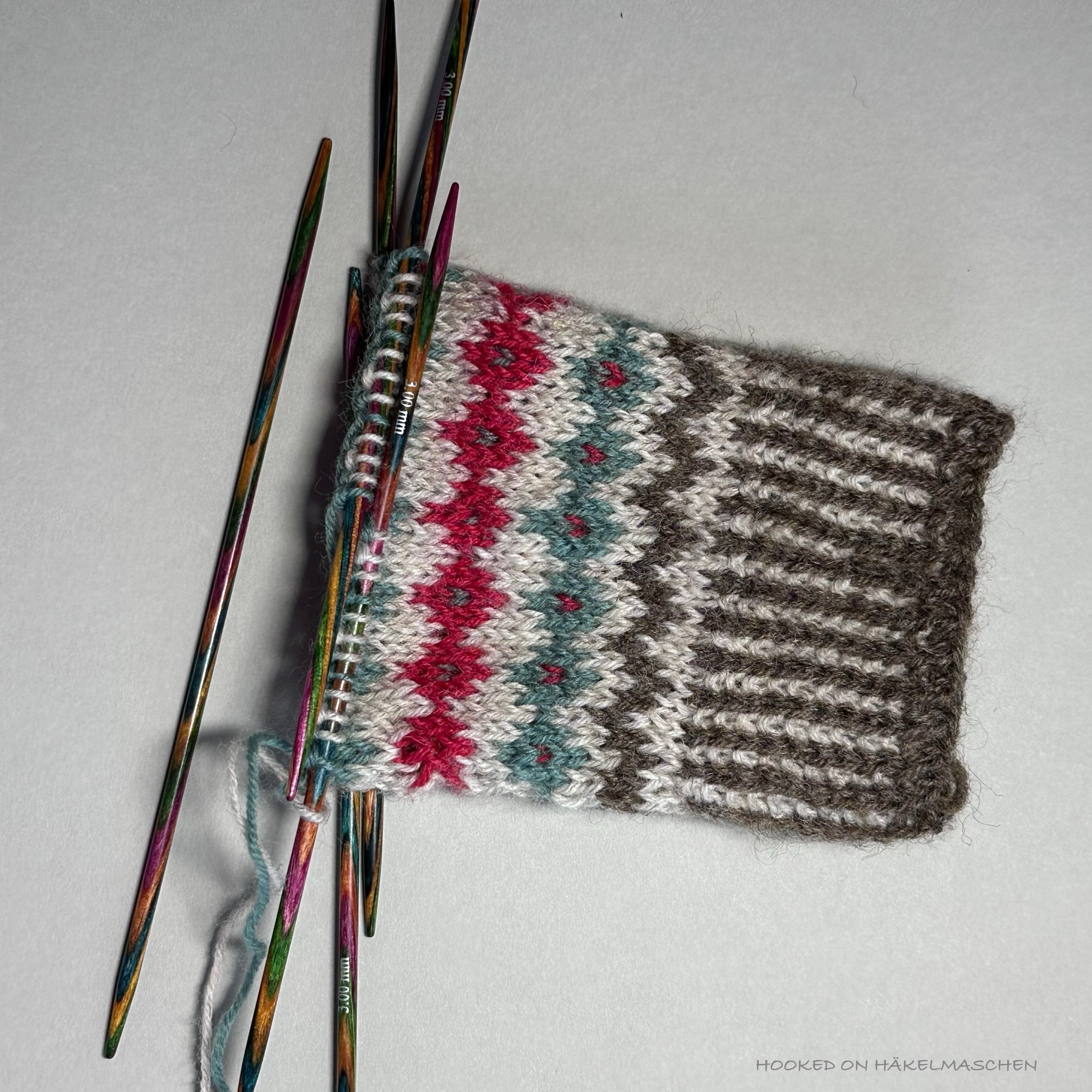
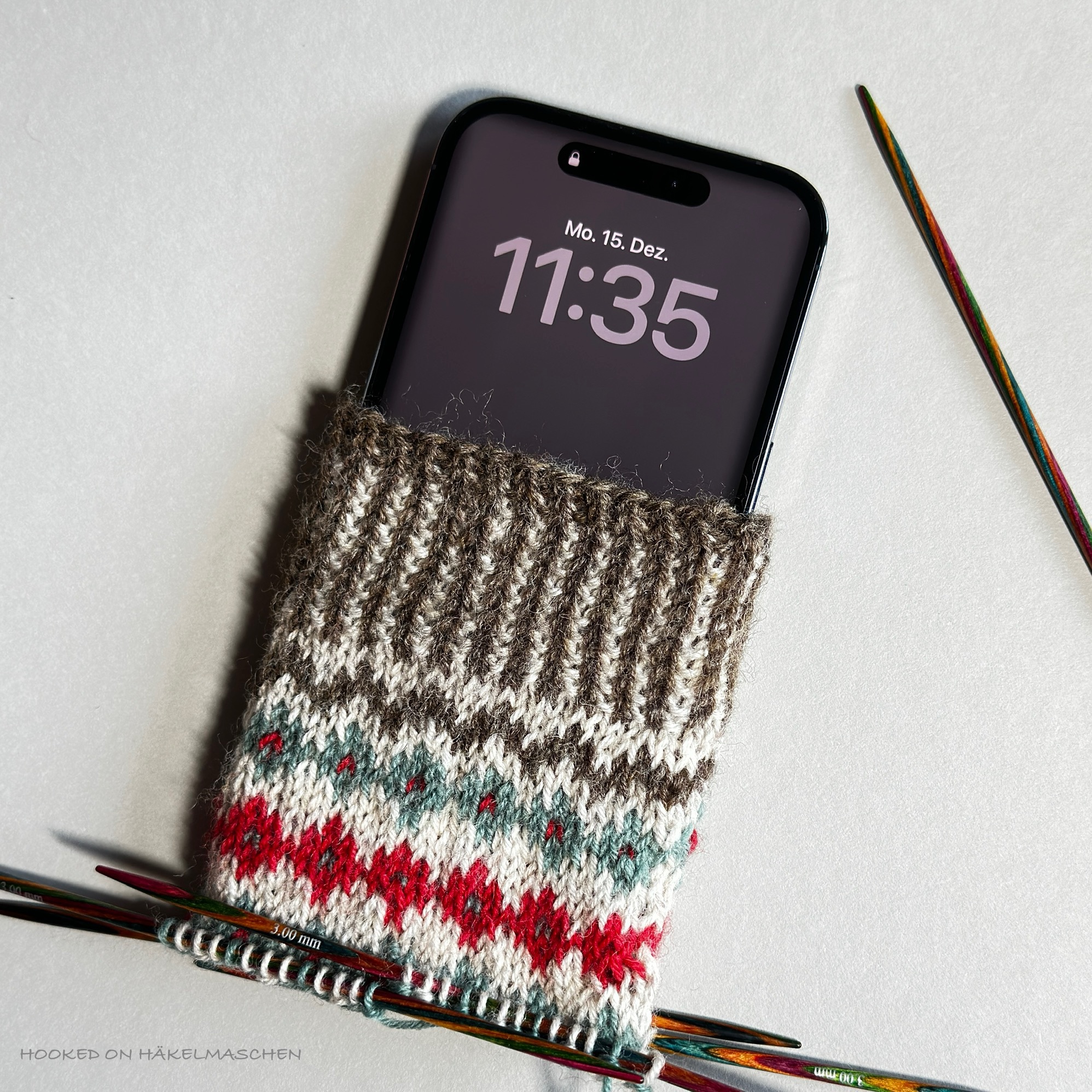
Besides that, I’ve just started a small project that might become a last-minute Christmas gift: a phone cozy.

The pattern comes from the book

SOXX Look by Stine & Stitch (Kerstin Balke),

a German pattern book featuring stranded colourwork designs for beanies, loops, socks and more. Unfortunately I’m not sure whether it’s available in English or outside Germany.

The phone cozy pattern has a short repeat, which makes it easy to adjust the width. It also includes instructions on which section to repeat if you need more length. With a bit of simple maths, it can even be adapted to make a tablet cover.

I‘m about half way done… Lovely, isn‘t it?

In case I got you inspired, here some links to

Patterns, Books & Videos That Inspired Me

Have a lovely time 💕

A bit off topic – my little excursion into knitting

A gentle dive into my renewed love for knitting — from experimenting with gradient squares to tackling my first Christmas stocking and discovering the joy of learning new techniques along the way.

It’s already mid-November – just a few weeks left until Christmas.

Honestly, I have no idea where this year has gone.

Much of my year was influenced by health issues with my eye. They often forced me to pause and to slow down.

Over the months, I collected several different diagnoses, and I’m now recovering from a stay in the hospital and eye surgery. Further treatment will accompany me for another three months, and a small hole in my retina will likely remain.

Still, I’m hopeful that by spring, with new glasses, I’ll be able to see reasonably well again.

As difficult as all of this sounds, it also allowed me to discover and learn completely new things.

I have developed a new fondness for audiobooks – very calming companions! And I learned that knitting is far less demanding on my eyes than crocheting. So I picked up my needles again and began searching for a suitable project.

Squares – this time knitted not crocheted

Some time ago, I ordered a beautiful gradient yarn from Wool Warehouse in the UK: Yarnsmiths Lagoon. I had originally planned to crochet a blanket made of differently sized squares, but I had never quite settled on a pattern that would do the colours justice. Now I wondered whether knitting might bring out the gradient even better.

I used to knit a lot – mostly socks and fine doilies, in a kind of lace knitting known as Kunststricken here in Germany. Back then, I mostly followed patterns, without thinking too much about the basic techniques. Only now did I realise how little I actually knew about increasing, decreasing, or constructing simple shapes like squares.

So I researched and experimented a bit … I finally decided on a relatively simple variant: diagonally knitted in garter stitch. I think this best shows the gradient of the yarn. Besides, knitting garter stitch is very relaxing for me.

Aren‘t these colours beautiful?

Along the way, my search for different techniques and tutorials took me in another direction: colourwork, especially stranded knitting. I’ve always wanted to try it, but I never have…

My first Christmas Stocking

I discovered – or better re-discovered – Arne & Carlos, two Norwegian textile designers. Their work is full of charm and tradition. Every year, they have new Christmas-themed designs: a Christmas stocking and 24 Julekuler (baubles).

Right now they’re hosting a mystery knit-along (KAL) for their 2025 stocking. If you enjoy knitting, the KAL is free – and it‘s still time to join. Just have a look at their site.

I did not join the KAL so far, but I treated myself to the pattern for their 2024 Christmas KAL, Jingle Bells Stocking. A lovely design!

Now I just hope my stocking will be finished in time for Christmas – there is much to learn! And my progress is very slow!

A Christmas Stocking is just a single sock ?

No! It‘s a completely new challenge!

The stocking is worked from toe to cuff, something I’ve never done before. I tried Judy’s Magic Cast On and the Turkish Cast On; after a bit of practice, both worked beautifully. But knitting the first rounds with only 16 stitches proved fiddly, so I ended up using a long cast-on and will close it later.

Next will be the heel, which is a so-called afterthought heel that is knitted in afterwards — another ‚first‘ for me.

In the meantime, I’m still experimenting with how to hold the yarns. I usually knit continental style, holding one strand of yarn in my left hand. Two strands, however, feel quite strange. Trying to keep both colours in position and not mix up the threads affects my tension. It becomes too loose.


A view inside


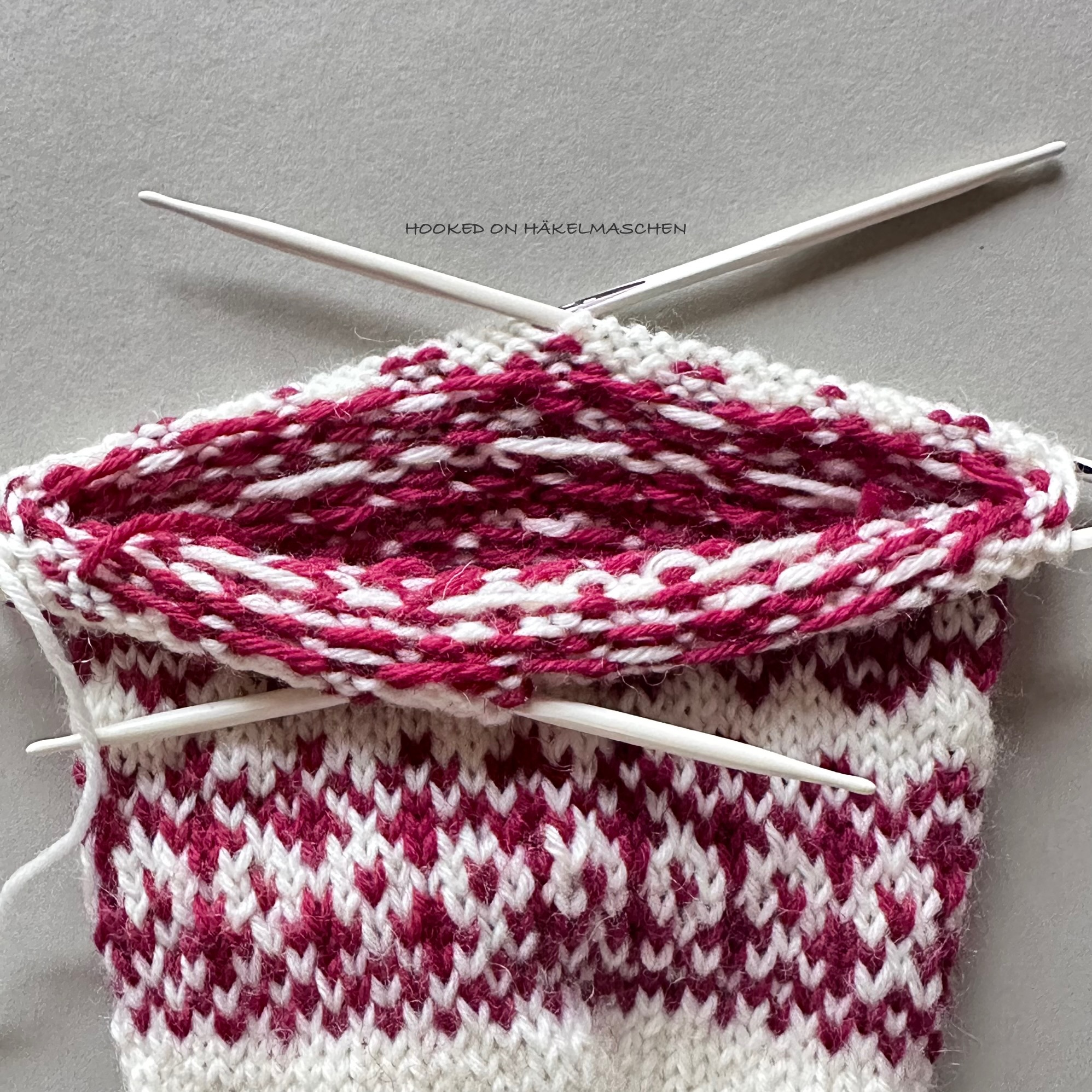
If, like me, you have never done colourwork knitting before, here you can see the little strands, called floats, that emerge when the unused yarn is carried. They need to be held at the correct tension – not too loose and not too tight.


So I tried a mixture of continental and English style: holding the main colour in my left hand and ‚throwing’ the contrasting colour with my right. Not my style either – my tension becomes too tight.

Well, it’s probably only a matter of practice.

Still, I’m quite pleased with the result so far. For a first attempt, it doesn’t look that bad at all.

So I’ll keep knitting a little each day — without pressure, just for the fun of it. Sometimes that’s exactly what a creative hobby should be!